In March 2021, I sat on national television and said we were at the precipice of a quantum shift. AI was removing task-based roles. The organisations that would survive were the ones with leaders who had already learned to deliver results in chaos and constraint.
Five years later, the numbers arrived. All at once.
I wrote the full analysis for Startup Daily. Here are two of the key arguments.
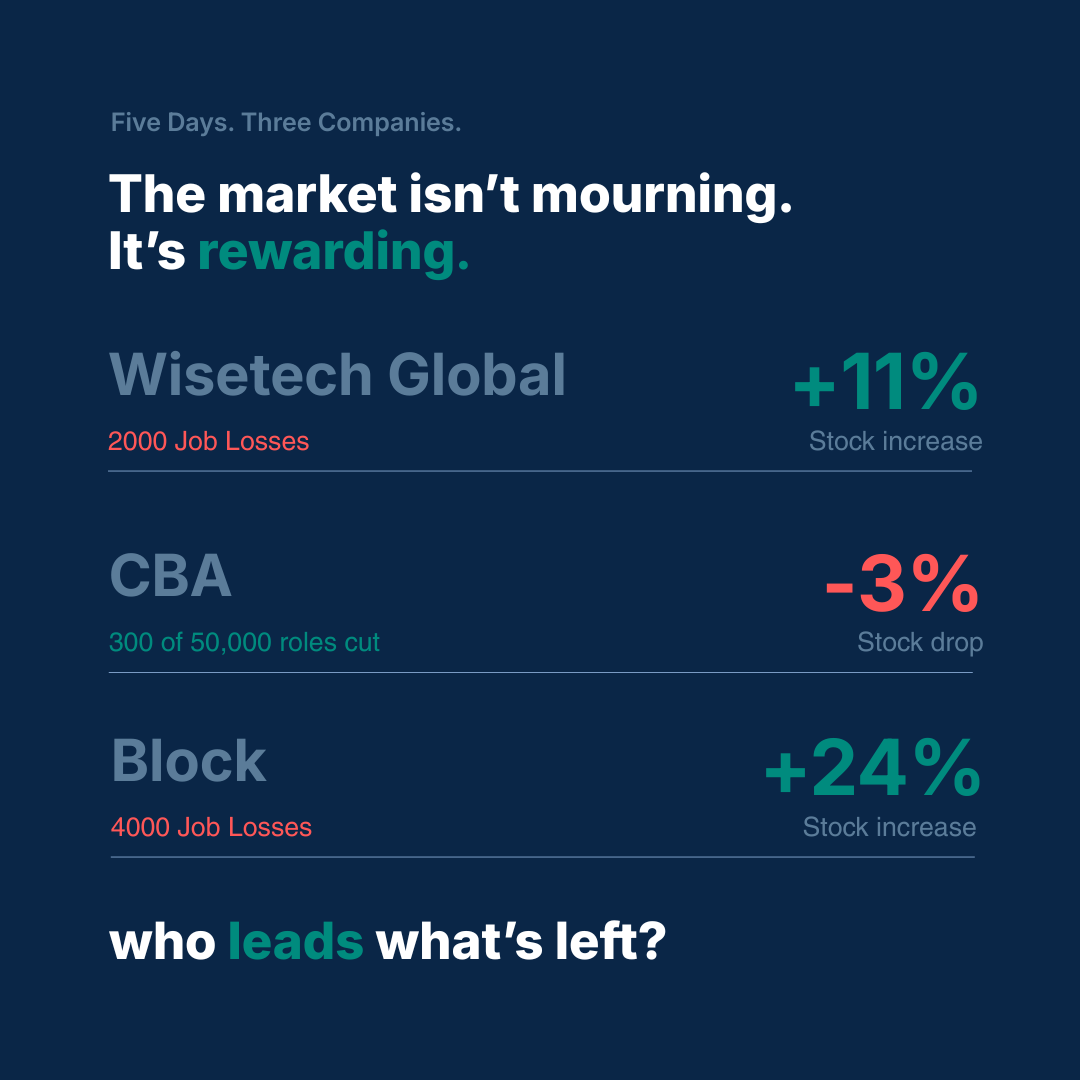
Block cut more than 4,000 roles last week. Stock up 24%. WiseTech Global cut 2,000 roles the same week. Stock up 11%. Commonwealth Bank eliminated 300 technology positions. Investors barely flinched.
The pattern is clear. When a company cuts staff because it is in financial distress, the market punishes it. When it cuts because AI enables the same or better output with fewer people, the market rewards it.
Block was not in distress. Its gross profit grew 24% in the quarter it announced the layoffs. WiseTech reported a first-half profit 6% ahead of consensus on the same day it announced the cuts.
These are not companies retreating. They are companies restructuring around AI as infrastructure, not as a feature.
The restructuring decision is easy. A board can make that call in an afternoon. The hard question is what comes next.
When you take headcount from a thousand to five hundred, when you collapse three functions into one, when you rebuild around AI as infrastructure, the people who remain need to operate at a level most of them have never been asked to reach. They need to make decisions that committees used to make. Lead teams at a pace that large organisations were never designed to move at.
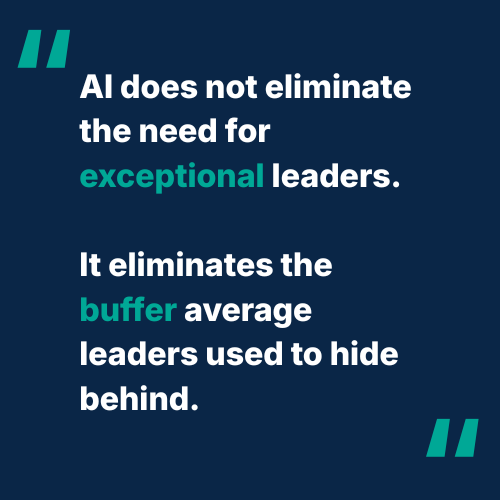
AI does not eliminate the need for exceptional leaders. It eliminates the buffer that average leaders used to hide behind.
The executives who can lead a restructured, AI-native organisation already exist. They were forged by a decade of startup conditions: no budget, no playbook, constant change, relentless pressure.
I wrote about this operator profile back in 2022 for Startup Daily, when I predicted the talent market would shift from a supply crisis to a capability crisis. The talent shortage was never really about headcount. It was about finding people who had built under constraint and could do it again at scale.
That profile, someone who runs lean by instinct, context-switches across product and operations, makes irreversible decisions with incomplete information, is now exactly what every restructuring organisation needs.
The organisations that thrive in the next decade will not be the ones with the most sophisticated AI stack. Those tools are a commodity. Every competitor has access to the same models, the same infrastructure.
The differentiator is the human who knows how to use it. Who has already built in the conditions that AI restructuring creates. Who does not need a playbook because they wrote the last one themselves.
Finding that person requires a network built inside the ecosystem where they were produced. Not a LinkedIn search filtered by job title.
Read the full piece on Startup Daily →
Hiring the leader who takes your organisation through this shift? Talk to us about your search.
Last week, 4,000 people at Block were told they no longer had a job. The stock rose 24%. WiseTech Global cut 2,000 roles - nearly a third of its global workforce - as part of a two-year AI restructuring plan. Commonwealth Bank eliminated 300 technology positions the same day. Three AI restructuring announcements. Five days. Three share prices up across the board.
That is today's headline. But the story begins a decade ago, and it starts with a bet I made in 2016 - not on a product or a market, but on a type of person. The founders I was working with in fintech were operating in conditions the rest of the corporate world had not experienced yet. I believed those conditions were coming for everyone. Last week, they arrived.
The market is not mourning these cuts. It is rewarding them. That is the fact worth sitting with, and it is the one that most of the coverage has moved past too quickly. In a traditional framing, a company cutting half its workforce is in crisis. Investors flee. The narrative is failure. That is not what happened.

What happened is that investors looked at Block's AI restructuring and concluded the company will be more valuable with fewer, more capable people and a properly deployed AI stack than it was with a larger, more expensive, less leveraged workforce. The cuts were not a symptom of decline. They were the mechanism of transformation. Block CEO Jack Dorsey was unambiguous in his letter to shareholders: 'Intelligence tools have changed what it means to build and run a company. A significantly smaller team, using the tools we're building, can do more and do it better.' WiseTech CEO Zubin Appoo was equally direct: 'The era of manually writing code as the core act of engineering is over.'
These are not euphemisms or careful corporate language. They are executives stating on the record that their previous headcount was a legacy of how organisations used to have to operate, and that AI has made that model obsolete. The market agreed, loudly, both times. Block is not alone and it will not be the last. Every week the number of similar announcements grows, and every week somewhere in a boardroom the same conversation is happening: we need to restructure, we need to go leaner, we need AI to do what teams used to do. What almost nobody is saying in that conversation is what comes after the cuts.
I find myself thinking about 3rd March 2021, sitting in front of a camera for Ausbiz TV. The interview was about remote work. The world had just spent twelve months working from home and everyone was trying to figure out whether that was permanent or a blip. The conversation turned to productivity, to AI, to what the jobs market was actually telling us beneath the headline numbers.
I had been doing my own research at the time. Tracking job ad data in fintech, running surveys across our network, talking to founders every week about what they actually needed versus what the market was supplying. The challenge with remote work, I argued, was not technology. The technology worked fine. The challenge was leadership. Leaders were struggling to build and maintain high-performing teams they could not see, and we were starting to see dips not in task completion but in the collaborative moments that produce the ideas nobody plans for.
'We are at the precipice of a quantum shift. Not just in how we work. In the economy. In everything. AI is removing task-based roles. The roles that remain will require a different kind of person. This is happening. Just because you don't see it doesn't mean it's not.'
The interviewer moved on. The segment ended. The world kept going. That was five years ago.
When I started Tier One People in 2016, the Australian fintech ecosystem was young and full of promise that not everyone believed in. The founders I worked with were building companies the incumbents did not take seriously, competing for talent against organisations with resources they did not have, solving problems that had never been solved before in markets that were still being defined. They had no budget, no playbook, and no margin for error.
The people who joined those companies were self-selecting into a formation that a traditional career path cannot replicate. I wrote in 2022 that the expectations placed on fintech employees are closer to elite sport than to corporate banking. In elite sport, players are hired not just for their skills but for their ability to perform under intense pressure. Delivering results without process was the only option because there was no process. Decisions had to be made fast because slow ones were fatal. Running lean was not a strategy; it was the only budget available.
These executives built cultures under pressure, scaled teams mid-flight, restructured while shipping, and did all of it under the scrutiny of investors who expected quarterly proof that the thesis was working. Becoming AI-native was not a priority on a roadmap; it was the only way to compete with organisations ten times their size. That is not a job history. That is a decade of conditions that produced a very specific kind of executive - one who has already lived through what every AI restructuring organisation is now trying to build.
When you eliminate the middle layer, collapse three functions into one, and rebuild your organisation around AI as infrastructure rather than AI as a tool, the people who remain need to operate at a completely different level than the people who left. This is not a technology problem. The AI stack is available to anyone. You can buy it, build it, deploy it. The technology is not the differentiator.
The differentiator is the human sitting at the top of that stack. The executive who can run a leaner, faster, higher-stakes organisation. Who can make irreversible decisions without a committee. Who can context-switch across product, data, operations, and culture without losing momentum. The assessment framework I built in 2016 has not changed: skills plus learning ability plus performance under pressure equals outcomes. The number one predictor of a leader in the AI age is the ability to context-switch. Fintech executives have been doing this ten times a day for a decade.
The current conversation is dominated by two camps. One says AI will take everyone's jobs and the future is bleak. The other says AI is just a tool and humans will always be needed. Both are wrong in the ways that matter to the people making hiring decisions right now. AI does not eliminate the need for exceptional leaders. It eliminates the buffer that average leaders used to hide behind: the layers of process, the large teams, the slow decision cycles that kept organisations running despite mediocre leadership at the top. What remains is a direct line between the quality of the leader and the performance of the organisation. In that environment, the difference between a good hire and a great one is not marginal. It is existential.
The organisations that get the AI restructuring right will do so because they solve the talent problem correctly. They will understand that the cuts are the easy part, that a board can make that decision in an afternoon. The hard question is what comes after: who leads an organisation with no redundancy, no process layers, and a direct line between leader quality and organisational performance.
The ones that get it wrong will make the cuts and then hire the same profile they always hired. They will promote the most experienced person in the room rather than the most capable one. They will apply traditional executive search methodology to a talent profile that traditional executive search was never built to find. They will discover, six to twelve months later, that the AI restructuring did not work. Not because the AI was wrong or the numbers were wrong, but because the person at the top of the stack was the wrong person. In a restructured organisation operating with no redundancy, that is a mistake that is potentially fatal.
The executives who built Australia's fastest-scaling fintechs are the most valuable leaders in any sector right now. Not because of their fintech credentials, but because of what those credentials represent. They have already done what every organisation undergoing AI restructuring is now trying to do. Functions collapsed, lean was built, ambiguity was led through without a safety net. Finding them requires a network built inside the environment where they were forged, not a LinkedIn search filtered by job title.
1 March 2016. A conviction.
3 March 2021. A prediction.
27 February 2026. A reckoning.
WiseTech. CBA. Block. Share prices up across all three. The market rewarding the AI restructuring. The era of large teams as a proxy for value officially over.
I did not build Tier One People to be right about a prediction. I built it because I believed, and still believe, that finding the right person for the right role at the right moment is the highest-leverage decision any organisation makes. The conditions that forged the operators in my network were brutal and clarifying in equal measure: no budget, no playbook, constant change, relentless pressure, results or nothing. Those conditions are now the operating reality for every organisation serious about competing in what comes next.
Those people are ready. They have been ready for a decade. The question is whether the organisations that need them are ready to find them. I have spent ten years building for this moment. It is here.
Dexter Cousins is the founder of Tier One People, Australia's leading executive search firm for fintech. Since. He has completed 200+ executive placements and hosts Fintech Chatter, Australia's leading fintech podcast with 350+ episodes and 30,000 monthly listeners across 40 countries.
If you are restructuring and facing the question of who leads what's left, that is the question Tier One People was built to answer.
Request a confidential briefing
"We are the most modern financial services platform on the planet."
Vishal Dilal, Pismo
Dexter is joined by Vishal Dalal, CEO International Business for Brazilian Fintech, Pismo. Pismo hit the headlines recently after it was announced Visa is acquiring the business for US $1bn.
Pismo offers Next-gen banking and cards technology through a truly cloud-native API platform. Pismo was founded in 2016 by experienced entrepreneurs and techies. They are a global company headquartered in São Paulo, Brazil, with offices in the United States and the United Kingdom. Vishal shares Pismo's plans for the region after they recently announced details of a partnership with Australian SME lender Grow Finance.
Dexter and Vishal also discuss:
- Pismo's rapid growth 🚀
- The rise of Brazilian Fintech 🇧🇷
- The attraction of Australia to Fintechs like Pismo 🤝
- How Australia is perceived as a Fintech nation 🇦🇺
- Does Australia have the best coffee in the world ☕️
☕️ According to Vishal, Australia has the best coffee in the world! As an Australian resident himself, he can confirm that nothing beats the coffee here. #FintechChatter
Vishal has a distinguished career in global financial services including stints with Citi and Barclays in London.
Vishal spent 5 years in Australia with McKinsey on major banking transformation programs. He joined Pismo in 2021 and is passionate about bringing Pismo's innovative technology to the Australian market.
For more information https://www.pismo.io/
Dexter Cousins is joined by cohost Simon Lee of Patona, our newest member of the Fintech Chatter crew, to bring you our new monthly Fintech News show.
As England and Australia thrash out the most hotly contested Ashes in decades a Geordie and a Kiwi are bringing a Baz ball approach the Fintech News!
- Parpera and Prospend on the Wise Platform
- Revolut launching in NZ
- The state of Aussie Fintech funding
- Why so many Fintech CEO's are resigning
Plus Dexter and Simon quiz themselves on their command of the Aussie language!
Join us every month as we discuss the latest news, insights, hiring, firing, capital raises, product launches and more.
Brought to you in partnership with Patona - The #1 platform to hire, manage and pay teams
By Dexter Cousins
"We were really deliberate in how we described the business and the problem we were solving. We wanted to convince investors that we had the expertise to tackle this complex problem,"
Macgregor Duncan, Constantinople.
In episode 145 of Fintech Chatter, I had the pleasure of speaking with Macgregor Duncan, co-founder of Constantinople. Constantinople is an all-in-one software and operational platform for banks, providing a fully managed service that covers customer experience, product infrastructure, operations, servicing, and compliance.
McGregor and his co-founder, Diane Challoner, founded Constantinople in 2022 and recently announced their launch, along with a record-breaking $32 million seed raise with Square Peg, AirTree, and Great Southern Bank.
In our conversation, McGregor shared insights into the massive problem Constantinople is solving, the challenges they faced in raising capital, and his personal journey from a global banking executive to a fintech founder.
Let's dive into the key themes discussed and explore the implications and potential impact of Constantinople's innovative approach to banking.
Constantinople aims to revolutionize the banking industry by providing a complete software and operational platform for banks. McGregor emphasized that their platform is the first of its kind, offering both infrastructure and operational services.
While other fintech companies focus on specific aspects of banking, Constantinople takes a holistic approach, addressing the entire range of infrastructure and operational needs.
"We saw an opportunity to package up all of the infrastructure and the operational services, do it using software for a fraction of the cost, improve compliance outcomes, and allow our client banks to focus on the things that really matter to their customers and the business of being a bank," McGregor explained.
By automating operational processes and embedding compliance obligations into the product itself, Constantinople enables banks to focus on customer relationships, brand development, and risk management. This approach not only reduces costs but also improves compliance outcomes and minimizes human error.
Raising capital in the fintech industry can be challenging, especially during tough times. However, Constantinople managed to secure a record-breaking $32 million seed round with Square Peg, AirTree, and Great Southern Bank. McGregor attributed their success to the unique value proposition they offer and their deep understanding of the banking industry.
"We were really deliberate in how we described the business and the problem we were solving. We wanted to convince investors that we had the expertise to tackle this complex problem," McGregor shared.
Constantinople's ability to gain customer trust was also crucial in their journey. McGregor highlighted their partnership with Great Southern Bank, which allowed them to pilot their platform and launch the bank's business banking services. This partnership serves as a testament to the value and potential impact of Constantinople's solution.
McGregor's personal journey from a global banking executive to a fintech founder was an important topic of discussion. He emphasized the advantages of having experience within the banking industry, as it provided valuable insights into the challenges faced by banks and the regulatory environment.
"Most banks around the world are under a lot of regulatory scrutiny, and the expectations have risen. But the tools at their disposal are somewhat old school. We saw an opportunity to bring all of this together into one native package, one native platform," McGregor explained.
However, McGregor also acknowledged the need for a different mindset when transitioning from a corporate environment to a startup. He highlighted the importance of being decisive, fixing problems quickly, and maintaining high standards within the company.
McGregor also emphasized the value of fresh perspectives and the ability to approach problems from first principles, which their young engineering team brings to the table.
Constantinople's innovative approach to banking infrastructure and operations has the potential to transform the industry. By automating processes, embedding compliance obligations, and providing real-time visibility into a bank's operations, Constantinople enables bank executives to focus on strategic initiatives and customer relationships.
The success of Constantinople's seed round and their partnership with Great Southern Bank demonstrate the market's recognition of the value they offer. As they continue to execute their vision, Constantinople aims to expand globally and onboard more banks onto their platform.
With their unique combination of banking expertise and engineering talent, Constantinople is well-positioned to disrupt the banking industry and create a new standard for operational efficiency and compliance.
In conclusion, Constantinople's all-in-one software and operational platform for banks has the potential to revolutionize the industry. By addressing the complex challenges of banking infrastructure and operations, Constantinople enables banks to focus on what truly matters – their customers and strategic initiatives.
With their recent funding success and strategic partnerships, Constantinople is poised for significant growth and impact in the fintech landscape.
Note: This thought leadership article is based on a transcript from the Fintech Chatter podcast episode featuring McGregor Duncan, co-founder of Constantinople. All quotes used in this article are verbatim and directly from the transcript.
Welcome to Fintech News - in this special edition Dexter Cousins chats to Scott Heyes of Mendoza Ventures about the Silicon Valley Bank crash.
Scott shares his first hand experience of events as they unfolded last Thursday with an urgent call from the CEO of SVB.
As we know things quickly escalated from there leaving most VC firms with little choice but to recommend their portfolio companies withdraw their funds.
Scott shares his views on what went wrong, how it could have been avoided and what the impacts will be both short and long term for the global startup sector.
To find out more about Mendoza Ventures - https://mendoza-ventures.com/
You can follow Scott Heyes - https://www.linkedin.com/in/scottheyes/
Follow us:
Apple: https://apple.co/3D7NsPt
Spotify: https://spoti.fi/3IzSViQ
Subscribe and like on Youtube: https://bit.ly/3tBlRmE
Connect on Linkedin: https://bit.ly/3DsCJBp
Follow on Twitter: https://twitter.com/DexterCousins
Co-host Chloe White joins Dexter Cousins with a special Blockchain news from Dubai. Plus the headlines and interesting events in February 2023.
Dexter Cousins and Chloe White have a conversation about the latest headlines in blockchain and digital assets. Chloe is based in the Middle East and has been working on a significant project in Dubai with the Virtual Assets Regulatory Authority. She explains that the Authority has launched a comprehensive set of licenses covering activities such as crypto exchanges, broker dealers, asset managers, and advisors. She also talks about the ambition and interest in blockchain and digital assets in the Middle East and how the region is seeking to capitalize on and plug the gaps of other regions. Finally, she shares her experience of working on this project and how it has scratched a deep itch in her brain.
The conversation focuses on the differences between the Middle East and the West when it comes to blockchain technology. The Middle East is seen as an optimistic environment with investors that are interested in the technology. It is also seen as a place where blockchain technology can be integrated into government systems, creating jobs and economic growth. The conversation also touches on how blockchain technology is used in combination with other technologies such as AI, VR, and AR to create a holistic approach to the potential of the technology. Overall, the Middle East is seen as a more optimistic place than the West when it comes to blockchain technology.
The token mapping consultation papers are a continuation of work from a bipartisan Senate inquiry that was led by Andrew Brad from the Liberal Party. Blockchain Australia requested that the treasury should undertake a token mapping exercise in order to improve their knowledge and capability of what was being developed in the space. The treasury has improved their capability since then, but due to staff rotation, the challenge remains in being able to follow the mapping through. The consultation paper is evolving into an exercise of taxonomy, or security token versus utility token kind of debate. There's an opportunity for people to submit their opinions before the deadline.
The four big banks in Australia have each begun to invest in blockchain and cryptocurrency technologies. NAB and CBA have both recently announced the creation of their own stablecoins. These coins are useful for web Three commerce and could eventually replace Swift, a system used for international money transfers. Chloe believes these banks are making a smart move, as stablecoins can offer capital and geopolitical efficiency. She also noted an example of crowdsource funding being used to finance a war in another part of the world, which demonstrates the power of blockchain technology.
0:00:00 "Exploring the Middle East's Growing Blockchain and Digital Asset Scene with Chloe White"
0:05:13 Exploring the Potential of Blockchain Technology in the Middle East
0:07:09 Heading: Token Mapping Consultation Papers: An Overview of the Treasury's Exercise and Its Potential Impact on the Blockchain Industry
0:11:15 Discussion on the Use of Stablecoins by Big Four Banks
0:13:25 Heading: Exploring the Use of Crowdsourced War Campaigns and Stablecoins in International Relations
0:15:54 Exploring the Impact of US Crypto Regulations on Global Innovation
0:23:13 Exploring the Role of Policymaking and Regulation in Cryptocurrency Adoption: A Discussion with Chloe Desouza
0:24:28 Exploring the Use of Bitcoin Technology for Beef Farming
Find out more about Genesis Block - https://genesisblock.com.au/
You can follow Chloe on Linkedin - https://www.linkedin.com/in/policyeconomist/
or Twitter - https://twitter.com/ChloeWhiteAus
Apple: https://apple.co/3D7NsPt
Spotify: https://spoti.fi/3IzSViQ
Subscribe and like on Youtube: https://bit.ly/3tBlRmE
Connect on Linkedin: https://bit.ly/3DsCJBp
Follow on Twitter: https://twitter.com/DexterCousins
0:00:00 A: Blockchain News presented by tier one people leaders in Fintech executive search. Welcome to Blockchain News, your monthly roundup and dissection of the interesting news headlines across blockchain and digital assets. I'm Dexter Cousins and my cohost, as always, is Chloe White. Chloe was Australia's inaugural National Blockchain Roadmap lead and former advisor to government on crypto asset innovation.
0:00:35 A: She's now playing a key role in policy development and regulation globally through her advisory business, Genesis Block. Chloe joins me today from the Middle East to discuss the latest blockchain and digital asset headlines and share her insights on what's happening across the globe. Chloe, great to see you again. I feel like I haven't seen you in ages, right? We were like every couple of weeks in 2022. We seem to be catching up. And I haven't seen you in about three or four months now.
0:01:05 B: Well, I think the Singapore Fintech Festival feels like such a long way away now. It was less or just around three months ago. Time's flown really quickly.
0:01:15 A: Yeah, it has. And as I mentioned, you're kind of globetrotting at the minute. Where are you dialing in from today?
0:01:22 B: I'm dialing in from Dubai.
0:01:24 A: Dubai one of my favorite cities.
0:01:27 B: It is a really special place.
0:01:28 A: Yeah, it's cool. Well, look, we're going to kind of COVID a few things today. We'll talk about the toque and mapping exercise and ours NAB stablecoin. We're going to look at some things happening globally. But look, I'd love to start with where you're at right now in Dubai because there's been some massive stuff happening there and I wanted to talk to you about an announcement that happened in the region with Abu Dhabi and their $2 billion kind of initiative to back Web three and crypto startups.
0:02:04 B: Yeah, look, there's been so much activity happening in the Middle East on crypto and blockchain over the last year, but it's really been heating up in the last month or so. As you mentioned, there was that Abu Dhabi announcement. Around the same time, Oman also announced that they were going to be launching a crypto regime. And in the Emirate of Dubai, they've also launched a crypto regime. And this follows on from some activities around the second half of last year in Saudi Arabia and Qatar. So there was a huge amount of competition, a huge amount of ambition and interest across the Middle East and particularly in the Gulf. And I think that a lot of jurisdictions here, whether they're at the Emirate level or nationally outside the UAE, they definitely recognize that there's a lot of opportunity in the blockchain and virtual asset space. And they're seeking to position themselves to capitalize on that and perhaps also plug some of the gaps and take advantage of how slow other regions of the world have been to take action in capturing value in this space.
0:03:09 A: Now, before we I hit the record button. You share in some pretty significant news. You've been in the Middle East for, what, six, seven months now, is that right? And working on something fairly big. Can you share with us what that is?
0:03:24 B: Yeah. Thanks, Dex. So I've been advising the Virtual Assets Regulatory Authority, Vara for short, which is a crypto bespoke regulator that's been launched in Dubai. This is a really exciting project because as far as I can tell, it's the first time that there's been a regulator that's been built from the ground up specifically to service the blockchain and virtual asset space in a holistic and comprehensive way.
0:03:51 B: And the exciting milestone that Vara achieved this month was the launch of a comprehensive set of licenses that cover a range of virtual asset services and activities. So it's now possible to come to Dubai and obtain a regulatory license to be a crypto exchange, a broker dealer, asset manager, advisor, and there are other license categories as well, but all the regulations and rulebooks are now live on the Vara website, Vara Ae.
0:04:22 B: So we're really excited to see what kind of feedback is coming through and the interest in response to that. But I do want to caveat all my comments by saying that I'm not on this show representing Vara or any government in any capacity, as always, just sharing my own views from my business and my observations. But it has been very meaningful to me personally to be able to play such a substantive role in the development of this regime. I think, Dex, because I did so much work in Australia over those years of thinking about how do you approach licensing and policy for this industry? It's scratched a deep itch in my brain. To have the opportunity to actually implement some of these ideas and to see them now live is something really satisfying for me to have been involved with.
0:05:13 A: We spent quite a bit of time together in Singapore and it was really clear that areas that they seen as where the technology was relevant is the Middle East different or are they kind of following a similar path?
0:05:27 B: The thing that really strikes me every time I'm in the Middle East is the focus and momentum behind the industry. Here you go to pretty much anywhere in the west or the English speaking world and there's a bit of a funk enforcement action, far ahead of policy development and a lot of pullback on investing and some negative media and things of that nature. It's quite different when you come to the Middle East. There's still a lot of interest in building, there are still investors around. So I think that it is definitely a more optimistic environment.
0:06:08 B: And I think that a similarity to some Asian markets, as you just mentioned, is a sort of focus on how you can integrate the technology into areas that are not just about speculation. It's not seen as something that is purely about speculating on new assets. So there's been some work done in dubai to sort of see how they can build blockchain into government systems. And there's a big focus on the metaverse and wanting to create jobs and economic growth around the metaverse. So it ties into digital economy and fintech strategies.
0:06:44 B: And so it's quite a holistic way of looking at the potential of the technology in combination with things like AI, VR, AR and so forth. So it's certainly a very optimistic and positive place in the world to be spending time when you see some of the negativity and pessimism in other markets.
0:07:09 A: Yeah, speaking of which, whilst you've been away, we've announced another consultation in Australia and the government's token mapping exercise, which I'm sure you knew about and was kind of announced a fair bit back, but it's now there and it's kind of in progress. Is this just another kind of delaying tactic and just kind of kicking the can further down the road?
0:07:38 B: The token mapping consultation papers are a really interesting one. It's a continuation of work that was already underway with the previous government. So the the origins of the token mapping exercise are actually from the bipartisan Senate inquiry that was led by Andrew Brad from the Liberal Party. And where token mapping came from was in the official Blockchain Australia submission to that inquiry.
0:08:02 B: We requested that the treasury should undertake a token mapping exercise in order to improve their knowledge and capability of what was actually being developed in the space. There was a lot of testimony given at those Senate hearings and I think Senator Bragg himself did have a number of lines of questioning on this in Parliament at different points in time around the lack of capability within the public service.
0:08:29 B: And to give the treasury credit, they have improved on that since that time. They've got more staff dedicated to this now than they had back then. So the capability of the Australian public service has lifted over the years. But I think that the original ambition of token mapping was to make sure that there was consultation undertaken with the industry to feed that expert information directly into the public service and secondly, to make sure that it would actually be documented in a transparent and formal way rather than the situation that you've tended to have in the past. Where because of this cultural feature of the treasury in particular, which is the key portfolio that's relevant to this aspect of the policy framework where staff tend to quite rapidly rotate in and out of roles.
0:09:22 B: When you do have staff with capability, they tend to then get rotated onto other issues as policy priorities change, which they have done regularly and rapidly over the past half a decade. So this is certainly not the first or second or third time that there have been attempts in the treasury to try to think through some of the complex policy issues here. The challenge is actually being able to follow that through without interruption or distraction. And so what seems to be happening now is the labor government has been elected, and so they're basically directing the treasury to say, well, yes, let's do the token mapping. But the way that the labor government has interpreted the purpose of the exercise is they're seeking how virtual to determine how virtual assets might be reconciled with the regulatory systems that are already in place for financial markets and consumer products.
0:10:20 B: And so I think that what's being communicated at the moment is it seems to be evolving into an exercise of taxonomy, or it's the old security token versus utility token kind of debate, in a sense. And I think that there's potentially a lost opportunity or a missed opportunity in seeing it through that lens. But I don't want to preempt any of the Treasury's conclusions. I'm actively supporting a number of submissions in response to this consultation, so I'm doing a lot of thinking on it. At the moment, there's only about another bit more than a week until submission deadline, so anybody who's interested in this issue is able to go and make a submission. You don't need to be someone of a special status.
0:11:11 B: It's open to the public, so it's an opportunity.
0:11:15 A: Djen is welcome.
0:11:19 B: Yeah.
0:11:20 A: NAB also announced stablecoin. So now we got two of the four big four banks who've gone down this path. I guess. First of all, my question to you, Chloe, is what is the play here?
0:11:40 B: Yeah, great question. It's been interesting to see. CBA has gone down the route of retail trading speculation, perhaps. And then we have these other two banks who've created a very similar stablecoin product and Westpac in the corner still trying to figure out what it wants to do and be in this world. And so I think the fact that stablecoins have been the product of choice for two of the four big banks is meaningful.
0:12:10 B: Stablecoins are popular in web Three for the same reason why Fiat is popular in the physical world. It's just very practical. It's really useful to have an already accepted unit of account to underpin a lot of your Internet native commerce. So I do think that it's a smart play and something that the big four banks should be investing in terms of their capability and looking at the use cases.
0:12:35 A: And do you think kind of banks creating their own stable coins will ultimately see the end of Swift?
0:12:43 B: Definitely. There's going to be a lot of not only capital efficiency reasons, but geopolitical reasons why different dictions might be looking at the potential of some of this technology to maybe not be a replacement for Swift, but to be an alternative in the foreseeable future for particular use cases. And this technology is already being used in such interesting ways. When you look at geopolitical issues, something that really struck me last year was there was the first example that I had seen of a war in one part of the world that had been funded via crowdsource funding in real time from people around the globe.
0:13:25 B: In the context of the Ukraine, Dow, and how rapidly they were able to deploy that capital towards military expenses, it was a crowdsourced war campaign. So there's all kinds of concerns, I think as well about sanctions and international relations and how this technology could be used by nation states as well as by institutions and retail. So we're certainly starting to see that global institutions are starting to get the hang of this space. It's taking them a while to get comfortable. I mean, when we look at the kind of stable coin that NAB is putting out, it's not like USDC or Tether. It's not an open permissionless composable asset.
0:14:19 B: It's essentially a tokenized deposit. So it's not going to have all of the utility and attraction of one of those other tokens that I mentioned. But it's certainly encouraging, I think, to see that they are looking at some of those capital efficiency motivations, the atomic settlement or T Zero being the main focus for NAB, but whether they will remain as just tokenized deposits, I think something interesting to think about for the future. Because when we look at the free floating pools of stablecoins that are being issued by technology companies rather than ADIs, that has obviously got a lot more use cases than the Adi sort of style issue stablecoins that we're seeing coming up. So the banks still have to navigate a lot of regulatory restrictions in that case. And so that's going to limit, I think, where they try to compete in terms of utility.
0:15:16 A: Paradoxes of the human race is that we tend to do our greatest bits of innovate periods of innovation during wars. And you talk there about Ukraine and Russia announced, I think, just this last few days that they're going to be launching their digital ruble in, I think, April of this year. What kind of pressure do you think that is going to put on the US. Because I think you kind of alluded to this earlier. They seem to be very much just it's almost like a McCarthy witch hunt but on people with crypto and kind of putting everybody in jail.
0:15:54 A: Do you think that this kind of play now might get them to kind of start to refocus and focus on actually the opportunity? And if you think back to, well, we weren't born, but in the 60s, you had the space race, you had the Cold War, and that kind of led to a lot of innovation happening and certainly the US. Was keen to be seen to be outdoing. Russia, do you think this news might get them to kind of start refocus and on actually partaking and being part of this ecosystem rather than kind of, I guess, seem to be cutting themselves off from it?
0:16:34 B: The US. Is already doing similar kinds of research and experimentation, but that's not getting as much press attention as the enforcement actions that they've been taking. And so I think there's an interesting question that the US would want to ask itself around. When is it in its interest and not in its interest to be the world's reserve currency and how does that translate through into payment systems and blockchain?
0:16:59 B: There are pros and cons to having that unique position among world currencies. But I think that the US. Throughout its history has demonstrated that it does enjoy the privilege of being the world's reserve currency and unit of account. And so to the extent that that does feed into its motivations to want to make more advancements on CBDCs, for example, and payment rails that it controls, then it will continue to feed through into the research and experimentation that's underway.
0:17:30 B: But that, I think, has been, like in many jurisdictions, more of a slow burn happening behind the scenes and then most of the attention. What we see reported on tends to be more focused on how to basically regulate the industries that have popped up around the products and services that are offered to the retail market.
0:17:51 A: There was an article that I read the other day, and I tend not to read any articles where it's the Winklevoss twins being interviewed, but this one kind of really caught my eye. And the reason why was the headline was crypto's next Bull Run will start in Asia. Clearly the Winklevoss twins weren't at Singapore Fintech Festival. What the mood was there. Having said that, though, I think both you and I and pretty much everybody that was there, could see possibly that the strongest region for the most solid use case as a region for peer to peer payments, tokenization and cryptocurrencies is Southeast Asia.
0:18:38 A: Given that, I guess, one, they've got a high kind of penetration of smartphones, but there's a lot of people that don't have access to banking services. It's not actually the infrastructure, legacy infrastructure that you have here in Australia, the US. Europe, for example. What are your thoughts on kind of Asia being the place where this kind of next wave of I don't want to use the term baldron, but this next kind of wave of innovation really kicks off.
0:19:12 B: I think it's quite a defensible position to say that a lot of the Asian region feels like a dam that's about to burst. And the reason that I say that is what I've observed is a lot of jurisdictions that tend to crack down the hardest on crypto are the jurisdictions where there's huge demand and popularity of these products and services. And so what that says to me is there is all of this pent up energy and product and investment that will be unleashed as soon as there's some kind of regulatory breakthrough. And not only is that the case in some of those regions that you just mentioned, but even looking at India, for example, indians are some of the world's biggest adopters of DFI, for example.
0:20:03 B: And that's just an enormous population with a huge amount of potential. Even in Africa, there's been a huge amount of engagement and interest in this space in Nigeria, where the government's been very concerned about regulation and wanting to control the growth of the market there. So once these governments have had an opportunity to get their head around some of the policy options and do a little bit of regulatory implementation, they'll be able to slowly allow things to open up a little bit and then it's going to open the floodgates.
0:20:39 B: So Hong Kong is a really interesting one to watch at the moment. They started to get a little bit more bullish in the second half of last year and they've made some more progress into this year as well. And so that's potentially a leading indicator of Chinese market activity. So from China to India to Africa, there's still so much more adoption to come online and I think a lot of the regulatory progress is going to unlock that opportunity.
0:21:10 B: I think that having those regulatory systems in place is not necessarily a requirement for the next bull run to kick off because oftentimes as well, what we observe is that consumer activity comes before regulation and so regulation tends to be a lagging indicator of adoption and activity.
0:21:32 A: Do you think given the recent events and what happened last year, that might change just because of how many consumers have been burned? And do you think we might need to now see regulatory measures come in place for people to feel safe to come back back in to the space?
0:21:53 B: I think it depends on the philosophy and attitudes of the particular jurisdiction. And also I think it comes down to the difference between the mindset of policymakers versus regulators. In some jurisdictions, policymaking and regulation will happen within the one entity or department or body, but in a country like the US or Australia, for example, the way that policymakers might approach things is not always united and it's not always the way in which regulators implement. And so I think there has been a lot of criticism heaped at the SEC in particular for this policy by enforcement kind of activity that they've been undertaking, where they seem to be wanting to punish their local actors for some of the mishaps that we've seen in the Bahamas and further abroad. So there certainly is, I guess, a bit of separation there. And so that's where I think we need policy to be moving more quickly, we need more resources than investment in policy because without policy, regulators don't have any other guidance and so they will just act according to the old laws and the old policies and ways of doing things.
0:23:13 A: So I mentioned at the beginning, it's been a while since we caught up and indeed the last time that we did catch up well, no, it wasn't, was actually the blockies. But prior to that was when we recorded the very first episode of blockchain chatter. And I'm now five episodes into that. And what's been really cool, Chloe, is just seeing the real world use cases for the technology and there's just more the more you look, the more that you can see them.
0:23:43 A: I read a really interesting article this week which was actually on ABC news site, and it was kind of disparaging in its tone, and it was about beef farmers and bitcoin, and it was the kind of usual thing around them being a cult and decentralized and all this stuff. But what really struck me about it was when you kind of cut through the cynicism in it, it actually seemed to me to be a perfect use case for bitcoin. I know I sent the article across to you. Did you get a chance to look at that? And what are your kind of thoughts on things like farming, beef farming, et cetera, as being the right type of use case for this technology?
0:24:28 B: Yeah, I did have a skim at that article, and it really reminded me of a lot of people that I have met in the bitcoin community who there is a meme, a strong meme in the bitcoin hardcore community around beef and around self sovereignty and being able to trade independently of third parties. And a lot of crypto does have that kind of libertarian cypherpunk origin. And I think that that still permeates throughout a lot of the industry and the community now. And I think it's important to understand that context when looking at the industry.
0:25:06 B: I think one thing that's interesting though about the changes in the Bitcoin community over time, there obviously I think is still that very hardcore group of core Bitcoin true believers who will always kind of prioritize use cases around. Things that enhance local communities, local trade, self sovereignty as being something that is really motivating for them and promoting Bitcoin as a future money.
0:25:37 B: Something that will become will one day come to be seen as money in its own right. But the bitcoin community and the bitcoin use cases are quite broad and becoming broader. And so one thing that's been an interesting development in the past couple of months has been the emergence of ordinals. And I find this interesting for two reasons. One is because I think it's brought people's attention to the fact that you can have NFTs in the bitcoin ecosystem and to people in our positioning to say, okay, well, how does this work and how do I be early to this ecosystem? As we've seen the enormous opportunities and success that came to a lot of people who were early in NFTs elsewhere in the blockchain industry.
0:26:22 B: So that's being looked at. But I think the fact that a lot of the influencers who are out there participating in the Bitcoin ordinal NFT project are people who are kind of seen as thought leaders and industry leaders and investors. But they're a different kind of person to the traditional bitcoin maximalist who promotes some more libertarian ideas that would be seen as being quite fringe and that the ABC might want to make fun of. And so it's a moderate kind of bitcoiner who's saying, this is where the technology is going or has the potential to go.
0:27:02 B: And we have seen an increase in demand for block space on the blockchain since ordinals started to become talked about more online in the past couple of months, so I think that's going to be a really interesting one to work.
0:27:14 A: Cool. Now, as we talked about earlier, you have an insane amount of travel planned in 2023. We're going to be doing this news roundup monthly. So where will you be dialing in from next month?
0:27:30 B: Chloe next time we catch up, I'm going to be in Amsterdam attending a few days of workshops on stablecoins and risks around stablecoins, so I'm really looking forward to that. I think it's going to be quite a rich trip for me, intellectually rich in what respect? I'm very passionate about all things stablecoins, so I'm particularly excited for these workshops.
0:27:59 A: Awesome. And how can people get in touch with or follow you?
0:28:05 B: Chloe I'm on Twitter as Chloewhite Oz, A-U-S and I'm on LinkedIn and I think I'm fairly easy to Google these days, so feel free to reach out through any of those channels.
0:28:20 A: Chloe, it's been great to catch up with you again. Thanks for joining me and sharing the insights.
0:28:24 B: It's a pleasure.
0:28:26 A: And you can connect with me, as always, on LinkedIn and Twitter. Thanks for tuning in. If you're new to the show, give us a follow and leave us a review up to five stars on itunes and Spotify. You can also watch us on Fintech Chatter TV on YouTube. Just hit the subscribe button like and leave us a comment. And if you've got any questions or suggestions, please leave them there. It all helps promote the show and gives me the motivation to keep delivering you zero cost insights and content.
0:28:56 A: If you're coming back, thanks for your continued support. And finally, if you're looking for world class leadership talent to build world class fintech and blockchain ventures, reach out to me or head over to tier onepeople.com until the next episode. Keep well.
This week we have a Fintech News with a difference. Toby Norton-Smith of X15 Ventures and Jaco Veldsman of Paytron join Dexter to chat about the latest Xccelerate Program by X15 (the ventures arm of Commonwealth Bank.)
Paytron is the winner of the most recent program focussed on payments. Jaco shares his experience of the program, some of the benefits and the types of Fintech startups that are best suited.
Toby gives a candid and down-to-earth representation of the challenges associated with working with major banks on innovation agendas.
Ask any Fintech leader their top three challenges right now, and talent is likely to feature among them.
Record low unemployment, closed international borders, the great resignation, remote workers, soaring salaries and a global skills shortage have created the most complex talent crisis in the modern era.
Business leaders are pleading with Government and the education sector to solve the problem. But with technology and business changing so fast, any help they provide could take years to produce any tangible benefits.
Many business leaders I speak to feel helpless right now. But what if you could solve the talent crisis in your business today?
The good news is there is a simple solution. The not-so-good news? Like innovation, the answer may be simple, but success comes from execution.
Planet Earth is home to 7.9bn people. We are arguably the most advanced civilisation in the history of humanity. Every company potentially has access to a highly-skilled and educated workforce, available anywhere, anytime (83.72% of adults have a smartphone and internet.)
Indeed it’s these conditions from which Fintech evolved. A startup with little capital can leverage cloud technology and smartphones to onboard and serve customers anywhere, 24:7.
So, I asked myself what would happen if I took the same innovative thinking and applied it to talent?
Could we solve the talent crisis in Fintech by applying First Principles and Design Thinking?
First-principles thinking solves problems by reducing them to their essential elements and building from the ground up.
But before solving the problem, I had to understand the problem. So I spent two years researching, including hundreds of founder interviews and data on 100 Fintech startups.
The research uncovered many problems, and I spotted recurring patterns, which helped me understand the real issue behind the talent crisis.
What became very apparent to me is that the ‘talent shortage’ problem in Fintech was, in most instances, an internal issue vs an external issue.
Even with an HR/Talent professional in place, hiring for Fintech is complex. Fintech requires a unique set of skills and behaviours, making finding the right people difficult, especially if you embrace traditional recruitment methods.
How we work, communicate, shop, bank, listen to music and watch TV has changed massively over the last 15 years. But, the way we recruit people has not.
1482 - Leonardo Da Vinci invented the resume.
1921 - Thomas Eddison developed the recruitment methodology still used today.
1923 - Alfred Sloan developed today's organisational management structure at GM motors
1962 - Myers Briggs personality profiling
1980 - Competency-based interviews
There’s an irony here that, like banking, the only innovation we have seen is digitising ancient systems and processes.
If we follow First Principles Thinking when asking the question ‘How do we solve the talent shortage’, one may conclude we are asking the wrong question.
In the corporate world, ‘Talent’ has become a ubiquitous term used to describe every employee. But when it comes to addressing a talent shortage, we must distinguish between skilled workers and talent.
A skills shortage and a talent shortage are two different problems.
Commonwealth Bank in Australia employs over 4000 software engineers. Yet, they are still lamenting a talent shortage. To put that number into context, that’s more software engineers than all BaaS companies combined.
Whether you are a Fintech or a tier-one bank, every company needs to innovate to survive. Therefore, if talent leads to innovation, then the most talented people will always be in demand. In theory, there will always be a talent shortage.
Talent in Elite sports has a different definition than in the corporate world. A sports club consists of leadership, support staff and talent (players). Players are hired not just for their skills but for their ability to deliver performances under intense pressure.
And talent is paid accordingly. So a player's earnings and career success mainly depend on their outcomes and performances.
In Fintech, the expectations placed on employees are closer to talent in elite sports than talent in a bank.
If no one has made ‘the thing’ you are making, people must learn on the job or ‘fly the plane as you’re building it.’
Therefore, a person's propensity to learn a new programming language under pressure is more critical to innovation than proficiency in Golang.
Based on our data, 90% of people who move from a large bank/financial institution to a Fintech startup leave within the first six months. So why is there such high turnover?
People are given a clearly defined task in a bank with support, training, tools, and resources. Compensated for completing tasks promptly, if an employee doesn’t deliver, the bank won’t fail. If an employee makes a mistake, they can hide it or blame someone else. This culture is pervasive in large institutions and has led to three CEO resignations from the Big Four banks.
This type of behaviour can also prove very destructive to Fintech startups. So if hiring from banks and financial institutions is too risky, where do you find talent?
It seems like a reasonable question to ask. But first of all, you need to ask, ‘how do I identify talent?’
Therefore, I have created a simple algorithm for assessing talent in Fintech:
At Tier One People, we assess every candidate on these four criteria. Using this assessment, only 2% of candidates make it onto a Tier One People shortlist. Out of 150 leadership hires, 42% are females following these principles.
To date, the algorithm results in a 97% success rate compared to a 90% failure rate when hiring people based on their experience in a bank.
Fintech 1.0 was all about picking the low hanging fruit. Banks were doing such a lousy job of digital and had such contempt for their customers that any Fintech with a decent CX could gain customers relatively quickly.
And this is precisely how I would describe the talent market. Fortunately, companies are doing such a terrible job of digital and treating candidates with such contempt that anyone who can offer better cx (candidate experience) will hire top talent.
Let’s face it, the candidate experience sucks. Job platforms, chatbots, online application processes and video resumes reduce the time for the recruiter at the candidate's expense.
An effective talent acquisition strategy mirrors an effective customer acquisition strategy.
Recruitment is all about sales and marketing. If you rely on job platforms as your primary distribution platform, you will always experience a talent shortage.
If you want to engage the best talent, an omnichannel strategy is essential, not buzzword bingo.
We stopped advertising on job boards three years ago at Tier One People and used the budget to create a podcast. As a result, the podcast has tripled the number of inbound enquiries we receive from top Fintech talent.
Combined with our partnerships (UK DIT, FinTech Australia, Blockchain Australia,) sponsorships, media appearances and content, a small business has created a globally recognised brand which attracts quality talent and clients.
Often, the best innovations come from reframing the problem and looking at it through the eyes of the customer. So when you start thinking of talent as people and as your customers - you are well on the way to solving the talent crisis.
Dexter brings an exclusive podcast interview with Michael Nuciforo, CEO of Thriday after they announced a $6m pre-series A round through NAB Ventures.
Thriday is one of the Fintech’s to watch in 2023 as they aim to take on Fintech OG Xero in the small business accounting space. https://www.thriday.com.au/
In other capital raising news, our friends at Shaype raised $33m in a Series C round fronted by Regal Funds Management.
The raise will support overseas expansion.
Dexter chats to Mendoza Ventures Scott Heyes about North American expansion. Scott is an Aussie living in Boston helping Aussie Fintech land and expand in North America.
You can connect with Scott https://mendoza-ventures.com/
Follow on your podcast player and leave a five-star review
Apple: Scroll to the bottom of the page (iphone or ipad only), hit 5 stars and write a review - https://apple.co/3D7NsPt
Spotify: in the app click 5 stars - https://spoti.fi/3IzSViQ
Subscribe and like on Youtube - https://bit.ly/3tBlRmE
Thanks for your support.
Founded by Dexter Cousins in 2016, Tier One People is on a mission to help Australia become the world leader in Fintech innovation.
Connect on Linkedin - https://bit.ly/3DsCJBp
If you are building a world-class Fintech venture and need help hiring tier-one people contact us
Intersekt 2022 was bigger and better than ever. Two days of conversations, insights, friendships being formed and connections being made. Along with lots of reunions, laughs, hugs and parties!
Almost 1000 people attended the sell-out event in what was a defining moment for the Fintech industry in Australia.
I had hundreds of conversations at Intersekt, if you came up and said ‘hi’ thanks so much. I am genuinely blown away by the support for the podcast and the impact it has. It was a real highlight getting to meet so many listeners in person.
I also had many conversations with founders, CEO’s, Board advisors and investors. And it’s given me a pulse on the current state of the Fintech industry not just in Australia but globally.
Here are some of the insights I gained from those conversations and what it all could mean for Australian Fintech over the next 12 months or so.
Deals are happening, but mainly at the seed and series A stage. Pretty much every VC and investor I spoke with were clear, they want to see revenue and they want to see product market fit and a strong use case.
They are also scrutinising founders a lot more ensuring the capital is spent wisely on key/mission-critical hires and driving revenue growth. It seems insane to be even saying this but Lean Startup is very much back in fashion!
There’s still some unsavoury behaviour going on with term sheets pulled at the last minute. But it is giving opportunities to Fintechs who offer alternative sources of funding. Could this be an opportunity for companies like Fundabl or FundSquire (who had a heavy presence at Intersekt,) to really kick on in 2023?
For lending Fintechs, life is getting tougher especially if warehouse funding deals are up for renewal.There’s definitely pressure in the home lending space as sales drop and the e cost of funding has increased 5x in 2022.
Offering interest free credit is going to prove very costly. And I am seeing BNPL businesses start to reinvent their propositions. Last year every lending business was wearing the BNPL badge, but now many Fintech are trying to rid themselves of that badge.
I expect to see consolidation and transformation in these businesses. Again these are skills required in the aftermath of the GFC across Aussie banks and financial institutions.
So where is The good news? I was pleasantly surprised by the energy and optimism last week.
The week started off very positively by joining up with the UK Department of International Trade Fintech delegation.
10 Fintech companies made up the delegation as well as representatives from Fintech North.
It’s always good to get an outsider's view and the feedback I received was positive with most delegates feeling Australia is a place they could do business. Our guests from the UK seem genuinely excited by the Australian opportunity.
Listen to UK Fintech Companies to watch out for
Sadly there were many people and companies not at Intersekt 2022. Volt Bank and Xinja are two high-profile examples that in Fintech fortune rarely favours the brave.
But there is an optimism and acceptance that we are moving into phase 3 of Fintech. If I cast my mind back 4 years ago and Sibos 2018, that was a landmark moment for Fintech down under. It’s a point where I personally felt I had made the right business decision by specialising in Fintech.
I have had some doubts over the past 12 months, especially with the noise around Web3. But Intersekt has rekindled my belief and passion for Fintech and here’s why:
Payments/defi, accounting/cost management, business lending, home loans and tech infrastructure are all growth opportunities.
The discussions in payments were all about tokenisation, CBDC’s and Defi. My fundamental belief is that these technologies would always play a role. My hesitation has always been centred around the technology usurping sovereign currencies.
That dream is a over and we are clearly seeing a world where the two coexist and enable rapid innovation.
As we enter tough economic times small businesses in Australia face a significant threat. I'm a small business owner and the CX and UX from my bank is woeful. The problem is I have very few options and the process of changing banks is heavily paper focussed and manual.
Access to capital remains a major problem with the segment largely ignored by the major banks. Here's the problem, Australia has 2.4m small businesses, including 1.5m sole traders. This is the lifeblood of Australia's economy.
I am genuinely excited by the solutions being built by my friends at Cape, Thriday, Hnry, MyGigsters, Patron - and as I mentioned previously alternative funding sources.
MyGigsters is a great example of why I am so optimistic. My key takeaway from last week is this.
Fintechs are building solutions that enable other Fintechs to launch and scale at low cost and fast. Running lean is now possible, building prototypes and getting products to customers can be done faster and cheaper than ever.
Back in 2018 a platform like MyGigsters would be very difficult to build and would take serious investment. By partnering with other Fintech's MyGigsters has been able to build something fast, at a low cost and get 3000 customers in 12 months.
It’s this infrastructure that enables rapid innovation. Lean startup really suits the Aussie market, we have a high proportion of entrepreneurs and almost 10% of the population own a business or are a sole trader.
Hiring at an Executive level has started to ramp up again after a quiet couple of months.
There are some important trends to be aware of. All hires I’m working on now require Execs with experience in managing through a downturn.
Even in Chief Product Officer roles the emphasis is shifting from tech/UX to leaders who can manage a P&L and demonstrate growing top line while cutting costs.
If you started your career post-GFC this may seem a little strange to you, but for those who went through the GFC, it looks like your experience could be in demand over the next 18 months.
The last 6 months have seen redundancies- more will follow!
So far the majority of redundancies have been poor performers, quiet quitters and those who refuse to return to the office. Sounds harsh but it’s a fact.
I’ve been vocal on this over the last six months to try and prepare my network for the change we are experiencing.
We all face a harsh reality now, the only indication that your operating model is working is profitability
Phase one of redundancies is to let go of the people who you won’t miss. Don’t let the crying CEO posts on LinkedIn fool you. There have been some serious performance and attitude issues for leadership to deal with over the last two years.
We are now hitting a phase of redundancies where great people are let go and top talent will hit the market. If you are a startup founder don’t get too excited just yet.
Salaries continue to be an issue. I see future pain for companies who have recently hired $150k candidates at $300k. As one CEO pointed out
‘at $160k they were great, but at $300k I’d expect 3 times the output I am getting from them today’
Elevating talent to their 1st exec position with only a few years of experience is like sending lambs to the slaughter in this current climate.
If you've had staff poached by offering double their salary, this may actually strengthen you and weaken your competitors. I expect to see serious levels of burnout as a result.
And this is why I think Profitable businesses will become the most sought after by talent. Sadly the industry will lose talent to Banks and tech companies like Canva will continue to poach our best people.
If I remember back to the GFC ‘unfashionable’ profitable companies were able to attract top talent from investment banks and management consultancies, as they sought a safe haven.
Commonwealth Bank is a great example, where they have transformed into one of the best-run digital banks in the world. Pre-GFC it was very difficult to convince tier-one talent that CBA was the right place for them.
Established, profitable companies in payments and financial services looking to innovate will offer compelling opportunities to top talent burnt out by startup life.
I am already seeing oustanding people avoid startups for more stable companies as we navigate this uncertain period.
Fintechs who run lean, generate revenue. move fast to profitability and have achieved product/market fit will attract the best investors and the best talent.
There have been lots of positive Financial results in the last few days.
Congrats to Rael Ross and the team at Butn - they hit $274m in originations in FY22 and over $1bn since launching, capping off a successful year since their 2021 IPO.
Wisr’s latest results project profitability in the next 12 months despite the challenging market conditions. Originations were at $611m for FY22.
Since launch in 2017 they’ve written $1.2bn in loans and have 24 consecutive quarters of loan origination growth.
Prospa announced strong 2022 financial results. Originations increased 52% this year to $732m and revenue increased 51% to $178m
$4.5m Seed round for Hello Clever
Peppermint Innovation have signed a 5 year deal with Visa to expand globally.
It gives Visa exclusive rights to provide Peppermint cards in Australia, Singapore and the Phillipines.
A big congrats to Trenna and the team for hitting a total of $116 million. A clear signal there is a market for unbiased, affordable financial advice.
It appeared the pioneering partnership was doomed once Afterpay was acquired by Block, as they get close to launching the Square Cash App in Australia.
Kudos to the Westpac Banking as a Service team for giving everything and pushing the boundaries on what was a groundbreaking Fintech partnership.
Events
APPOINTMENTS
Stephen Doyle has been appointed the new Head of Distribution at Bridgit.
And Spriggy have appointed Scott Eddington as Chief Commercial Officer. Scott joins from World Remit.
If you are coming back, thanks so much for your support.
If you’re new to the show, make sure to follow us and leave a review.
Every like, share, review and follow really helps us promote and support the Aussie Fintech ecosystem.
"follow" on your podcast player and leave a five-star review on
Apple scroll to the bottom of the page (iphone or ipad only), hit 5 stars and write a review
Spotify in the app click 5 stars
Subscribe and like on Youtube
Thanks for your support.