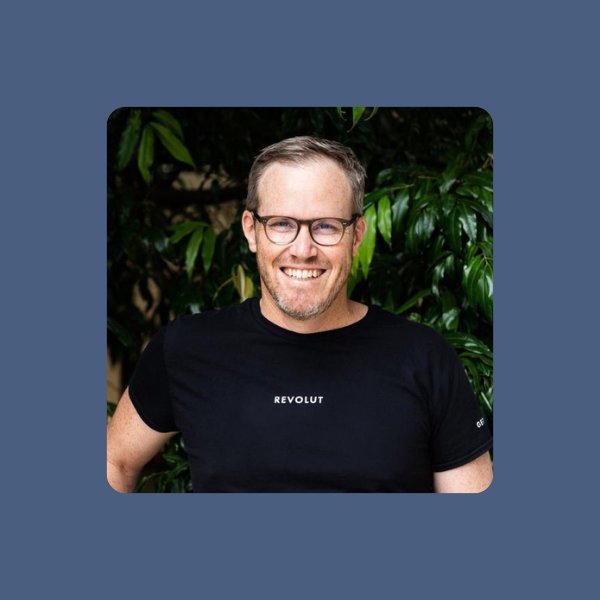
Revolut Australia CEO Matt Baxby has done what most Australian neobanks couldn't: reach 1 million customers and profitability. Six years after soft-launching with three employees during a global pandemic, the Revolut Australia CEO sits down with Dexter Cousins on Fintech Chatter to discuss the journey from travel FX startup to 30-product super app, the $250 million saved for Australians, and the ambition to become the country's number one finance app. More importantly, Matt Baxby reveals the hiring philosophy and culture that made it all possible.
This interview was recorded on 4 February 2026.
Dexter Cousins: Matt, congratulations on a massive milestone. Let's start with the big news: Revolut Australia has just hit 1 million customers. Take us through what that means.
Matt Baxby: Thanks, Dexter. Yeah, we crossed 1 million customers at the end of January, which is a really proud moment for the team. But what's more meaningful to me is that we've saved Australians close to $250 million in FX fees compared to what the major banks charge. That demonstrates there's a real need for what we're offering in this market. When you can put that kind of money back in people's pockets, you know you're solving genuine problems.
DC: The awareness is certainly building. People are starting to understand there are alternatives to those airport FX desks, and Revolut is at the front of that pack. But you've evolved well beyond just travel money, haven't you? You're now offering 30 plus products.
MB: Absolutely. When we launched six years ago, the proposition was simple: bring together disparate financial solutions into one app. Things like overseas money transfer, bill splitting, peer-to-peer transfers. One of the key features from those early days that's still incredibly popular is the ability to transfer any currency directly to another Revolut customer in a different market. No friction, no cost, no waiting around for three days. That was the hook.
But you're right: we've expanded significantly. Today we're a modular platform. There's no set use case for our customers. Some people use us primarily for travel, others for everyday spending, some for investing in crypto or US shares. We build based on what customers tell us they need solved.
DC: That's interesting because as a Gen Xer maybe it's my eyes going, but the app is getting more complex to navigate with all those features. Is product proliferation becoming a challenge?
MB: [Laughs] Fair observation. Look, we're very aware of that, and it's something we're constantly working on. But I'd rather have that problem than the alternative: being too narrow in what we offer. The development continues to be driven by customer feedback. If enough customers are telling us they need something, we'll build it. That customer-first approach has been core to our success.
And here's the thing that keeps me confident we're on the right track: word-of-mouth referrals still represent a large proportion of our new customer acquisition. That's the highest compliment we can receive. When customers are actively recommending us to friends and family despite the complexity, it tells me we're delivering real value.
DC: Let's talk about Revolut Business. Small businesses are the backbone of the Australian economy, but they often feel overlooked by the major banks and even by many fintechs. What's happening there?
MB: Revolut Business has been incredible since we launched it in 2023. We've seen 235% growth in transaction volumes over just the last 12 months. The opportunity is massive because you're right: small businesses have been underserved for years.
The really exciting development is our new merchant acquiring product. We've just launched physical terminals and payment gateways through "Revolut Pay." What makes this powerful is we have a double-sided marketplace: a large consumer base who already have Revolut on their phones, and a rapidly growing small business base. When you can connect both sides, you create real network effects.
DC: That's a significant expansion beyond your core FX and payments business. Speaking of expansion, where are you with the APRA banking licence?
MB: The process is ongoing, and it remains very important to us. A banking licence enables services like interest-bearing savings accounts and broader credit products. It also provides government guarantees on deposits, which builds customer trust and gives us access to more sustainable long-term funding.
But here's what's critical: the lack of a licence hasn't constrained our product delivery or business growth. We've been very deliberate about that. We've continued shipping products, growing customers, and most importantly, we reached profitability in 2024. That's a very different path from other neobanks in Australia.
DC: Indeed. Most of the local neobanks either failed or were acquired before reaching profitability. What did Revolut do differently?
MB: Our strategy was fundamentally different from day one. We established a strong foothold in payments and foreign exchange first: areas where we could demonstrate clear value and actually make money. Then we expanded the product offering from that profitable base.
A lot of other neobanks tried to be full-service banks from the start, which meant massive infrastructure investment before they had meaningful revenue. They were burning capital trying to replicate everything the Big Four do, just with a better app interface. That's incredibly capital intensive and the unit economics don't work until you have massive scale.
We took a different approach. Build what customers need, prove the economics work, then expand. Stay lean, stay focused, stay profitable.
DC: Let's go back to the beginning. You joined Revolut in February 2020 as the first Australia CEO. You started with three people, then literally one month later, COVID hit and the world went into lockdown. What was going through your mind?
MB: [Laughs] Honestly? It was a significant inflection point, to put it mildly. Here we were with a travel-oriented FX proposition, and borders just… closed. Completely. For what ended up being over a year in Australia.
But looking back now, I'd say it was the best thing that could have happened to us. It forced us to think much more broadly and pivot into new opportunities immediately. We accelerated our plans for US share trading, we introduced cryptocurrency exposure, we focused on international e-commerce. All the things that didn't require getting on a plane.
That agility, that bias to action, is core to Revolut's culture. Our founders backed us to make those pivots quickly. We didn't spend six months doing market research and business cases. We identified the opportunity, built the product, shipped it, learned from it. That's how we survived and then thrived despite the pandemic.
DC: You mentioned culture, and I want to dig into that because you've built teams at Virgin under Richard Branson, at Bank of Queensland, and now at Revolut. How do those experiences compare?
MB: They're all very different cultures, but there are principles I've carried through. At Virgin, I learned the power of entrepreneurialism and brand: what it means to genuinely put customers first and challenge incumbents. At BOQ, I learned the discipline of running a bank, dealing with regulators, managing risk at scale.
What I've adapted for Revolut is being very specific about what type of people succeed here. We're rigorous about hiring problem solvers: people who can think critically and exhibit a strong bias to action. We assess that through interview scenarios, not just by asking people to talk about their CV.
DC: Your recruitment process has a reputation for being thorough. And you're doing all of this with a "work from anywhere" policy, which is quite different from the banking norm.
MB: The remote working policy works because of the discipline and mindset of the people we hire. We have high expectations for performance, ambitious quarterly KPIs, and structured measurement. There's a misconception that you need people in an office to have performance oversight. What you actually need is clarity on objectives, rigorous measurement, and people who are self-motivated.
If you've hired properly — true problem solvers with a bias to action — it doesn't matter if they're working from a Sydney office or a beach in Byron Bay. They'll deliver. If you haven't hired properly, having them in an office won't fix that.
DC: You now have 100 people in Australia. When you're hiring, what are the absolute non-negotiables?
MB: Problem-solving ability and cultural fit around action. I'd rather have someone who can think critically, move fast, and figure things out than someone with a perfect CV who needs to be told exactly what to do.
We're also looking for people who are comfortable with ambiguity. Revolut is a founder-led organisation. Nick, our founder, sets ambitious goals without caveats. His goal for us is to be the number one app in the finance category in Australia. Not "number one neobank" or "number one among challengers." Number one, full stop. You need people who find that energising, not terrifying.
DC: That's quite an ambition when you're competing against the Big Four banks who control 80% of the market. After six years and 1 million customers, how's that battle going?
MB: We're bringing genuine competition to a market that's needed it for years. The Big Four have had it pretty comfortable: wide margins, suboptimal user experiences, business models built on customer apathy. We're changing that equation.
What's surprised me is how quickly Australians have embraced an alternative once they try it. The word-of-mouth growth I mentioned earlier: that's people voting with their wallets and their recommendations. That doesn't happen if you're just marginally better. It happens when you're delivering something genuinely different.
Are we number one yet? No. But every customer we win, every dollar we save them, every feature we ship: we're getting closer. And unlike some of our competitors who've fallen by the wayside, we're profitable and sustainable. We're in this for the long term.
DC: Looking forward, what's the vision for the next 3 to 5 years?
MB: All our actions, whether it's our F1 sponsorship, our product development, our marketing, are focused on that number one goal. We want to be the app Australians open every day to manage their money. All their money. Spending, saving, investing, borrowing.
We'll continue expanding our product suite based on customer needs. The banking licence, when it comes through, will unlock more capabilities. We'll keep investing in making the experience better, more intuitive, more valuable.
But fundamentally, it's about meeting Aussie consumer needs better than anyone else. That's been our mission from day one, and it won't change.
DC: For people interested in joining this journey, where should they look?
MB: Head to revolut.com and check out our careers page. We've got live roles across product, engineering, operations, commercial, compliance: pretty much every function you'd expect. If you're someone who loves solving problems, moving fast, and making an impact, we'd love to hear from you.
DC: Matt, congratulations again on the milestone. It's been an incredible journey to watch, and I'm proud that Tier One People could play a part in it six years ago.
MB: Thanks, Dexter. And thanks to you and the Tier One People team. We couldn't have done it without finding the right people, and that partnership has been crucial to our success.
Revolut Australia has 1 million customers and 100 employees nationwide. The company is certified as a Great Place to Work in Australia and is actively hiring. For more information, visit revolut.com.
Tier One People is Australia's leading fintech executive search firm. Six years ago, Tier One People placed Matt Baxby as Revolut Australia's founding CEO - a placement that has delivered 1 million customers, $250 million in savings for Australians, and a profitable, sustainable fintech business.
That's what happens when you find the 1% who define what's possible.If you're building a fintech team or looking for your next role in fintech, visit tieronepeople.com or connect with Dexter Cousins on LinkedIn.
Jonny Wilkinson is co-founder of Equitise. Equitise is a crowdfunding platform which simplifies the investment marketplace. It removes traditional barriers to investing in sourcing capital by making the process quick, easy and safe. Enabling your average Aussie to invest in early stage startups like Xinja. Jonny shares his personal journey of launching the business and gives his views on the investment market.
Tier One People’s Dexter Cousins chats to Jonny about his own journey with the business and the future for Equitise.
We are an investment platform for unlisted companies to raise funds via crowdfunding. Essentially we make it possible for everyday investors to put a relatively small amount of money into supporting startup businesses. The idea for Equitise began in 2014 in a pub at a mates birthday. My co-founder Chris (Gilbert) were both chatting about wanting to get out of our corporate gig. We both had some knowledge of the potential changes taking place in crowd funding both regionally and globally and figured we'd go for it. The next morning we weren't sure what was going to happen. Nursing a sore head, scrolling through my newsfeed I was drawn to something which was to become the precursor to the H2 accelerator.
Xinja was the very first retail, equity crowdfunding deal done after the laws changed and the exact same day our licence was granted. The 11th January 2018 was the day we launched with Xinja. It went gangbusters, beyond our wildest expectations. I didn't leave my desk other than go to the bathroom a couple times on that day. We ended up raising about $2.5 - $3 million for them.
We’ve been extremely lucky to work with some great businesses including Car Next Door, GoCatch and Endeavour Brewing, a boutique beer label. We've helped lots of companies raise money, not just once, but a second or third time. To date we've carried out 74 raises for 65 companies over the past few years. In total that equates to approximately $45 million.
It’s been nothing short of amazing. When we set out on this mission we needed companies and investors to enable us to fulfill our wish to make investing more open and transparent to every investor. Buying into a VC fund costs on average $250,000, which puts it beyond reach for the average investor. With Equitise, investors require, on average just $250, which provides opportunity for most people to build a portfolio. They can back some amazing, exciting businesses with the potential to grow tremendously and potentially provide great returns.
The ability to invest is also great for the economy. Crowdfunding allows companies who are innovative and small the ability to grow and create future employment. Equity crowdfunding helps underpin the early stage capital markets. We're very passionate about being able to offer investing opportunities to everyone.
https://www.buzzsprout.com/703249/4300637-ep-22-jonny-wilkinson-equitise?client_source=small_player&iframe=true&referrer=https://www.buzzsprout.com/703249/4300637-ep-022-jonny-wilkinson-equitise.js?container_id=buzzsprout-player-4300637&player=small
A number of factors are in play. Stock markets are trying to predict the future, and COVID-19 has thrown things into disarray lately. Previous downturns like the GFC were a top down structural issue, which slowly unwound and devalued a whole lot of assets.
What we are seeing now is a supply/demand, bottom up driven outcome. The opportunity for the economy and indeed the world to switch back on and return to normal is much greater.
There is more money in the world today than ever before. In recent years people are most likely reassessing their situation.
We're very lucky to have extremely mature superannuation industry in Australia, with a figure in the region of $2.6 trillion AUD. This is a huge amount of money to underpin the economy with. Nine and a half percent of the gross national income in Australia is deposited into superannuation funds each month.
If there aren't any new issuances on the ASX, most of the focus and allocation of a lot of these assets is towards Australian stocks. The asset prices will just get pushed up. Which means the ASX keeps on growing even if there isn't commensurate, actual growth in the underlying companies on the ASX.
Without a doubt it’s quicker and easier for people to take these opportunities now. Opening an account can all be achieved in a few minutes. The speed in which it can be achieved allows people to seize on opportunities. If you're sitting on cash or you’re looking to rotate your asset allocation it's a tremendous time to be alive.
I recall a time back at Citibank, when we were trying to set up some Australian institutional clients it was an arduous process. The steps and the forms needed to set up trading in the US was quite involved. Whereas these days individuals can do it in a matter of minutes and lots of the processes are automated.
"I'm never going to try and start another business where I need to get laws changed!"
jonny wilkinson equitise
In 2014, H2 accelerator accepted Equitise into their accelator programme. Legislation was expected to change in a relatively short period of time, 6 to 12 months at most. Then we had a change of government and the time frame changed overnight, we had no end date in sight.
Having quit our jobs, borrowed money and building the investment platform, we didn't know what to do.
We had always planned that Equitise would be an Asia Pacific company eventually, starting in Australia, New Zealand then Asia. The order changed. We jumped on a plane to New Zealand and started cold calling people, sending emails and LinkedIn connections.
Chris and I quickly followed up with meetings. Venture capitalists, angel investors, lawyers, accountants, basically anyone who we thought might be interested in investing. When we met with the regulator they were very encouraging. And after a brief board meeting (Chris and I were the only two board members at that time) we decided to launch in New Zealand first.
I got on a plane the next day and moved to New Zealand for 18 months. We got the business quickly set up and licenced.
In Australia the process to get the legislation changed to allow for equity crowdfunding, was pretty arduous. We had to lobby the government and the opposition and took trips to Canberra a few times. It took a lot of time and pushing from different angles.
FinTech Australia has been an amazing platform for us to help get access and lobby the government. I was lucky enough to be put on a FinTech advisory panel to the government, which opened up another avenue for us. We had to work with ASIC making sure we put regulations in place to get licensed in Australia before we finally got the go ahead. I'm never going to try and start another business where I need to get laws changed!
We now have ten people in the business split fairly equally across technology, marketing, deals and management working collaboratively within the business. Our marketing team also works with each of the companies we are raising money for, as well as doing the broader Equitise marketing.
It’s amazing and we're very proud of what we have achieved. It gets us out of bed every day. We get to speak to amazing people doing tremendous things. When we see the companies we help continue to grow, it's very rewarding.
Private companies are the lifeblood of the economy, they drive growth and employment.
The second company we ever raised money for in New Zealand works in a pretty niche space providing financial products to retirees. They don't think they would have been able to go on had we not helped them with their first raise. They now have more than $250 million funds under management and we’ve raised for them four or five times.
We've got lots of exciting things coming up, which we've been holding off on due to COVID-19. This has allowed us to build an exciting new platform where we’ve built the technology from scratch. We have launched Bricklet, which is a fractionalized property play. We've got a bakery business producing authentic, certified organic, whole food.
Humaniti is a personal finance offering where you can actually earn money. There's a lot of exciting things coming through in the short term and we’re busy stacking the pipe with some exciting stuff coming for the second half of the year.
Cuscal has a rich history of technology innovation in Australia and is the main investor behind Neo bank 86 400. They were the first provider to go live on the new payments platform, switching on 30 clients simultaneously on one day.
Tier One People’s Dexter Cousins talks to Bianca about the next evolution for Cuscal as we enter the open banking era.
Cuscal is Australia's leading provider of payment solutions. We are an ADI (Authorised Deposit taking Institution) and have all the same licencing and payment capabilities as the major banks in Australia. However, we provide our services on a wholesale basis operating in the business to business space. What it means in essence is, we provide the back office functions for mutuals, credit unions and Fintech’s.
Cuscal have been operating in Australia since the 1960’s, formed by the mutual sector as an industry body. Our origins in the mutual sector mean culturally we have always had our members best interests at heart. Cuscal’s strong focus on the customer experience and passion to "do the right thing" is at the core of our values.
We have been heavily involved in financial technology innovation from our inception. Back in 1977 we launched Australia's first ATM in collaboration with Queensland Teachers Credit Union. In 1982 we were the first to issue a scheme debit card in Australia. Fast forward to 2018, which was a huge year for Cuscal, we had the NPP launch.
Cuscal enabled 50% of those financial institutions to go live. Later that same year we simultaneously launched over 30 clients going live with the three global digital wallets, Apple, Google and Samsung. It was an immensely proud year for us.
We built on our success the following year when we launched the first digitally issued card for one of our clients in Western Australia.
Our journey towards a digital bank started many years ago. We saw digital banking as the future of banking. The real opportunity for us lay in our end to end payment expertise and a long history of working with banking clients.
In August 2017 business case approval was granted and we started work. From the beginning we made a conscious choice to establish an independent organisation with its own leadership team, premises and board to allow the organisation its independence and autonomy.
This ensured the right focus to achieve the vision, and last September 86 400 was born. We're so proud of the innovative, mobile only banking experience now being offered to Australians through 86400.
As the founding shareholder, our licence agreement with 86 400 effectively enables Cuscal to be the sole distribution partner for all of the digital capabilities we have built. Our goal was to allow Cuscal the ability to launch those capabilities to other clients, which is our plan in the coming year.
We have a very broad base of clients who are predominantly based in Australia, with a couple of US clients. These include large and small financial institutions, Acquiring Clients, Fintechs, Corporates and Payment facilitators. We’re focusing on how we can deliver the solutions our current clients need in the most optimised manner.
We are also doing what we do best, being the source of thought leadership to our clients. Being a scout for what is coming down the pipeline in terms of investing their money, as well as providing some perspective and prioritisation.
Open banking is a big area for us. The 86 400 white label licence services also provide us the opportunity to utilise some of the digital capabilities for our clients that we built for 86 400. COVID-19 has highlighted the need to have a really clear digital strategy and a digital engagement programme. We are planning a roll out of some of these services for our existing clients in the year ahead.
It's certainly been a journey. The positive decision to change and diversify was made approximately 10 years ago. New products require capability from technology. It required a rethink in the way we delivered programmes of work. From this came the need to bring in people who have successfully managed similar programmes to drive change.
The NPP programme was probably our biggest learning platform. When we started the build of NPP, waterfall practices were our go to method. We quickly moved to an agile way of delivery which again meant new people to drive the upskilling we needed. Many FinTech startups go through a growing pain process and the NPP was our experience with those pains.
Pushing to have 30 clients go live in one day also gave us the confidence to recognise we are a nimble organisation with less complexity than the major banks.
Cuscal have always been; a) client focused, with an emphasis on doing the right thing and b) providing a great employee experience. This has become even more focussed in recent years.
There's four main areas we look for in our people. Top of this list is energy. We want people who are looking to make a difference and getting stuff done.
The second is people who will work as one team, people who think only of their own success and reward tend not to work for us.
Thirdly we want people who are accountable in all aspects of their work, process, product, service whatever it may be.
Finally being outcome focused. Having a really clear strategy to make sure everything they're doing is driving towards executing their strategy.
We’ve had a few challenges, one of these is competing with the Neo banks. People are naturally attracted to the hottest startups who get a lot of press. Our strength is Cuscal being a bank. It comes with financial security, regulation, certainty. Startups can be exciting but they also come with a lot of risk.
We are well networked from an industry perspective. Our people sit on most of the working groups, boards, committees and forums in Australia from a payments perspective. All of the benefits that come with working for a bank. Our dual pronged approach is that we are also a FinTech. We work on innovative and transformative products and services. But we offer an environment where our people have the resources to deliver. We’re essentially the best of both worlds.
We're also a small organisation who encourage our people to sit in on forums with leadership, board members and their direct reports . Our people have a voice and provide invaluable feedback.
Our heritage in the mutual space has seeped through to our organisation. Cuscal has an ethos of doing the right thing for our customers. Our way of operating is in complete contrast to other organisations where they are KPI driven. The benefit for our people is the opportunity for them to stand up and really differentiate themselves in the market to their end customers.
Cuscal is really enabling competition in the Australian market and we're really proud to be able to support this thinking.
Data is at the heart of driving a tailored customer experience. Mobile being the first way in which consumers are looking to engage. Our beliefs form our strategy which I summarise as four pillars.
Firstly, Our clients need to get to market as quickly and cheaply as possible. We’re making everything really modular, plug and play to enable this.
The second pillar is around expanding our client reach to ensure we can scale to deliver much more competitive pricing for our customers. We've made significant investments in NPP, as well as digital capabilities and our fraud solutions. We're really looking to scale those solutions and reach as many customers as possible.
"Cuscal has an ethos of doing the right thing for our customers"
bianca bates
The third area is increasing the relevance of our payment solutions. Many products we have been delivering since inception. We need to continually focus on using the right systems and tech stack to deliver those products. An example of our focus here is with our fraud platform which we replaced when we introduced NPP’s new payments stream. We now have a new platform using machine learning and artificial intelligence for fraud monitoring services to customers.
The fourth area is making strategic investments in innovation. We really see this as essential in maintaining our position of leadership and relevance whilst capturing emerging markets.
Our big focus here is really on open banking, hence our investment in bringing 86 400 to life. We're really clear on our strategy. We're into the second year of our five year plan.
Forbes recently launched their list of the world's top banks based on factors including ethics and customer centricity. Of the twenty Australian banks that featured, I’m proud to say seven are clients of Cuscal.
They process more than $13 billion in transactions each year. Gocardless is backed by some major players in the VC world, including Accel partners, Salesforce Ventures, and Google Ventures.
Carolyn is a payments veteran holding senior positions at eBay, PayPal, and winner of the 'Women in Payments Award' in 2019.
Carolyn talks with Tier One People‘s Dexter Cousins about her journey and shares her tips on how to make the Country Manager role a success.
My journey into Fintech started with Braintree, which was part of the PayPal business. To provide some background, Braintree is the technology stack behind the acceptance of credit cards. They helped build some of the world's most amazing payment experiences for companies like Uber and Airbnb.
It was an exciting time as the technology and company kept evolving. But in order to continue my career in this field, I acknowledged I needed to adopt an attitude of continuous learning especially around payments. And if I wanted to become a leader then I needed to develop skills in other areas too.
GoCardless launched 6 years ago in the UK by three co-founders, Hiroki Takeuchi, our CEO, Tom (Blomfield) and Matt (Robinson). Together they developed a simple online tool that would allow SMEs to collect direct debit monies via bank debit. Both Tom and Matt have moved on to found other major Fintech companies, Monzo and Nested.
In the past banks made it incredibly difficult for SMB/SME’s to access these facilities because they needed to underwrite the risk associated with bank debits. A small business who wants to get bank debit facilities needs to put down a big reserve as security to mitigate the risk, often totalling hundreds of thousand of dollars. It was from this idea that GoCardless was born.
GoCardless is going from strength to strength in 2020. We are currently connected in 30 countries. With boots on the ground in London, Paris, Munich, Melbourne and San Francisco. Over 450,000 merchants use us as their platform every day.
There were a couple of things that really jumped out to me when I was interviewing for the role. The business had an instant entrepreneurial feel. Everybody I met was very clear about the goals and outcomes of GoCardless. They were aligned to solve real problems on a global scale. Everyone I met was focused on how their role impacted the success of the business. I found this really inspiring.
Employees recognise what a great business GoCardless is and are fully invested in how they can play a part in the continued success. There is a collective passion.
The distance and the practicality around our different time zone is the greatest challenge. To combat this we have to make sure there's an extension of the culture between UK and all our global offices. Everyone adds to a companies culture as the organisation evolves.
Whilst our roots are in the UK and we have a lot of similarities between us, there were still things needing adjustments. We had to tweak our onboarding processes to suit as an example.
It was very important and critical to our growth that we tweaked early and started to pivot certain elements. We brought our UK product to Australia, keeping everything that's great about it, whilst carrying out tweaks for Australia to increase appeal to the local market.
We currently have 2100 active merchants using on a regular basis, which is incredible for how long we've been in the Australian market.
In addition we have got great brands to join us including, Deputy, DocuSign, Siteminder, Vitality, Butn, Archa, Indebted, Glow Power, Pulse, Movember and most of these have been global deals, where GoCardless is used in multiple markets.
Globally, we have about 230 different platforms. Xero, which is our key partner for us globally, has Gocardless as the only bank debit solution on their platform.
Salesforce billing is one of our most recent global partnerships. Gocardless works with some fantastic billing platforms like Zora, Charge B, Charger Fire, Recurly, who have been instrumental in getting us to this point.
Early on I convinced two people on secondment from the UK office to stay here with me and continue the journey. They had both worked with the UK office for 3 to 4 years and brought an instant extension of the culture to Australia. It is a winning strategy, that I would highly recommend for other fintech launching in Australia.
In addition I've worked with some amazingly talented payment nerds over the last few years who reached out to me when I moved into this role. But as we grow it will become more challenging as we go outside of natural networks.
I hire passionate, dedicated people who have well researched ideas and buy into what we're doing. Culture fit is the main part of our interview process. Which is why we have multi-level interviews including those carried out by peers. Some people make it easy for us to decide whether they will work out by their behaviour outside of the interview process. I always ask reception for their thoughts as an example. I am amazed how people are delightful to me in an interview yet awful to our people in reception.
We talk a lot about our values, why we do what we do and the problems we are trying to solve. We want to work with people who have pride in their job and bring craftsmanship to their role.
You can also learn a lot about a person in the language they use. “I” instead of “We” can often be a sign that someone takes credit for or doesn't recognise the contribution of their colleagues. This attitude is a big problem in a startup.
It is so exciting to be part of this industry. We’ve recently stitched together our global network of bank debit schemes. We can now collect for you in 30 countries and settle back to your home account.
Our recent partnership with Transferwise has been a huge boost for our business, and it is a global first. We can also settle with your local entity of choice. For the first time we can now truly rival schemes like Visa, MasterCard and Amex which is really exciting.
We’ve used all the transactional data across the 30 billion dollars of payments that we process to build a payments intelligence platform. And we've developed a new product called Success Plus that uses AI.
This has enabled us to use those analytics to drive further efficiency. Which allows us to understand our customers more. But we keep innovating, as I see so many fintechs pop up that are solving something for a consumer, educating them around how to manage their money better. It's such an exciting industry to be part of.
Francine Ereira is Country Head of Klarna, a Fintech founded in 2005 in Sweden, with the aim of making it easier for people to shop online. Klarna is now one of Europe's largest banks, providing payment solutions for 85 million consumers across 205,000 merchants in 17 countries.
Klarna offers a smooth, one click purchase experience that lets consumers pay when and how they prefer. Launching in Australia in February 2020 it counts Commonwealth Bank, Sequoia Capital, Visa and even Snoop Dogg as investors.
Francine talks about the launch with Tier One People's Dexter Cousins.
Klarna established in Stockholm 15 years ago by three young Swedish gentlemen, with a simple vision to make online payments easier for consumers and retailers. We completed our first transaction back in April 2005 in partnership with a Swedish bookshop. Since then, we've expanded into 19 markets, serve over 85 million consumers and work with in excess of 205,000 retailers across the globe.
Australia is a relatively mature market. It's sophisticated with an engaged consumer base who are willing to try new payment products. Based on our adoption of Klarna, Australia as a country is always looking for something bigger, better and bolder, especially in the millennial market.
What Australia brings for Klarna is the ability for us to position ourselves as a responsible lender. We are helping consumers to budget and we are partnering with retailers to help them grow their businesses. The reason Klarna came to Australia is our competitors in this market have a very transactional relationship. What Klarna does well globally is develop relationships by engaging customers through curated personal content, rather than just a transaction.
During my first week at Zip Co I was present at a partnership meeting with Klarna. What I remember about that meeting was the level of professionalism and the pace at which Klarna worked. They had a dedication to working towards a great opportunity. Whilst the opportunity to partner with Klarna didn’t work out with Zip, it stayed in my mind the ease of which they wanted to partner and how they went about doing that. I witnessed first-hand their passion and devotion to solving problem spaces. When Klarna announced their partnership with CBA in Australia, I knew this was my chance to be part of it.
We've got a really close working relationship. There is a strong alignment between Klarna and CBA. We both have a commitment towards customer obsession and protecting consumers, for example our drive towards responsible lending.
We have regular meetings to discuss growth and what we both want to achieve in this market. It's not like it's big brother watching over us. It truly is a partnership, exploring a range of opportunities to grow together, including co-marketing opportunities and developing opportunities as we go.
The culture is honestly something that I've not experienced before. I've worked with very large global corporations and some great startups. Klarna's cultural perspective encourages people to speak up and take accountability. Empowerment is something in our organisation I find incredible. We empower everyone to deliver in a fast-paced environment.
To provide some insight of how empowering it is I'll share a conversation Sebastian and I had. He told me “Fran, Australia is yours to make successful” and I said, “What does success look like?” He said, “No, you tell me what success looks like to you and then go and deliver on it, because I know that's what you're capable of doing”.
"That’s the essence of the culture, it is truly incredible"
FRANCINE EREIRA
If I can paint more literal picture, we work in small teams of eight people. Each team focuses on an individual problem space, looking to foster a startup mentality. If you think about our product space, we are quickly able to iterate and enhance our products based on customer feedback.
That's something that you don't see a lot of in big tech teams that have longer roadmaps, you can't have that agility, which is the complete opposite of our small teams.
Klarna still identifies people by core competencies, data and analytics, finance, marketing, tech product, etc. But every team, irrespective of competence is only eight people. And some of those teams will be cross functional. Our product team, for example, has lawyers, analysts and developers.
Basically a group of people who can run a small business sufficiently on their own within the organisation. It's a really clever concept because it means that you're able to self-service, right? You're not relying on all these other pieces, you're actually self-sufficient to run and that means you can run faster, quicker and achieve desired outcomes.
We’ve got some very big plans for Aus. Today we are 27 people and we're growing quickly in the market, which is really exciting. We've had a very warm reception and that’s mainly because consumers are truly at the heart of everything we do.
I could have utilised support and services from our central services team in Sweden. The reality of the time differences between us brought about a realisation that this didn't quite work, we really needed to create those roles within Australia. The team is a lot bigger than initially forecasted year one because we don't want to compromise on the level of service and delivery to our customers.
The reality is that Australia is a competitive landscape. Only 10% of Australians have actually conducted a buy now pay later transaction. We're seeing numbers grow on a daily basis with new audiences, particularly with the pandemic. There's a whole new audience now shopping online that hasn’t before.
What we want to do is disrupt and show consumers what an amazing shopping experience looks like and to show Australians that we can deliver what they want. We do listen and put customers at the centre of everything that we're doing. Our ambitions are very bold, and I'm very confident that we can deliver on them. I can't wait to show the results of that in a couple of years time.
My foray into FinTech was quite an interesting one. I was actually working at Tomando, which you may recall was an incredible fulfilment platform. During my time at Zip I had established really strong relationships within the payment ecosystem including platform providers, solution providers and retail. It was at a time when Larry was in the early stages at Zip Co, I think three years in at that stage, and looking at how to partner and breakthrough. We started talking and did a dance around for quite a number of months until I was I love the sound of this. This is really exciting, I think I need to get on board. Which was how I got into the FinTech space.
The reality is all jobs out there are there for the taking by anybody, irrespective of race or gender. It think it boils down to females being less likely to consider themselves worthy of running the race. If we only tick 9 of the 10 boxes then we won't apply. The mindset of guys is different. They think I've got three of those things, let's have a go.
It’s about helping women take those risks because they are so capable. We are so judgmental of ourselves, we really are our own worst enemies to be quite honest, to a large degree we are perfectionists when we don't tick all the boxes, so we just don't go for it.
Personally, I think that's a big contributing factor. This is a shame because what you need around any boardroom table is a really diverse bunch of people. Different people think and act in different ways, and ultimately you need that level of diversity to win and have robust challenges or conversations. And constructive conversations help you get to where you want to go.
One of the things that Klarna are quite good at doing particularly in trying to keep diversity and balance happening is seeking out people, giving them the confidence to give it a go. What I say to my team all the time, is if you've got what you think it takes to get this done, look at what you've got, not what you don’t have, to deliver and go for it
It doesn't matter whether there are guys or girls in my team or not at the end of the day, I want everyone to strive and push themselves further than they've ever pushed themselves because we all benefit collectively from that.
Emma Weston is the CEO and a co-founder at AgriDigital, an AgTech meets FinTech company. They digitise and de-risk global Agri supply-chains with a current focus on the grain and cotton industries.
Emma: I've got two co-founders, Bob McKay and Ben Reed. We've actually all worked together for a really long time. There's lots of gray hair on the team and the main focus of our domain is agriculture and green supply chains. That's what we know really well, but throughout our history we've been building our own companies and our own tech and we've also been building out supply chain finance businesses.
We came together again in 2015 as a trio and founded AgriDigital. The mission, to build a single source of truth platform that was going to deliver simple, secure, and cost effective core supply chain operations technology to the SME sector in the supply chain.
And at the same time crucially provide access to working capital. That was the mission that brought us together. We had a small core team, with a couple of developers that we'd worked with previously, in previous businesses. And we're now at just a little over 40 people with operations in Australia and a team of 10 people in Manila in the Philippines. We're also now branching into North America, both the USA and Canada.
Emma: Massive, just in terms of scale for us. To give everyone an idea, our target market is farmers and buyers, traders, and consumers of grain commodities. Our customers would be a dairy or a feedlot or a mill as an example, but also storage and logistics companies.
We are very much a whole of supply chain tech in terms of our offering and the market in the US and Canada. Well, let's just take North America. It has a combined market almost 15 times the size of the Australian market, and that’s just by an economic value, but in terms of number of participants, it's around about 25 times the size, so in terms of the number of users it's a massive market as well.
Emma: It's been pretty challenging this year, that's for sure. Location was critical. What is the best location in a massive market, where should we launch? How do we get the talent needed for our business? How do we easily access to our customer base? Our farmering customers in the US and Canada are spread across the country, which makes it difficult.
It's not possible to have an office footprint that's going to serve everyone. Location was a big challenge to begin with. Covid-19 has forced a change in our thinking. We recognise now our focus should not be on location, but on talent. Where is the talent and how do we tool up the talent and bring them on and use our culture as a bonding tool to ensure that we can all work together, even if we're not in the same location.
So that's been an initial challenge, also just maintaining and seeding a culture, if that makes sense. How do you take what you've built in Australia and take that across from a team perspective. Most of the challenges have been internal as opposed to the challenges of the market or the challenges of the customer, all the product, which we really do have a good handle on.
Emma: I think it's a really interesting question as to whether we have deliberately tried to position anything at all, or whether we have allowed the product and the problem to speak for itself. Increasingly we have worked with our audience to understand that blockchain is not a silver bullet. It's not a solution in total. It's part of a toolkit that we need in order to be able to attack these really big problems around integrity and trust within our food and agricultural system.
Also, so we can deal with quite operational matters, such as back office efficiencies, trading book or position reconciliation in real time, payments and so forth. So we've really focused on three areas or three buckets as we call them.
One of those is around payment and transaction security and talking about that with farmers and others. Another one is around network and market efficiency. So the value that we all get by starting to come onto a common platform and common piece of infrastructure. And the third area is around the transparency and providence piece.
Emma: You are being very kind giving me an opening here Dexter. We do have some good news to share, a new product Waypath launching on 26 June. It's a global product targeting farmers, not just in Australia and North America. It enables farmers to become their own trader, their own elevator or storage operator and to be able to enter the supply chain and manage their commodities into the supply chain in their own right.
We're really excited to be offering WayPath. It is a way to connect the digitalization on the farm with the digitization in the supply chain. We're basically providing a product that is the last link between farm digitization and supply chain digitization. It's going to be really, really big for farmers. We've got heaps of interest and engagement by our early adopter group.
It really is just the beginning. It's initial focus is our supply chain, but we have plans for Waypath to deliver our supply chain finance in the future. So we'll be bringing finance at the click of a button to farmers globally.
Dexter Cousins speaks with Marie Steinthaler, VP Asia with Truelayer about Australia's 1st July launch of CDR and open banking.
TrueLayer is a platform that provides global access to open banking. And what I mean by that is essentially a way for our clients to securely access their end users bank data, and payment capability through one normalised platform. And we do that by going out and finding the best banking API's out there. We then normalise across many different countries, use cases, API protocols, you name it, and then package it up in a platform that our clients can build on top of and innovate on top of by using their customers banking data or payment rails.
I would define open banking as a manifestation of the belief that the data that you create when you bank is yours. So the information that you create, every time you pay for something, you send a payment, you use your banking services, that is your data, and you should be able to use that data to your benefit. Whether that be better pricing, better access to products, verify certain things about your person that may otherwise be hard to verify. And to just make it very easy for you to be in control of how that data gets shared and how it gets used.
The empowerment of the customer is very much at the heart of open banking. Beyond that, at an industry level, it’s about making the collaboration between financial institutions and fintechs more open and more focused around the customer. That's at the heart of it. And TrueLayer was born to enable such a collaboration.
Yeah, going great. And we love working with Revolut and other internationally minded high growth, tech forward businesses. I like to call them an execution machine. They're so good at putting new products out there and listening to their customers. They make it very easy for customers to adopt new things like open banking. And we're excited about some of the new things they're working on as well.
We are building a global platform. So while we started in the UK and expanded to Europe, when we looked at the rest of the world, it was really a case of looking for markets where a few things are in place. One is a growing and well supported FinTech ecosystem. The second is regulators who are conducive and supportive of open banking, and want it to happen quickly. The third is our existing customers and if they want to expand to a region.
Australia scores well for TrueLayer on all three criteria. And, as I'm sure you know, FinTech Australia, and organisations like that are testament to the growing ecosystem in the market. There's also a huge amount of room for disruption. When you when you look at how profitable Australia is, as a market for financial services, as the saying goes your margin is my opportunity.
Australia has had some very well documented trust issues with banks and a royal commission. What have you learned from open banking in the UK that you think Australia can action to really help push ahead?
One narrative I've heard in a lot of conversations with potential clients or people in the Australian ecosystem is sometimes a bit of impatience or disappointment with the speed of the development in Australia.
If the CDR API is launched in July, it's still going to be faster than PSD2 was launched in the UK and in Europe. Fundamentally, I think for such a complex industry spanning project, Australia is doing a decent job at speed.
Obviously, that's no reason to slow down and I think we all want it to happen. ASAP.
I would focus on thinking about use cases and not being afraid to give use cases a try. The big questions and the most important aspect of CDR is Will people actually use this? Are they going to be willing to share their data?
When CDR launches I expect to see a rolling start. I don’t expect a switch to flick on July 1st and CDR will be all functional and ready. But the success of CDR does require some early adopters, innovators and thought leaders to take the plunge and use the infrastructure. It’s the only way to improve, because it's not going to get better if no one uses it.
That is a risk. Luckily in the UK, we work with companies who were willing to take that leap with us. I'm pretty optimistic that there will be companies in Australia who want to do this, don't want to give anyone an excuse to shut CDR down. It's up to all of us as an industry to say let's make this useful. And let's make it happen.
Paul Weingarth is CEO and Co-Founder of Slyp, an innovative provider of digital receipts sent straight to your banking app. Slyp eliminates paper receipts, helps retailers' engage with customers and makes it easier to file tax returns.
2020 has been a big year with CBA investing in the business, making Slyp the first Fintech startup to partner with all 4 major banks in Australia.
I spent part of my career at PayPal, where I lead the merchant and strategic partnership team for Australia and New Zealand. I saw a huge opportunity to provide a step-change in the consumer experience. Particularly around paper receipts and unlocking value around the payment. What I couldn’t see was a platform for retailers and consumers to engage in a much more personalised and engaging way.
But it was a personal experience that I had while I was paying with my phone. I was buying a power tool, and I got to the checkout, tapped my phone. And after the transaction, the cashier told me to take a picture of the receipt on my phone and email it to myself.
I thought There's got to be a better way of doing this, particularly with the evolution of contactless payments and how far that technology's come. Australia really is a world leader, but the stuff that happens post payment or around the payment is being left behind with paper receipts.
I was very fortunate to find two other co-founders. I am very humbled that they came on the journey when I had this crazy idea to transform the post purchasing experience. Spiro Rokos, our CTO and Chief Product officer was formerly the Head of Technology at PayPal, so I have a long standing working relationship with him.
Most importantly, early on when he and I were together, we realised the banking world is a completely different beast. We needed to find someone who had really solid executive experience in the banks. And that's when Mike Boyd came along. Mike was the former CIO of the institutional bank at ANZ. And in his most recent role before he left to join us, was Group Data Officer of the bank. So we were very fortunate for Mike to join.
The movement away from physical contact and the acceleration of moving to a cashless society. Receipts are an extension to that, and we see a big opportunity for us to make an impact right now. And in the future with a more intuitive and clever way for retailers to engage with their customers after they leave the store.
The big vision for Slyp is to completely transform the way retail and commerce for that matter is done. That sounds like a pretty big bold ambition. You look at what's happening in China, in Asian markets, for example, you've got these super apps, Alipay and WeChat Pay. They've done an incredible job at not only transforming the use of cash to digital, but completely transforming the way consumers and merchants connect.
You can book a restaurant table, you can repurchase items that you bought in the store online through their app, it's incredible what they've done.
The payment is the commodity, moving money from A to B is the commodity, it's what you wrap around the payment. Now, if you look at the players like Alipay and Wechat, they operate in what we call a closed loop environment or what we in the payments industry refer to as a three party model.
The unfair advantages of a three party model is that the digital wallet (wechat, Alipay) they know, every single customer and every single merchant in the transaction. The model is conducive to enabling amazing connections between merchants and consumers, because there's one centralised provider of that payment system and that network. Now if you look at what's happening in Australia, for example, the way banks operate is a four party mode. There is no common denominator and a lot of fragmentation under that model.
One of the reasons the banks want to partner with us is, we take all the benefits of a three party model and bring it into the four party model. By consolidating these fragmented networks into one network, and into one standard, Slyp is creating a whole new world of opportunity for retailers to re-engage with customers in a personalised clever way around the payment.
Our distribution is reliant on the scale of the banks to actually deliver the receipt to the customer inside the banking app. Customers will simply be able to pay with their card or their phone. And then without having to do anything different, they will receive this smart receipt. So it's not just a digital safe, it's a smart receipt with a bunch of really intuitive features that instantly and automatically go integrate with your banking app with context. So when you click on a transaction or when you want to search for a receipt, it's all sitting there right inside your banking app.
Obviously, for the solution to work it is paramount we get those banks on board and partnerships in place. Banks have a really good coverage when it comes to the retail or the merchant side. So we're partnering with them to roll out the solution across Australia on both sides of the network, which is very, very exciting.
The banks have done collaborations before, Eftpos, Bpay and even most recently with the New Payments Platform. So it isn’t uncharted territory in terms of banks collaborating to build an industry standard. Where our collaboration is uncharted territory is for the Big 4 to invest in an early stage FinTech like Slyp, who operate completely independent of them.
And I really think that's a new way of innovating. And putting the customer at the centre of innovation. And we're really humbled and honoured to have the opportunity to build this in partnership with the banks for Australia. I mean, it's a, it's a big, it's a big task for us to take on. We're a relatively small team, but we can move fast and obviously, with the backing of the banks, not only from a financial perspective, but from a distribution perspective, all of the pieces of the puzzle come together quite nicely.
We hope our collaboration with the banks is a signal to many fintechs. I think more than ever, the banks are realising that rather than build ourselves, let's partner.
To be fair to the banks there’s a big disconnect too. We even went through this ourselves. What we thought was enterprise bank grade ready was not. To go from a proof of concept to a fully functioning core banking app is like learning how to drive a car vs. learning to fly a plane.
If the FinTech community wants to truly partner with banks then they need to be particularly strong in areas like security, data governance and privacy. Otherwise you are turning up to a gunfight with a knife.
Security, privacy etc. are very important to us. But our obsession as a FinTech, as with every other FinTech is to focus on the customer. People say, Oh, you're in the receipts business or you're in the data business, the rewards business. No, we're in the business of customer experience. And that's what gets us out of bed every morning.
And our obsession as a FinTech, as with every other FinTech is solely focus on the customer. People say, Oh, you're in the receipts business or you're in the data business, the rewards business. No, we're in the business of customer experience. And that's what gets us out of bed every morning.
Absolutely, particularly now with CBA, coming onto the board, it really does cement Slyp as the partner to deliver an industry standard for digital receipting. Retailers, they all understand the value prop. They all understand that this is the right thing to do for their customers.
They all understand that this is actually really good value for them as a business. But what they weren’t so sure about, Is Slyp the real deal? Are we the chosen one? So there were still some question marks obviously before this announcement with CBA having a big chunk of the consumer card issuing space.
I don't know the exact numbers, but CBA definitely holds the leading position. So we were very fortunate that CBA came on to the network and that is absolutely going to help us flourish.
"Good leaders really understand that it's not about them. It's about what they can do to get the best out of everybody else around them. "
David M Brear 11:FS
Exclusive Interview. Dexter Cousins chats to David M Brear CEO of 11:FS, the globally renowned Fintech and digital banking consultancy. Find out David's secrets on leadership, attracting the very best talent and how to bootstrap a global business.
David: We've been up to a few things other than just hanging out with microphones and doing podcasts.
Over the last three and a bit years, we've built Mettle, a SME challenger bank with NatWest in the UK. In Hong Kong we’ve worked with WeLab and Standard Chartered and in Singapore we’ve worked with our good friends Grab. We’ve also worked with a number of different companies in South Africa and we are midway through building out a consumer bank in the US.
From an 11:FS perspective, we live by the mantra that digital financial services are only 1% finished. Our mission is to change the fabric of financial services. And we do that in many different ways.
On one side we have a consulting services business working with people around the planet, whether it's regulators or banks or tech players or whoever wants to build out new green field propositions. We help to define strategy and move the ideas forward.
On the other side, it's about building products that actually solve problems we've had ourselves, whether it's things like Pulse, a global benchmarking tool, or the blockers we’ve come up against for delivering truly digital services at speed and scale.
That directly led us to establish 11:FS Foundry, which is a digitally native approach to core banking with a full stack architecture.
David: Four years back we struck on a thesis that we are so early in the cycle of change. The promise of everything the Internet brings to an industry that fundamentally hasn't changed for 300 years was nowhere near being realised.
Digital is really about using the power of data to create an ultra personalised experience with much better services and products.
Unfortunately the way in which big banking organisations have implemented digital is more about taking people and paper out of the process. That’s digitisation, not digital.
The justification of every bank's digital transformation had been cost driven. It has only been in the last few years where banks have realised they need to revolutionise their approach and provide better services and products.
The change has predominantly been led through major changes globally, in the regulatory space and through competition. New players have come into the space, whether that be Fintech startups or Big Tech companies like Apple, and they are showing the banks that people just want better services.
We are just at the beginning of fundamental shifts in banking and financial services.
David: We’ve taken no money. From month three of founding the organisation we were profitable. This pre revenue nonsense is definitely not for me. I don't think you can call it a business unless it makes profit and makes revenue. Call me old fashioned on that one. But for me, it's all about creating something of value for people. And if you do that then you should be able to monetise it.
There have been key moments where we have been very lucky and times when we have been ballsy. Episode One of Fintech Insider is an example. We had no listeners and no idea how we were editing the show, but managed to get a sponsor because they believed in what we were doing.
The first client of 11:FS Pulse was brought in as a partner before the product even existed. DNB invested in Foundry when it was no more than 11 slides.
We've been lucky to find people who believe in what we are doing, are probably as crazy as us and share the same vision, which is awesome. But ultimately our success comes down to creating things that are of great value to our clients.
David: I'm 39 years old now. Entrepreneurs my age can attract the right talent more effectively than people who are starting out a lot younger. You build up a network of people over your career where you think I don't know when, but we're gonna work together again.
I met Jason Bates (11:FS cofounder) back when he was at Starling, I was still at Gartner. I knew with Jason we'd work together at some point. Similar to Ryan Wareham, our COO. We worked really well together when I was at Lloyds Banking.
You get a feel for people in terms of their unique strengths. If there is a pre existing relationship you already have an understanding of each other. From there you build a founding team.
Beyond that, I honestly think success is fundamentally about momentum. One success leads to another success, which over time creates a magnetic pull where you attract the right people.
David: Yeah, 100%. It’s crazy, we get hundreds of emails from people interested in working with us either as employees, partners or clients. At the beginning of the company you're five people sitting around a table trying to figure out how you can compete with Accenture and McKinsey.
We couldn't outspend them from a marketing perspective. So, we decided to out play them with brutal authenticity and a level of distribution that would create a fundamentally different way of engaging with our customer base.
We set out asking;
David M. Brear 11:FS
'How can we be authentic? How can we be provocative? How can we really establish human connections with the brand? '
Even now we could not reach the amount of people that we do with the level of content marketing that we put out using our competitors marketing approach. We have focused so much on brand narrative, it’s not about the products or services we offer. Our brand narrative is fundamentally about what we believe in and our values.
When you align with people on your belief system or your aspiration about what the industry could be, then you find a higher level of connectivity that you can never achieve by sending out a bullshit brochure.
David: 11:FS is my first CEO role. I have worked for some really good CEOs and one or two really bad ones in the past. But I’ve probably learned more from the really bad CEOs, especially on what not to do when it comes building a winning culture!
The 11:FS culture is based on servant leadership. We are not a hierarchical company and believe bad and good ideas can come from anywhere. Whether it's bad ideas coming from the very top or good ideas coming from anybody across the organisation.
Trust is a huge thing from my perspective as a leader. If you have 360 degree trust of your people in the business then there is a positive intent running through the whole company.
When it comes to leadership I don’t consider myself a businessman. I'm more of a sports guy. So, I always look to bring the same mentality of a very successful sports team into the 11:FS team culture.
I think there's an honesty to sports that is often very much missing within the business world. Transparency and accountability are key to a sports team.
If somebody's playing badly on the team, they know and you know really quickly. There is nowhere to hide, but as a sports team you'll do everything you can to increase the productivity of the team and increase the impact you can make from an individual perspective.
With sports teams it is as much about psychology as it is physiology. And I think that is missing in the business world.
Good leaders really understand that it's not really about them. It's about what they can do to get the best out of everybody else around them.
Whether it's creating a sense of urgency, whether it's creating a vision and reinforcing it until the goal is reached, whether it's giving people a level of motivation to run through walls they wouldn't have tried to do before.
In big organisations leadership stops being about getting the best out of the people and focuses on managing the board or managing a group of shareholders.
And that's where I think you start to see a significant drop in the productivity of people within an organisation. And unfortunately, it's where you start to see an almost unrecoverable position from a cultural perspective.
I am a banker by background, I spent 15 years with one of Australia’s Big 4 banks and was given the opportunity to run banks in the Pacific and Japan. I came back to Australia to run a mid- sized mutual bank, and immediately before starting 86 400, worked for Cuscal (100% shareholder of 86 400).
Cuscal has an impressive track record of enabling competition through innovation and technology. They are an early adopter and one of the key founders of the new payments platform. While the big four banks are going very slow rolling out NPP, Cuscal quietly launched more than 40 financial institutions on day one, and did the same with Apple Pay.
Cuscal could see the trends overseas in terms of digital banks and spent a couple years researching international markets. We looked at bringing some of those models to Australia and decided to build a digital bank ourselves. I was involved in the original business case and then moved into the CEO role once Cuscal decided to move ahead with 86 400.
Crazy busy!
But there is no other job I’d want, anywhere else in the world than the one I have right now. Building a full bank from scratch is incredibly challenging and exciting. We've gone through the process of getting a full banking license and now we are live. It has been an incredible journey so far and an amazing two years.
Working with our Chairman, Anthony Thomson is an unbeatable learning experience and I am supported by an amazing group of people. We’ve gone from 8 people on day one to now just over 90 people.
The reality is that the build will never be finished. The big difference between 86 400 and incumbent bank is the build. We have daily live releases and new updates to the App every four or five days at the moment. So the product is never going to be finished, we are constantly building.
But it is very exciting to be live with the product and finally putting it into customers hands. We think 86 400 is a really strong day one offering to customers, but we intend to improve. We have made it our mission to help Australian’s take control of their finances.
I think that's perhaps the wrong question to ask. The big four banks currently own 85% of the market so we are entirely focused on providing a product that offers a better experience, service and value than the big four banks.
That is the market we want to go after. We see the Big Four as the competition not NeoBanks.
8 million Australian’s currently bank using their smartphone. Of that 8 million 86 400 is focused on the 25 to 45 year age group (4.6 million) but our youngest customer is 16 and our oldest is 88!
We are giving customers something entirely different, smart banking.
Before launching 86 400 an enormous amount of research was conducted over two years to unearth and understand the real problem in banking.
People naturally point to the Royal Commission and highlight trust as the problem. Trust is massively important but the real problem we see is this;
Money and our finances are becoming very difficult to manage.
More than 65% of Australians have a relationship with multiple banks. Today we have more money coming in and out of our bank accounts than ever before, which we never see, subscriptions, direct debits and we tap our card or phone more than ever.
It is like money has become invisible. People feel like they are not in control of their spending, making them increasingly anxious about money.
Our core company value is to help Australian’s take control of their money. So the 86 400 team have designed and built a smartbank that helps Australians take control of their money.
A smartbank is a very different premise and value proposition to the large incumbent banks. 100% cloud based technology, purpose built for people who use their smartphone for everything, banking, payments, applying for a loan etc.
One of 86 400’s unique features is the ability to link up to 150 other different banks to the App and view your credit card, transaction accounts, savings accounts, personal loans etc. You can see all your finances in one place. It gives customers immediate value when they join 86 400.
That’s what we think will help us compete against the big four banks.
We are extremely happy with the early feedback. There are two measures we are focused on right now and the initial response is very encouraging;
Are customers happy with the product?
And are customers happy to tell other people about the product?

We believe that customers should own their data and if a company does hold data it should be used to the customers advantage, not just to sell more products.
Banking has always been focused on the past. A bank statement records what you have already spent, it is too late to do anything about it once you get the statement. Even with today’s banking apps customers see their statement now, but they are still looking backwards.
Once a customer links all of their bank accounts with 86 400, smart algorithms predict what bills are coming up in each separate account. That's a massive difference to what we see anyone else is offering in the market and the feature is resonating extremely well with our early customers.
It takes 120 seconds to open an account. You sign up and get immediate value. This is just a small example of what customers can expect from us when open banking really gets going.
86 400 is one of only two banks to be chosen for the Open Banking pilot program. We are very excited and consider it a huge privilege to play such an important role influencing the future of Australia’s banking industry for the betterment of customers.
But we are not naive, there is a long road ahead and there will be challenges along the way. Not everyone has bought into the benefits of open banking and we are already seeing some resistance as Cuscal witnessed when rolling out NPP.
In total there over 90 staff. Roughly 50% of the team are tech people. Developers, Engineers, Designers, UX and Data Scientists. As a fully licensed bank we have risk, finance and credit functions. The homeloans business is about to go live to the public so we have a full team in that business unit.
The entire team is a mix of highly experienced bankers and highly experienced tech people. We only employ people who are digital natives and passionate about technology. We don’t expect a 30 year banking veteran to become a developer, but you have to be comfortable using technology and be passionate about what technology can do to revolutionise the banking industry.
Our core company value is to help Australian’s take control of their money. And that principle determines not only the product we are building but the culture we are creating too. Thousands of people reach out to me and the team asking about career opportunities with 86 400.
The first thing we look for are people who can actually do the work themselves. There isn’t the luxury of hiring people whose unique skill is to run a team or focus solely on strategy. We need leaders who can be strategic and actually do the work required to deliver. I appreciate we are looking for a very unique person and skillset.
86 400 operates an Agile environment with a fortnightly showcase where our people stand up and share what they have delivered in the last two weeks. That can be frightening to some people coming straight from a big bank environment. But it's highly exhilarating for the people we seek to employ, because they get to build stuff without the blockers you get in large organisations.
We have a dedicated HR team which is a big help. It’s a very exciting time to be in the industry. Our people are genuinely passionate about changing banking for the good of customers. 86 400 is small, we have a very flat structure so there is much greater ability to influence outcomes for those who are prepared to roll up their sleeves and Get Things Done.
We are a technology business first. But right now we don’t have the room for bean bags and a table tennis table. We don’t see the need for an innovation hub because if the innovation isn't happening around the boardroom, then 86 400 has a BIG problem.
It is reassuring for me as CEO to see the team stay here because they feel the work they are doing is important and has meaning. And not stay here because we have beer pumps and table tennis. The whole team shows enormous pride in the work they are doing.
Success is celebrated as a team. When the first home loan was finalised, when we got our license, when we went live with the core banking system, when the first card transaction with an ATM happened. All of these milestones have been celebrated as a team.
There will be lots more to celebrate over the next few months. The homeloans product goes live to the public soon. The biggest celebration for me is the feedback we get from customers every day. It’s so rewarding to know that 86 400 is truly delivering on our core principle of helping Australian’s take control of their money.
Of the 50 possible deployments we can do in a day, we can push five of them out to customers who get an iterative, improving application every single day. The most deployments we have done in a day is ten. At the moment, we're sitting at an average of six.
Dom Pym - Up Bank
Dom speaks to Dexter Cousins about their journey to becoming Australia's first ever mobile phone only bank.
Dom Pym: The idea for UP was born out of frustration. As an entrepreneur, I have a tendency to solve problems, problems for me personally, my family, my mates. And turn it into a business.
The story of UP goes back five years. My business partner and I were looking for the next business opportunity and raising capital. We met with lots of people and got talking to the CEO of Bendigo Bank who were out to tender for a new mobile banking system. Ferocia were there to raise capital and ended up building the platform for Bendigo. That's how the relationship with Bendigo started.
The platform was a huge success and won multiple awards, but nobody knew who Ferocia, people just assumed Bendigo built the platform.
The success of the Bendigo platform led to work with one of the major Australian Banks. A project in Asia, to build a digital bank across 10 countries. We spent two and a half years building this thing and it never got into a customer's hands. We worked with people in San Francisco, Hong Kong and Singapore, and spent a lot of time travelling. Then a new CEO arrived. The strategy changes and the Asia project is scrapped. On Friday, we were talking about the success of the project. The following Monday, the whole thing was off a right. Ferocia had dedicated two and a half years of resources, people and energy into it.
The executives we worked with on the project moved to another Big Four bank. They called and asked us to work with them on a new digital bank they had planned for Australia. Ferocia spent 18 months on that project. Again, the product never got into customers' hands. By this stage, we had spent four years building digital platforms and never got to see anything in the market. As you can imagine we were deeply frustrated.
The first digital bank in the world was started by an Aussie, Joshua Reich with Simple. We also noticed what Brett King was doing with Moven. And we were inspired to build a truly digital bank here in Australia. We thought ‘stuff it. Let's build our own bank.’
There was just the small problem of raising 100 million and getting a core banking system. Not impossible but very unlikely. So we decided to go down a different path, partner with a bank. In 2016, there were no RADIs. So, we decided to look for partners and it was an easy conversation to have with Bendigo. The partnership already worked and there was a lot of trust between us.
But, you can't just borrow another banks license. We spent about 18 months putting the legal structures and contracts in place. Finally in October 2017, UP went into production, Australia’s first cloud-hosted bank, with Google Cloud Platform.
We ran UP for a year, initially with our own staff, then Bendigo staff. Next, we extended to friends, family and a small beta testing group, about 1500 people in total. We resolved any issues around regulation, compliance, risk, security, cloud hosting before the official launch of UP Bank in October 2018.
Dom Pym: By February 2019 UP Bank had 50,000 open accounts and 30,000 unique customers (some people open multiple accounts). We are growing at between 500-1000 new customers per day. We had anticipated decent traction being first to market and having the power of Bendigo behind UP.
In January, we conducted benchmarking against Australia’s banks. The data indicated UP Bank as Australia’s third fastest growing bank, behind CBA and ANZ, but we had overtaken the likes of Macquarie, ING, NAB. ING announced record numbers in customer acquisition last year, something like a 47% increase.
Dom Pym: That is the secret sauce recipe everyone is looking for. How do you get rapid growth and brand recognition, without spending a truck load on marketing, advertising, and promotion?
The strategy is proven with other digital banks around the world. Word of mouth, a strong referral network and happy customers are the key channels for growth.
There’s been minimal paid digital promotion on Facebook, Twitter, Instagram, Snapchat, Google and so on. Social media is a very successful channel for us. It's not so much that we are spending on advertising to customers. We use social to communicate with customers.
Twitter is a fantastic tool to communicate with our customers. Not just me, our Head of Product, Head of Technology, Head of Design and the rest of the team are active on twitter. Twitter is an amazing tool for growth and we haven’t spent a cent on advertising on the platform. Facebook, we did spend money on, and we were able to acquire customers.
You wouldn't think that a bank could acquire customers through Facebook, Snapchat, Instagram. We ran basic digital promotion campaigns, that created a viral effect. It was fascinating to watch people engage differently on each social media channel.
On Facebook, tens of thousands of people write about UP to their mates. They tag their friends in a post, it is like an endorsement that goes viral. With social media, we can acquire a thousand customers a day, through a single social channel without doing anything because of the strength of the brand. People love it. How many people in the world wear T-shirts, hats, badges, stickers and merchandise for their bank?
Experiential promotion and marketing works really well for us too. We'll do industry events, like the Fintech Summit where we might do a panel or a key note or whatever.
But we have had most success sponsoring community events. We have sponsored university events, the Australian Design Industry Awards, the Pause Conference in Melbourne. Probably our most successful event was PAX, which is a computer gaming event where they have 100,000 people attend. We missed Sibos because we were busy at PAX!
We decided rather than attend an industry event like Sibos, Money 2020 etc we would try a gaming event. PAX is the world's biggest gaming conference. People dress up as their favourite video game character and play video games. You wouldn't think a bank would be there, but we were signing new accounts on the spot, giving away T-Shirts, hats, merchandise. What really drove new customer sign ups was challenging them to a game of Mario Kart.
Our development team built software to track each game in real time with a leader board. People at the event would then compete against each other, it was a big hit. We even had the Mario Kart world champion come and take part in the challenge, two of the UP team members actually beat him.
It was a fantastic event to win new customers. Within a few days 100,000 passionate gamers not only knew about UP Bank, they had played a game of Mario Kart with the Founder, the Head of Technology, a Developer. Everyone at the event thought of UP as a totally different digital bank that lived in their world, in their community.
The UP website now has the word banking crossed out. We have replaced it with living. Banking is just a utility, It is something that should be in the background supporting life. We met one guy at PAX who used the round up function on our app to save for his ticket to the event. It is such a beautiful story, as here was someone passionate about gaming, using our software to realise their dream of attending the worlds biggest gaming event.
Dom Pym: Today, 29 people. It's always been a goal to remain small and agile. UP is a nimble team of like-minded people, we are more like a family than a team. We set out to be the first in the world to launch a fully operating digital bank with less than 30 people. It is amazing what the team has achieved.
Monzo, Revolut, N26, Simple, these companies have hundreds of staff. UP was built on the hypothesis of using technology and automation to keep a digital bank below 30 people. I am not sure if we can remain below 30 people forever, but if we could, that would be awesome.
"People are the secret sauce to the success of UP."
Dom Pym, Up Bank
The culture, the family that we've created, the way that we bounce off each other, the way we work together, the way we collaborate and help each other, is the reason for the success of UP. And that extends to the relationship with Bendigo.
Success can be distilled down to recruitment, the way we hire people and the caliber of people we hire.We place a huge emphasis on skills within the team. Everybody is multi-talented, no-one is doing a single specific role. Our people have an inherent ability of our people to learn on the job.
So when people are sick or when people are on leave or when we lose a staff member, we can still deliver across marketing, risk, security, compliance, technology, operations, cloud hosting. Every outcome we need to deliver for our customers can be met by not just one or two or three people, but by everyone in the team.
Most of the team has one degree of separation. Everyone that works here has worked with at least one team member before. We've got 10 people who have worked here for more than five years, five people who have worked with me for 10 years. Then there are those whom we’ve worked with in the past who keep in touch. One person came back to work with us recently. They left 10 years ago, joining Square in San Francisco. He had been working as Head of Technology development, moved back to Australia and came back on board.
Dom Pym: UP is a collaboration between a technology company (Ferocia) and a bank (Bendigo and Adelaide) Working with an existing bank to develop new financial products is not an easy process. When we looked at other digital banks like Simple in the US, they launched quickly through a partnership with BankCorp.
But when BBA bought Simple they spent the next two years also transitioning core banking systems and didn't really innovate or create new product. Monzo partnered with Wirecard, then when they received a banking license, decided to build their own core banking system. We believe UP Bank has a strategic and competitive advantage by not having to build a core banking system. But if we had our time again, we might want to...
And that's purely because of the amount of effort involved in building product in a legacy core banking system. In our view, a core banking system is essentially a database of debits and credits. If you treat it in that way, innovation is possible outside of the core system using it solely as a regulatory ledger.
We hear people in banking say, you can't build a digital bank on top of legacy systems. Well you can because we've done it. But, I would still seriously consider building a core banking system if I had to start all over again.
Dom Pym: People have commented that the Apple Card app has similar functionality to UP. So, I find it quite flattering that the greatest tech innovation company ever is following in our footsteps.
I say this a little tongue in cheek. However, we work closely with Apple here in Australia and done a lot of first-mover stuff with them. Apple Pay integration, Apple Watch integration, push notifications with merchant identification.
The model Apple has chosen, partnering with Goldman Sachs, is similar to the UP model. Apple is focused on the customer experience, a technology company delivering a superior customer experience. I will go on record and say Apple have the ability to acquire more customers than any bank in history.
It's all about the customer experience and the delivery of the service, Apple has nothing to do with banking. That is all done by Goldman Sachs. Even if the interest rate is not attractive, it doesn't matter, it is going to be the easiest card in the world to use and that's what matters.
Neo Banks all over the world are selling financial services in the same way it has been done over the last 100 years. Create a financial product, price it, then sell it to consumers. What consumers want, in our view are products to power their lives. Let’s say you want to buy a car. Do customers care if there is a savings product, insurance product, loan product, transaction account all powering the service? Or do they care about the experience? Apple will totally nail the customer experience.
The interest rate may be high, but customers might not even pay interest, if the service helps them pay off the debt within the interest free period.
Anyone in banking who thinks that Apple Card won’t make an impact because it is just a credit card geared to millenials is perhaps naive and missing the real threat.
From day one UP has positioned itself as technology-led banking versus banking led technology. I don't know whether there will be other banks around the world, position themselves as a technology company. We set the goal of five deployments per day. Our entire banking platform can be deployed in 45 seconds. A full regression test of every single device, every single operating system, every single-use case in the entire application is completed within 26 minutes. We can do that twice in an hour, which is 50 times every day.
Of the 50 possible deployments we can do in a day, we can push five of them out to customers who get an iterative, improving application every single day. The most deployments we have done in a day is ten. At the moment, we're sitting at an average of six.
I'm not certain of other tech companies in any industry in the world that can talk about that level of iteration and innovation.
The card product announced by Apple is very similar to the card product we have in development. But we will launch before Apple does in Australia. Eventually we will offer credit cards, mortgages, share trading products because we're operating under a banking license.
We have experienced rapid growth in terms of customer numbers, but at the same time we have been developing a product roadmap. We get hundreds of inquiries from customers every day through social media, through the support channel with product ideas. The team came up with the idea to release a public roadmap communicating to customers what is coming next and when it is coming.
We call it the Tree of UP, we think is quite unique, certainly in banking, and even in technology. The next 12 months of product development is publicly available. You can click on the different branches and see what we're currently working on. The roadmap is our way of communicating to customers who we are, what it is we do and why. Because we're delivering improvements every single day customers are tweeting, instagramming and sharing these new features. We believe delivery is the best way to delight customers.
We recently launched a pull to save function. Some people have said The Gamification of saving for a whole new generation of Australians has been nailed by that one feature. It’s an amazing compliment.
Internally, there were reservations about launching the ‘pull to save’ feature. How would customers react? Should we be focussed on delivering traditional products, joint accounts, credit cards, home loans?
Fair question. But for the team at UP, being able to change the decision making and saving habits of an entire generation is a more lofty goal.
For those who are not aware of Revolut it is a phenomenal growth story. Launching in 2015 Revolut has over 5 million customers in Europe, and another 350,000 joining each month. June 12th 2019 saw the launch of a public beta in Australia. Find out more about Revolut
Will: Revolut launched in July 2015 as a solution to hefty bank fees and bad exchange rates when sending and spending money abroad. Our founders, Nik and Vlad, are no strangers to the worlds of finance and tech, so it was clear from the start what needed to be done.
I should start by saying that Revolut isn’t a bank in Australia right now, although we were recently granted a banking licence by the European Central Bank.
What differentiates us from traditional banks and systems, are unprecedented levels of freedom and control for our users. Customers can open an account from their phone in minutes, then spend and transfer money around the globe at the real exchange rate, hold and exchange up to 15 currencies in the app, and manage their money better with built-in budgeting and spending analytics. European customers can also receive their salaries with Revolut, and use Apple Pay.
Before joining Revolut, I was a lawyer at a firm called Russell McVeagh, then spent three years building a crowdfunding Fintech startup, Equitise, with a couple of co-founders. It was an amazing experience and I learned a lot, but I heard about Revolut and thought it had unique potential to go global from day one. They had a small team solving a real problem that affects billions of people around the world.