What AI job losses tell us about the next decade

In March 2021, I sat on national television and said we were at the precipice of a quantum shift. AI was removing task-based roles. The organisations that would survive were the ones with leaders who had already learned to deliver results in chaos and constraint.

Five years later, the numbers arrived. All at once.

I wrote the full analysis for Startup Daily. Here are two of the key arguments.

Why the market rewards AI job cuts

Block cut more than 4,000 roles last week. Stock up 24%. WiseTech Global cut 2,000 roles the same week. Stock up 11%. Commonwealth Bank eliminated 300 technology positions. Investors barely flinched.

The pattern is clear. When a company cuts staff because it is in financial distress, the market punishes it. When it cuts because AI enables the same or better output with fewer people, the market rewards it.

Block was not in distress. Its gross profit grew 24% in the quarter it announced the layoffs. WiseTech reported a first-half profit 6% ahead of consensus on the same day it announced the cuts.

These are not companies retreating. They are companies restructuring around AI as infrastructure, not as a feature.

Who leads what's left after the cuts

The restructuring decision is easy. A board can make that call in an afternoon. The hard question is what comes next.

When you take headcount from a thousand to five hundred, when you collapse three functions into one, when you rebuild around AI as infrastructure, the people who remain need to operate at a level most of them have never been asked to reach. They need to make decisions that committees used to make. Lead teams at a pace that large organisations were never designed to move at.

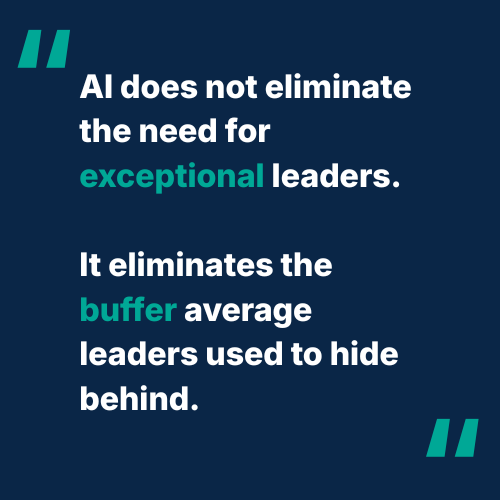
AI does not eliminate the need for exceptional leaders. It eliminates the buffer that average leaders used to hide behind.

The leaders who already operate this way

The executives who can lead a restructured, AI-native organisation already exist. They were forged by a decade of startup conditions: no budget, no playbook, constant change, relentless pressure.

I wrote about this operator profile back in 2022 for Startup Daily, when I predicted the talent market would shift from a supply crisis to a capability crisis. The talent shortage was never really about headcount. It was about finding people who had built under constraint and could do it again at scale.

That profile, someone who runs lean by instinct, context-switches across product and operations, makes irreversible decisions with incomplete information, is now exactly what every restructuring organisation needs.

What this means for founders and CEOs hiring right now

The organisations that thrive in the next decade will not be the ones with the most sophisticated AI stack. Those tools are a commodity. Every competitor has access to the same models, the same infrastructure.

The differentiator is the human who knows how to use it. Who has already built in the conditions that AI restructuring creates. Who does not need a playbook because they wrote the last one themselves.

Finding that person requires a network built inside the ecosystem where they were produced. Not a LinkedIn search filtered by job title.

Read the full piece on Startup Daily →


Hiring the leader who takes your organisation through this shift? Talk to us about your search.

Who leads what's left - AI restructuring.

Last week, 4,000 people at Block were told they no longer had a job. The stock rose 24%. WiseTech Global cut 2,000 roles - nearly a third of its global workforce - as part of a two-year AI restructuring plan. Commonwealth Bank eliminated 300 technology positions the same day. Three AI restructuring announcements. Five days. Three share prices up across the board.

That is today's headline. But the story begins a decade ago, and it starts with a bet I made in 2016 - not on a product or a market, but on a type of person. The founders I was working with in fintech were operating in conditions the rest of the corporate world had not experienced yet. I believed those conditions were coming for everyone. Last week, they arrived.

Why AI layoffs sent three share prices higher

The market is not mourning these cuts. It is rewarding them. That is the fact worth sitting with, and it is the one that most of the coverage has moved past too quickly. In a traditional framing, a company cutting half its workforce is in crisis. Investors flee. The narrative is failure. That is not what happened.

What happened is that investors looked at Block's AI restructuring and concluded the company will be more valuable with fewer, more capable people and a properly deployed AI stack than it was with a larger, more expensive, less leveraged workforce. The cuts were not a symptom of decline. They were the mechanism of transformation. Block CEO Jack Dorsey was unambiguous in his letter to shareholders: 'Intelligence tools have changed what it means to build and run a company. A significantly smaller team, using the tools we're building, can do more and do it better.' WiseTech CEO Zubin Appoo was equally direct: 'The era of manually writing code as the core act of engineering is over.'

These are not euphemisms or careful corporate language. They are executives stating on the record that their previous headcount was a legacy of how organisations used to have to operate, and that AI has made that model obsolete. The market agreed, loudly, both times. Block is not alone and it will not be the last. Every week the number of similar announcements grows, and every week somewhere in a boardroom the same conversation is happening: we need to restructure, we need to go leaner, we need AI to do what teams used to do. What almost nobody is saying in that conversation is what comes after the cuts.

What I predicted about AI and jobs in 2021

I find myself thinking about 3rd March 2021, sitting in front of a camera for Ausbiz TV. The interview was about remote work. The world had just spent twelve months working from home and everyone was trying to figure out whether that was permanent or a blip. The conversation turned to productivity, to AI, to what the jobs market was actually telling us beneath the headline numbers.

I had been doing my own research at the time. Tracking job ad data in fintech, running surveys across our network, talking to founders every week about what they actually needed versus what the market was supplying. The challenge with remote work, I argued, was not technology. The technology worked fine. The challenge was leadership. Leaders were struggling to build and maintain high-performing teams they could not see, and we were starting to see dips not in task completion but in the collaborative moments that produce the ideas nobody plans for.

'We are at the precipice of a quantum shift. Not just in how we work. In the economy. In everything. AI is removing task-based roles. The roles that remain will require a different kind of person. This is happening. Just because you don't see it doesn't mean it's not.'

The interviewer moved on. The segment ended. The world kept going. That was five years ago.

What AI restructuring leaves behind after the cuts

When I started Tier One People in 2016, the Australian fintech ecosystem was young and full of promise that not everyone believed in. The founders I worked with were building companies the incumbents did not take seriously, competing for talent against organisations with resources they did not have, solving problems that had never been solved before in markets that were still being defined. They had no budget, no playbook, and no margin for error.

The people who joined those companies were self-selecting into a formation that a traditional career path cannot replicate. I wrote in 2022 that the expectations placed on fintech employees are closer to elite sport than to corporate banking. In elite sport, players are hired not just for their skills but for their ability to perform under intense pressure. Delivering results without process was the only option because there was no process. Decisions had to be made fast because slow ones were fatal. Running lean was not a strategy; it was the only budget available.

These executives built cultures under pressure, scaled teams mid-flight, restructured while shipping, and did all of it under the scrutiny of investors who expected quarterly proof that the thesis was working. Becoming AI-native was not a priority on a roadmap; it was the only way to compete with organisations ten times their size. That is not a job history. That is a decade of conditions that produced a very specific kind of executive - one who has already lived through what every AI restructuring organisation is now trying to build.

Why the leader above the AI stack is the differentiator

When you eliminate the middle layer, collapse three functions into one, and rebuild your organisation around AI as infrastructure rather than AI as a tool, the people who remain need to operate at a completely different level than the people who left. This is not a technology problem. The AI stack is available to anyone. You can buy it, build it, deploy it. The technology is not the differentiator.

The differentiator is the human sitting at the top of that stack. The executive who can run a leaner, faster, higher-stakes organisation. Who can make irreversible decisions without a committee. Who can context-switch across product, data, operations, and culture without losing momentum. The assessment framework I built in 2016 has not changed: skills plus learning ability plus performance under pressure equals outcomes. The number one predictor of a leader in the AI age is the ability to context-switch. Fintech executives have been doing this ten times a day for a decade.

The current conversation is dominated by two camps. One says AI will take everyone's jobs and the future is bleak. The other says AI is just a tool and humans will always be needed. Both are wrong in the ways that matter to the people making hiring decisions right now. AI does not eliminate the need for exceptional leaders. It eliminates the buffer that average leaders used to hide behind: the layers of process, the large teams, the slow decision cycles that kept organisations running despite mediocre leadership at the top. What remains is a direct line between the quality of the leader and the performance of the organisation. In that environment, the difference between a good hire and a great one is not marginal. It is existential.

What a decade in fintech produced that no other sector did

The organisations that get the AI restructuring right will do so because they solve the talent problem correctly. They will understand that the cuts are the easy part, that a board can make that decision in an afternoon. The hard question is what comes after: who leads an organisation with no redundancy, no process layers, and a direct line between leader quality and organisational performance.

The ones that get it wrong will make the cuts and then hire the same profile they always hired. They will promote the most experienced person in the room rather than the most capable one. They will apply traditional executive search methodology to a talent profile that traditional executive search was never built to find. They will discover, six to twelve months later, that the AI restructuring did not work. Not because the AI was wrong or the numbers were wrong, but because the person at the top of the stack was the wrong person. In a restructured organisation operating with no redundancy, that is a mistake that is potentially fatal.

The executives who built Australia's fastest-scaling fintechs are the most valuable leaders in any sector right now. Not because of their fintech credentials, but because of what those credentials represent. They have already done what every organisation undergoing AI restructuring is now trying to do. Functions collapsed, lean was built, ambiguity was led through without a safety net. Finding them requires a network built inside the environment where they were forged, not a LinkedIn search filtered by job title.

How to hire a leader for an AI-native organisation

1 March 2016. A conviction.

3 March 2021. A prediction.

27 February 2026. A reckoning.

WiseTech. CBA. Block. Share prices up across all three. The market rewarding the AI restructuring. The era of large teams as a proxy for value officially over.

I did not build Tier One People to be right about a prediction. I built it because I believed, and still believe, that finding the right person for the right role at the right moment is the highest-leverage decision any organisation makes. The conditions that forged the operators in my network were brutal and clarifying in equal measure: no budget, no playbook, constant change, relentless pressure, results or nothing. Those conditions are now the operating reality for every organisation serious about competing in what comes next.

Those people are ready. They have been ready for a decade. The question is whether the organisations that need them are ready to find them. I have spent ten years building for this moment. It is here.

Dexter Cousins is the founder of Tier One People, Australia's leading executive search firm for fintech. Since. He has completed 200+ executive placements and hosts Fintech Chatter, Australia's leading fintech podcast with 350+ episodes and 30,000 monthly listeners across 40 countries.

If you are restructuring and facing the question of who leads what's left, that is the question Tier One People was built to answer.

Request a confidential briefing

Checkbox AI CEO Evan Wong: How to Build Enterprise Software That Scales

How Checkbox AI CEO Evan Wong Built a $100M Legal AI Company in 9 Years

Checkbox AI CEO Evan Wong just closed a $23 million Series A at a $100 million valuation. The journey from bootstrapped startup to serving over 100 enterprise organizations—including SAP, PepsiCo, Telstra, and Woolworths—took nine years, three funding rounds, and a strategic pivot that changed everything.

On this week's Fintech Chatter podcast, Evan shared the lessons learned building Checkbox AI from stealth mode to becoming the "AI Legal Front Door" for Fortune 500 companies.

The Strategic Pivot: From Multi-Sector to Legal AI

When Checkbox AI launched in 2016, the vision was broad: a no-code platform that could automate workflows across any business function—legal, HR, compliance, procurement.

The product worked. Early customers found value. But scale remained elusive.

"At some point, we made the decision to go from being a platform that could serve multiple functions to focusing purely on legal," Evan explained. "That's not easy—you're essentially choosing to walk away from potential customers and revenue."

The pivot unlocked growth. By positioning Checkbox as the AI Legal Front Door for enterprise, the company found product-market fit with in-house legal teams struggling to manage increasing volumes of requests from business units.

Today, at Hitachi, 83% of routine legal and compliance requests are partially or fully automated through Checkbox's platform—freeing legal teams to focus on high-value, strategic work.

Building for Enterprise From Day One

Most SaaS companies start mid-market and struggle to move upmarket. Checkbox AI took the opposite approach, targeting enterprise customers from the beginning.

"We dealt with the pain upfront," Evan said. "Had to do SOC 2 early. Had to build robust features for enterprise at the get-go."

The strategy paid off. Today, Checkbox's average sales cycle for Fortune 500 companies is approximately three months for six-figure USD deals.

But building for enterprise requires discipline around product development. With large customers comes the temptation to build what they ask for—not necessarily what the broader market needs.

"Take everything from a customer as a data point, not as an instruction," Evan advised. "Customers are experts in the problem. You're the expert in the solution."

The $23M Series A: Touring Capital, Peak XV, and Strategic Angels

Checkbox AI's Series A round was led by Touring Capital, with participation from existing investors Peak XV (formerly Sequoia Capital India) and Tidal Ventures, plus new investors Conductive Ventures and Five V Capital.

The round also included Jerry Ting, VP and Head of Agentic AI at Workday, who was formerly Co-Founder and CEO of legal AI company Evisort.

The capital validates Checkbox's approach to legal AI: rather than building standalone chatbots, Checkbox embeds AI agents directly into enterprise workflows—email, Slack, Microsoft Teams, Salesforce, and intranet portals.

"As more legal work becomes AI-assisted, the winners will be the platforms that can route requests intelligently, integrate across the legal tech stack, and turn institutional knowledge into scalable workflows," said Evan Wijaya, Principal at Touring Capital.

Competing in a Market with $5B+ Valuations

Legal AI is attracting massive capital. Harvey raised at a $5 billion valuation. EvenUp hit $1 billion. How does Checkbox compete?

"It's actually a good sign," Evan said. "Higher tides raise all boats. There are billions of dollars in productivity to be unlocked in legal."

Checkbox differentiates through its focus on workflow orchestration and enterprise integration rather than broad AI assistants. The company was named in Gartner's 2025 Hype Cycle for Legal Tech as category-defining infrastructure.

The Nine-Year Journey: Bootstrapping to Series A

From founding in 2016 to Series A in 2026, Checkbox raised only $6 million USD before this latest round, remarkably efficient for a company generating eight figures in annual recurring revenue.

The timeline included:

- 2016-2018: Bootstrapped in stealth mode, founders not drawing salaries

- 2018: $1.77M angel round

- 2022: $6.3M pre-Series A led by Sequoia India's Surge and Tidal Ventures

- 2026: $23M Series A at $100M valuation

"Australian companies are really good at building with a frugal mindset," Evan noted. "Coming to the US, investors are always impressed with how efficient we are."

Building with AI-First Mindset

As Checkbox scales from 75 to 100+ employees, the company is embedding AI-first thinking throughout the organization.

"Do you first jump to hire someone when you need bandwidth, or do you consider what AI tools can give you leverage?" Evan asked. "That order of operation in your brain—that's the mindset we're building."

AI proficiency is now a hiring criterion. Every team member is expected to leverage AI tools to increase their output and impact.

"There's companies like Cursor who have gone to really big scales of revenue with very lean teams," Evan said. "The tools are there now. It's about leveraging them."

Lessons for Enterprise Software Founders

On Product-Market Fit

"People think achieving product-market fit is a moment in time. But there's a key word—market. And markets change constantly. You have to keep chasing it."

On Customer Development

"Customers often explain what they want in solution form, but they're not the solution experts. You're the solution expert. The customer is the expert in the problem."

On Strategic Focus

"Who are NOT your customers is just as important as who ARE your customers. That gives you clarity in who you want to build for."

On The Long Game

"Most startups either scale much faster or they die. We sustained the business through a longer timeline by building efficiently and staying focused on enterprise customers who could deliver meaningful contract values."

What's Next for Checkbox AI

The Series A capital will fund two primary areas:

1. Engineering, product, and design: Expanding the team primarily based in Sydney, Australia

2. Go-to-market: Scaling sales and marketing to compete globally

"We want to become the cornerstone technology for enterprise legal teams," Evan said. "You wouldn't start a sales team without Salesforce. You shouldn't start a legal team without Checkbox."

Hiring Enterprise Software Leaders?

At Tier One People, we specialize in placing executives who can scale enterprise software companies from Series A to market leadership. 

Whether you need a Chief Revenue Officer who understands enterprise sales cycles, a VP of Product who can balance customer demands with strategic vision, or engineering leaders who can build for scale we connect you with the 1% who define what's possible.

Contact Dexter Cousins: Contact

About Evan Wong

Evan Wong is Co-Founder and CEO of Checkbox AI. A serial entrepreneur who founded Hero Education at age 17, Evan has built Checkbox from a bootstrapped Sydney startup into a legal AI platform serving 100+ organizations including Fortune 500 companies. Named to Forbes 30 Under 30 in 2019, Evan recently closed a $23 million Series A at a $100 million valuation.

About Fintech Chatter

Fintech Chatter is Australia's leading fintech podcast with 350+ episodes reaching 30,000+ fintech professionals in 40 countries monthly. Hosted by Dexter Cousins, the show features conversations with fintech CEOs and founders about how they're building category-defining companies.

Watch the full conversation:YouTube link

Build Your Professional Brand Using First Principles

Last week, you built your Career Balance Sheet. You listed every problem you've solved. You put real numbers on your impact.

Maybe you automated processes and saved $1.5M. Maybe you closed a deal worth $20M in ARR. Maybe you cut sales cycles from 6 months to 8 weeks.

But here's the first principles question: What's the fundamental truth underneath all those achievements?

Strip away the job titles. Strip away the company names. Strip away the activities.

What's left is your pattern. Your superpower. Your professional brand.

Not a vague statement like "I'm a strategic leader." A precise statement built from fundamental truths that makes someone say "I need that person right now."


Breaking Your Career Down to First Principles

Look at your Career Balance Sheet. All your achievements are there. Now look for the pattern.

What's the thread that runs through everything you've done?

Let me show you with real examples.

The CFO who raised Series A ($5M), Series B ($15M), Series C ($40M), and took the company public ($200M valuation).

Pattern: Takes companies from early stage funding to IPO.

Professional brand: "I'm the CFO who takes companies from seed to IPO."

The CRO who joined at $2M ARR, built the sales team from 3 to 15 people, and left at $22M ARR.

Pattern: Scales revenue in the $2M to $20M range.

Professional brand: "I'm the CRO who scales revenue from $2M to $20M ARR."

The Product Leader who inherited a feature with 15% adoption, rebuilt the feedback loop, redesigned onboarding, and hit 82% adoption.

Pattern: Makes products people actually use.

Professional brand: "I'm the Product Leader who took feature adoption from 15% to 82%."

See the pattern in these patterns?

Each one has three elements:

  1. Your role - CFO, CRO, Product Leader
  2. Specific numbers - Seed to IPO, $2M to $20M, 15% to 82%
  3. The outcome - What actually happened

Not activities. Not responsibilities. Outcomes.


How to Test Your Professional Brand Statement

Now you need to know if your brand actually resonates.

Think of it like a doctor testing a diagnosis. You have a hypothesis. You run tests. You see if you're right.

Create three variations of your brand statement. Test them.

Update your LinkedIn headline with Version A. Give it two weeks. Track profile views, connection requests, InMail messages.

Switch to Version B. Another two weeks. Compare the numbers.

Test in real conversations. When someone asks what you do, use your brand statement. Watch their reaction.

Do they lean in and ask questions? That's resonance.

Do they nod politely and change the subject? That's not working.

After 4-6 weeks, you'll have data. One version will clearly outperform. That's your signal. That's what the market wants.


Finding Companies That Need Your Exact Capability

Your professional brand tells you exactly who to target.

"I'm the CFO who takes companies from seed to IPO" → Target companies that just raised Series B or C. They'll need IPO prep in 18-24 months.

"I'm the CRO who scales revenue from $2M to $20M ARR" → Target companies currently at $2M to $5M ARR who just raised Series A.

"I'm the Compliance Head who gets startups their license" → Target pre-license companies that just raised funding.

You're not searching "fintech jobs."

You're searching for companies at the exact stage where they need your exact capability.


Building Your Problem Portfolio: 10-15 Target Companies

Create a hit list of 10-15 companies you've researched deeply. For each one, track:

  1. Evidence they need you - Funding stage, LinkedIn posts, job listings
  2. Specific pain points - What they're struggling with right now
  3. Your solution - Straight from your Career Balance Sheet
  4. Your entry point - Who you know, how to reach them

Not 200 random applications. 10-15 companies where you've done your homework.

This is precision targeting, not spray and pray.


What Quantified Professional Brands Actually Look Like

Before: "Hi, I'm applying for your CFO role. I have 15 years of finance experience. I'm detail-oriented and a strong communicator."

After: "Hi, I noticed you just closed your $40M Series C with Sequoia. Based on their portfolio pattern, you're likely 18-24 months from IPO conversations. I'm the CFO who's taken three companies through that exact journey. The biggest challenge is always audit readiness 12 months before filing. I'd like to discuss what you're seeing."

Which one gets a response?

The second one shows you understand their business. You've done your homework. You're not applying - you're offering to solve a specific problem they have right now.

That's the difference between 1% response rates and 60% response rates.


Your Next Step: From Balance Sheet to Professional Brand

You have your Career Balance Sheet. Now turn it into your professional brand.

Extract the pattern. Write it as one quantified sentence. Test it. Find companies who need exactly what you do.

Then reach out with precision, not desperation.

Listen to the full episode of Finding Your Next Role in Fintech for the complete framework, testing methodology, and research strategies.

Episode 1 - The Career Balance Sheet framework

Episode 3 - How to use professional networks

Download the Professional Brand Worksheet and Problem Portfolio template to build your brand and target list.


Building a fintech leadership team?

Revolut Australia CEO Matt Baxby Interview: 1M Customers

Revolut Australia CEO Matt Baxby: From 3 Employees to 1 Million Customers and Profitability.

Revolut Australia CEO Matt Baxby has done what most Australian neobanks couldn't: reach 1 million customers and profitability. Six years after soft-launching with three employees during a global pandemic, the Revolut Australia CEO sits down with Dexter Cousins on Fintech Chatter to discuss the journey from travel FX startup to 30-product super app, the $250 million saved for Australians, and the ambition to become the country's number one finance app. More importantly, Matt Baxby reveals the hiring philosophy and culture that made it all possible.

This interview was recorded on 4 February 2026.

How Revolut Australia Reached 1 Million Customers and saved them $250M

Dexter Cousins: Matt, congratulations on a massive milestone. Let's start with the big news: Revolut Australia has just hit 1 million customers. Take us through what that means.

Matt Baxby: Thanks, Dexter. Yeah, we crossed 1 million customers at the end of January, which is a really proud moment for the team. But what's more meaningful to me is that we've saved Australians close to $250 million in FX fees compared to what the major banks charge. That demonstrates there's a real need for what we're offering in this market. When you can put that kind of money back in people's pockets, you know you're solving genuine problems.

DC: The awareness is certainly building. People are starting to understand there are alternatives to those airport FX desks, and Revolut is at the front of that pack. But you've evolved well beyond just travel money, haven't you? You're now offering 30 plus products.

MB: Absolutely. When we launched six years ago, the proposition was simple: bring together disparate financial solutions into one app. Things like overseas money transfer, bill splitting, peer-to-peer transfers. One of the key features from those early days that's still incredibly popular is the ability to transfer any currency directly to another Revolut customer in a different market. No friction, no cost, no waiting around for three days. That was the hook.

But you're right: we've expanded significantly. Today we're a modular platform. There's no set use case for our customers. Some people use us primarily for travel, others for everyday spending, some for investing in crypto or US shares. We build based on what customers tell us they need solved.

DC: That's interesting because as a Gen Xer maybe it's my eyes going, but the app is getting more complex to navigate with all those features. Is product proliferation becoming a challenge?

MB: [Laughs] Fair observation. Look, we're very aware of that, and it's something we're constantly working on. But I'd rather have that problem than the alternative: being too narrow in what we offer. The development continues to be driven by customer feedback. If enough customers are telling us they need something, we'll build it. That customer-first approach has been core to our success.

And here's the thing that keeps me confident we're on the right track: word-of-mouth referrals still represent a large proportion of our new customer acquisition. That's the highest compliment we can receive. When customers are actively recommending us to friends and family despite the complexity, it tells me we're delivering real value.


Revolut Business Australia: 235% Growth in Transaction Volumes

DC: Let's talk about Revolut Business. Small businesses are the backbone of the Australian economy, but they often feel overlooked by the major banks and even by many fintechs. What's happening there?

MB: Revolut Business has been incredible since we launched it in 2023. We've seen 235% growth in transaction volumes over just the last 12 months. The opportunity is massive because you're right: small businesses have been underserved for years.

The really exciting development is our new merchant acquiring product. We've just launched physical terminals and payment gateways through "Revolut Pay." What makes this powerful is we have a double-sided marketplace: a large consumer base who already have Revolut on their phones, and a rapidly growing small business base. When you can connect both sides, you create real network effects.

How Revolut Australia Succeeded Where Other Neobanks Failed

DC: That's a significant expansion beyond your core FX and payments business. Speaking of expansion, where are you with the APRA banking licence?

MB: The process is ongoing, and it remains very important to us. A banking licence enables services like interest-bearing savings accounts and broader credit products. It also provides government guarantees on deposits, which builds customer trust and gives us access to more sustainable long-term funding.

But here's what's critical: the lack of a licence hasn't constrained our product delivery or business growth. We've been very deliberate about that. We've continued shipping products, growing customers, and most importantly, we reached profitability in 2024. That's a very different path from other neobanks in Australia.

DC: Indeed. Most of the local neobanks either failed or were acquired before reaching profitability. What did Revolut do differently?

MB: Our strategy was fundamentally different from day one. We established a strong foothold in payments and foreign exchange first: areas where we could demonstrate clear value and actually make money. Then we expanded the product offering from that profitable base.

A lot of other neobanks tried to be full-service banks from the start, which meant massive infrastructure investment before they had meaningful revenue. They were burning capital trying to replicate everything the Big Four do, just with a better app interface. That's incredibly capital intensive and the unit economics don't work until you have massive scale.

We took a different approach. Build what customers need, prove the economics work, then expand. Stay lean, stay focused, stay profitable.


COVID-19 Pivot: How the Revolut Australia CEO Adapted in 2020

DC: Let's go back to the beginning. You joined Revolut in February 2020 as the first Australia CEO. You started with three people, then literally one month later, COVID hit and the world went into lockdown. What was going through your mind?

MB: [Laughs] Honestly? It was a significant inflection point, to put it mildly. Here we were with a travel-oriented FX proposition, and borders just… closed. Completely. For what ended up being over a year in Australia.

But looking back now, I'd say it was the best thing that could have happened to us. It forced us to think much more broadly and pivot into new opportunities immediately. We accelerated our plans for US share trading, we introduced cryptocurrency exposure, we focused on international e-commerce. All the things that didn't require getting on a plane.

That agility, that bias to action, is core to Revolut's culture. Our founders backed us to make those pivots quickly. We didn't spend six months doing market research and business cases. We identified the opportunity, built the product, shipped it, learned from it. That's how we survived and then thrived despite the pandemic.

Revolut Australia's Remote Work Culture: 100 Employees, Work From Anywhere

DC: You mentioned culture, and I want to dig into that because you've built teams at Virgin under Richard Branson, at Bank of Queensland, and now at Revolut. How do those experiences compare?

MB: They're all very different cultures, but there are principles I've carried through. At Virgin, I learned the power of entrepreneurialism and brand: what it means to genuinely put customers first and challenge incumbents. At BOQ, I learned the discipline of running a bank, dealing with regulators, managing risk at scale.

What I've adapted for Revolut is being very specific about what type of people succeed here. We're rigorous about hiring problem solvers: people who can think critically and exhibit a strong bias to action. We assess that through interview scenarios, not just by asking people to talk about their CV.

DC: Your recruitment process has a reputation for being thorough. And you're doing all of this with a "work from anywhere" policy, which is quite different from the banking norm.

MB: The remote working policy works because of the discipline and mindset of the people we hire. We have high expectations for performance, ambitious quarterly KPIs, and structured measurement. There's a misconception that you need people in an office to have performance oversight. What you actually need is clarity on objectives, rigorous measurement, and people who are self-motivated.

If you've hired properly — true problem solvers with a bias to action — it doesn't matter if they're working from a Sydney office or a beach in Byron Bay. They'll deliver. If you haven't hired properly, having them in an office won't fix that.

DC: You now have 100 people in Australia. When you're hiring, what are the absolute non-negotiables?

MB: Problem-solving ability and cultural fit around action. I'd rather have someone who can think critically, move fast, and figure things out than someone with a perfect CV who needs to be told exactly what to do.

We're also looking for people who are comfortable with ambiguity. Revolut is a founder-led organisation. Nick, our founder, sets ambitious goals without caveats. His goal for us is to be the number one app in the finance category in Australia. Not "number one neobank" or "number one among challengers." Number one, full stop. You need people who find that energising, not terrifying.


Revolut Australia CEO on Taking On the Big Four Banks

DC: That's quite an ambition when you're competing against the Big Four banks who control 80% of the market. After six years and 1 million customers, how's that battle going?

MB: We're bringing genuine competition to a market that's needed it for years. The Big Four have had it pretty comfortable: wide margins, suboptimal user experiences, business models built on customer apathy. We're changing that equation.

What's surprised me is how quickly Australians have embraced an alternative once they try it. The word-of-mouth growth I mentioned earlier: that's people voting with their wallets and their recommendations. That doesn't happen if you're just marginally better. It happens when you're delivering something genuinely different.

Are we number one yet? No. But every customer we win, every dollar we save them, every feature we ship: we're getting closer. And unlike some of our competitors who've fallen by the wayside, we're profitable and sustainable. We're in this for the long term.

DC: Looking forward, what's the vision for the next 3 to 5 years?

MB: All our actions, whether it's our F1 sponsorship, our product development, our marketing, are focused on that number one goal. We want to be the app Australians open every day to manage their money. All their money. Spending, saving, investing, borrowing.

We'll continue expanding our product suite based on customer needs. The banking licence, when it comes through, will unlock more capabilities. We'll keep investing in making the experience better, more intuitive, more valuable.

But fundamentally, it's about meeting Aussie consumer needs better than anyone else. That's been our mission from day one, and it won't change.

Revolut Australia Careers: How to Join the Team

DC: For people interested in joining this journey, where should they look?

MB: Head to revolut.com and check out our careers page. We've got live roles across product, engineering, operations, commercial, compliance: pretty much every function you'd expect. If you're someone who loves solving problems, moving fast, and making an impact, we'd love to hear from you.

DC: Matt, congratulations again on the milestone. It's been an incredible journey to watch, and I'm proud that Tier One People could play a part in it six years ago.

MB: Thanks, Dexter. And thanks to you and the Tier One People team. We couldn't have done it without finding the right people, and that partnership has been crucial to our success.


Revolut Australia has 1 million customers and 100 employees nationwide. The company is certified as a Great Place to Work in Australia and is actively hiring. For more information, visit revolut.com.

About Tier One People

Tier One People is Australia's leading fintech executive search firm. Six years ago, Tier One People placed Matt Baxby as Revolut Australia's founding CEO - a placement that has delivered 1 million customers, $250 million in savings for Australians, and a profitable, sustainable fintech business.

That's what happens when you find the 1% who define what's possible.If you're building a fintech team or looking for your next role in fintech, visit tieronepeople.com or connect with Dexter Cousins on LinkedIn.

Inside Revolut's Growth Strategy With CEO Matt Baxby

Revolut Australia CEO Matt Baxby just crossed a milestone that most Australian neobanks never reached: 1 million customers and profitability. In the latest Fintech Chatter episode, the Revolut Australia CEO breaks down how they went from three employees in February 2020 to 100 employees, $250 million saved for Australians, and $4.4 million in profit while revenue grew 163%. More importantly, Matt Baxby reveals the hiring philosophy and cultural decisions that made it possible.

How Revolut Australia Reached 1 Million Customers: The Numbers

Revolut Australia's recent results tell a story most Australian fintech founders wish they could tell:

While competitors like 86 400, Xinja, and Volt either failed or were acquired before reaching profitability, Revolut cracked the code on sustainable fintech growth in one of the world's most concentrated banking markets.

Revolut Australia's Profitable Growth Strategy: Revenue First, Scale Second

The difference between Revolut's success and the failures of other Australian neobanks comes down to strategy. Matt explains: "Our strategy was fundamentally different from day one. We established a strong foothold in payments and foreign exchange first: areas where we could demonstrate clear value and actually make money. Then we expanded the product offering from that profitable base."

Most Australian challengers tried to replicate everything the Big Four banks do from day one—massive infrastructure investment before meaningful revenue. "That's incredibly capital intensive and the unit economics don't work until you have massive scale," Matt notes.

Revolut took the opposite approach: build profitable foundations, prove the model works, then scale. The result speaks for itself.

Matt Baxby's Hiring Philosophy: Problem Solvers Over Perfect CVs

Six years and 100 hires later, Matt has refined Revolut's hiring philosophy to a sharp edge: problem-solving ability beats credentials every time.

"We're rigorous about hiring problem solvers: people who can think critically and exhibit a strong bias to action. We assess that through interview scenarios, not just by asking people to talk about their CV."

The non-negotiables are clear: "I'd rather have someone who can think critically, move fast, and figure things out than someone with a perfect CV who needs to be told exactly what to do. We're also looking for people who are comfortable with ambiguity."

This matters because Revolut operates on quarterly cycles, shipping features in months that traditional banks take years to deliver. Finding people who thrive in that environment requires testing for real problem-solving ability, not just impressive previous employers.

It's a hiring philosophy shaped by Matt's unique background: 10 years under Richard Branson at Virgin Group learning entrepreneurial culture, plus 7 years at Bank of Queensland as retail banking chief and CFO mastering banking discipline and regulatory compliance.

"At Virgin, I learned what it means to genuinely put customers first and challenge incumbents. At BOQ, I learned the discipline of running a bank, dealing with regulators, managing risk at scale." That combination became Revolut Australia's DNA.

Revolut Australia's Remote Work Culture: 100 Employees, Zero Office

Revolut Australia built all 100 employees on a "work from anywhere" policy, radical in an industry where physical presence has been seen as essential for oversight and culture.

Matt's logic is straightforward: "The remote working policy works because of the discipline and mindset of the people we hire. We have high expectations for performance, ambitious quarterly KPIs, and structured measurement. There's a misconception that you need people in an office to have performance oversight. What you actually need is clarity on objectives, rigorous measurement, and people who are self-motivated."

If you've hired true problem solvers with bias to action, location becomes irrelevant. "If you've hired properly, it doesn't matter if they're working from a Sydney office or a beach in Byron Bay. They'll deliver. If you haven't hired properly, having them in an office won't fix that."

This approach requires extraordinary discipline in the hiring process. Every person must be someone who can work autonomously, set priorities within broader company objectives, and deliver without constant supervision.

Founder-Led Ambition: Revolut Australia's Culture Strategy

Revolut is founder-led, and that shapes everything about the culture. Founder and CEO Nik Storonsky sets ambitious goals without caveats: "His goal for us is to be the number one app in the finance category in Australia. Not 'number one neobank' or 'number one among challengers.' Number one, full stop."

That level of ambition requires a specific type of person. "You need people who find that energising, not terrifying," Matt explains.

It's a useful filter in the hiring process. Some candidates hear that ambition and see an exciting challenge. Others hear unrealistic expectations that will lead to burnout. Revolut wants the former.

Revolut Business Australia: 235% Growth Year-on-Year

While consumer banking gets the headlines, Revolut Business has quietly become a growth engine. Transaction volumes grew 235% year-on-year, and in 2026 Revolut launched Australia's first 360-degree merchant acquiring platform.

"The opportunity is massive because small businesses have been underserved for years," Matt notes. The power comes from having both sides of the marketplace: a large consumer base with Revolut on their phones, and a rapidly growing small business base. "When you can connect both sides, you create real network effects."

It's another example of Revolut's strategy: find underserved segments, build profitable solutions, scale from there.

What Revolut Australia's Success Means for Australian Fintech

Revolut Australia's success proves a few critical lessons for fintech founders and talent:

Revenue before infrastructure. Don't try to replicate everything incumbents do from day one. Find your profitable wedge, prove it works, then expand.

Hire for problem-solving, not pedigree. Credentials from brand-name institutions don't predict success in fast-moving fintech environments. Critical thinking and bias to action do.

Remote work succeeds with the right people. Location independence works when you hire self-motivated problem solvers and create clarity around objectives and measurement.

Founder ambition attracts the right talent. Unreasonably high goals filter for people who find big challenges energising rather than terrifying.

Speed beats perfection. Quarterly execution cycles and rapid pivots beat multi-year planning in fast-moving markets.

Revolut Australia's Vision: Becoming Australia's Number One Finance App

As Revolut continues toward becoming Australia's number one finance app, the hiring discipline that got them from 3 to 100 employees will be tested as they scale further. But with proven processes, clear culture, and strong partnerships, they've built a foundation that can support that ambition.

"All our actions, whether it's our F1 sponsorship, our product development, our marketing, are focused on that number one goal," Matt says. "We want to be the app Australians open every day to manage their money. All their money."

Six years ago, Tier One People placed Matt Baxby as Revolut's founding Australia CEO. Today, that placement has delivered 1 million customers, $250 million in savings for Australians, and a profitable, sustainable fintech business.

That's what happens when you find the 1% who define what's possible.


Watch the Full Episode

Building a fintech team that can compete with billion-dollar incumbents? The right founding leader changes everything. Visit tieronepeople.com or connect with Dexter Cousins on LinkedIn.

How to use professional networks for job hunting.

Stop Networking Like Everyone Else (The 95-5 Principle)

Most people treat networking like fitness. They lie on the sofa for three years eating chips and drinking beers, watching sport instead of playing it. Then they wake up one day, realize they've gained 20kg professionally, and can't climb the career stairs anymore.

Sound familiar?

You go three years without talking to anyone in your network. Then you panic. Coffee meetings everywhere. LinkedIn messages flying. Desperate energy everywhere.

Here's the problem: You wouldn't train for a marathon by doing nothing for three years, then running 100km the week before the race. Your network works the same way.

The 95-5 Principle

When I launched Tier One People 10 years ago, I had 5,000 contacts in my database. Most people would email all 5,000. Spray and pray.

I did something different.

I filtered that list down to 98 people using a specific method. That was my critical 5%.

Those 98 people generated over 95% of my business results in the first year.

Here's the truth: 95% of your results will come from 5% of your network.

Not 10%. Not 20%. Five percent.

How to Find Your Critical 5%

Break your network into three tiers:

Tier 1: Former bosses and colleagues who are now in hiring positions. People who know what it's like to work with you and can now make hiring decisions.

Tier 2: People with massive networks. Clients, law firm partners, investors, VCs, board members. People whose job is knowing other people.

Tier 3: Everyone else.

Your critical 5% is Tier 1 plus Tier 2. That's your focus.

The Message That Actually Works

Here's what everyone else writes:

"Hi X, how are you? Not sure if you heard but I was made redundant the other day. I'm on the market and I've attached my CV. Would love to catch up for a coffee, my shout."

See the problem? You're leading with your need. You're asking for too much. And you're valuing their time at the price of a flat white.

Here's what works:

"I'm thinking about a few possible career paths and as someone I highly rate and whose opinion I trust, I wondered if you had two minutes to chat. I know you won't sugarcoat things."

Two minutes. Not coffee. Not lunch. Not a job.

Two minutes is incredibly hard to say no to.

The Psychology That Makes It Work

When you ask people for two minutes, they ask you for coffee.

When you ask them for their honest opinion, they give it. I've never met a single person who didn't enjoy telling me what they really thought.

But here's where the magic happens:

As soon as someone says "I think you should do X," they feel responsible for helping you do it. And they follow up with "Let me introduce you to Y."

Now you get another meeting with an influential person who could hire you. And you arrive pre-endorsed.

This is the compound effect. One conversation generates 1-2 warm introductions. Those introductions generate more conversations. Those conversations generate opportunities.

When I sent my two-minute message to 98 people, I had 60 meetings confirmed within 3 days. That's a 61% response rate.

Not because I'm special. Because the message made it easy to say yes. And because I focused on my critical 5%.

The Trust Shortcut

Years ago, I watched a sales rep push past me at a networking event and try to force his business card on a CEO. She calmly put her hands behind her back and said:

"You don't need to give me that. What you need to do is get someone I know and trust to give it to me."

That taught me everything about networking.

Stop trying to build trust from scratch with cold emails and forced connections. That takes months or years.

Instead, leverage the relationships you already have. When your former boss introduces you to their colleague, you don't start at zero. You start at 50%. You borrow their trust, their credibility, their relationship capital.

That's why warm introductions are 10 times more powerful than cold outreach.

Start Today

Your critical 5% might be 10 people. It might be 50. It might be 200. The number doesn't matter.

What matters is this: Stop trying to network with everyone. Start identifying your critical 5%.

Better contacts beat more contacts every single time.


Listen to the full episode for the complete T1/T2/T3 framework, exact email templates, and the two-minute call structure that turns conversations into opportunities.

Download the Network Activation Worksheet with email templates, conversation scripts, and tracking tools.


Fintech Jobs: And How To Find Them.

Finding Your Next Role in Fintech - Episode 1

If you're struggling to land a job in fintech here in Australia, you're probably approaching it the wrong way.

Most people searching for fintech jobs treat the hiring process like they're applying for permission to work. They craft the perfect resume, polish their LinkedIn profile, and hope someone notices them among hundreds of other applicants. But here's the uncomfortable truth: in today's competitive fintech job market where candidates need an average of 294 applications to secure employment, being "qualified" isn't enough anymore.

It's time to stop looking for happiness and start solving problems.

The Career Balance Sheet Framework for Fintech Jobs

In Episode 1 of our new video series, Finding Your Next Role in Fintech, we introduce a framework that flips the traditional fintech job search on its head: the Career Balance Sheet.

Just like a company's balance sheet shows assets and liabilities, your Career Balance Sheet demonstrates the tangible value you've created throughout your career. But instead of listing job duties and responsibilities, you're documenting concrete problems you've solved and quantifying the value you've delivered.

This isn't about exaggeration or spin. It's about recognising that every role you've held, every project you've completed, and every challenge you've overcome has created measurable value for someone. Your job is to articulate it clearly.

Why This Changes Everything When Applying for roles in Fintech

When you position yourself as a problem-solver rather than just another applicant in the fintech jobs market, three things happen:

  1. You stand out immediately. While other candidates applying for fintech jobs are saying "I have 5 years of experience in payments," you're saying "I reduced payment processing failures by 40%, saving $1.2M annually."
  2. You speak the language of business. Fintech executives don't hire people for credentials, they hire solutions to their problems. When you demonstrate that you understand their challenges and have solved similar ones before, you're no longer competing on qualifications alone in the fintech job market.
  3. You build confidence. Searching for fintech jobs can be demoralising, especially when you're facing rejection after rejection. But when you take inventory of the real value you've created, you remember what you're capable of and that confidence shows up in every interview.

Real Examples of Career Balance Sheets for Fintech Roles

In the episode, we walk through four detailed examples across different fintech roles. These real-world scenarios show how professionals in various fintech jobs have documented their value:

The AI Implementation (Risk & Compliance)

The Regulatory Framework (Compliance Leadership)

The Strategic Sale (Business Development)

The Product Acceleration (Operations/Product)

Each example demonstrates a simple but powerful formula: Problem + Solution + Quantified Value = Your Competitive Advantage

Types of Fintech Jobs This Framework Works For

This Career Balance Sheet approach works across all fintech jobs, including:

No matter what type of fintech job you're pursuing, documenting your value creation is what sets you apart from other candidates.

Building Your Own Career Balance Sheet

Ready to document your value? We've created a free Career Balance Sheet worksheet to guide you through the process.

The worksheet helps you:

Download the Career Balance Sheet Worksheet (Free PDF)

Why This Matters for Fintech Jobs in 2025

In 2025, fintech jobs in Australia have become more competitive than ever. With sustained economic pressures and increased application volumes, standing out in the fintech job market requires more than just qualifications, it requires proof of how much value you create.

The candidates getting hired aren't necessarily the most experienced. They're the ones who can clearly articulate the problems they solve and the value they create. This approach gives you a competitive edge.

Understanding what fintech employers are really looking for (problem-solvers who can demonstrate measurable impact) is the key to landing your next fintech role.

Watch the Full Episode

This blog post only scratches the surface of what we cover in Episode 1. In the full video, we walk through:


About This Series

Finding Your Next Role in Fintech is a 5-part video series that applies business methodologies like first principles thinking, lean startup, design thinking, enterprise software sales frameworks and go-to-market strategies to your Fintech Job Search. Whether you're pursuing permanent roles or exploring fractional opportunities, this series will transform how you approach the fintech job market.

Coming Soon:


Looking for Fintech Jobs in Australia?

At Tier One People, we specialise in connecting exceptional fintech talent with financial technology companies across Australia and globally. Whether you're searching for fintech jobs in risk management, compliance, payments, lending, or business development, we understand what employers are looking for.

If you're ready to position yourself as a problem-solver rather than just another applicant in the fintech job market, we'd love to connect.

Explore Fintech Jobs | Subscribe to Our Newsletter


Dexter Cousins is Managing Director of Tier One People and host of the Fintech Chatter Podcast. With over 25 years in recruitment, he works at the intersection of AI and fintech, helping shape Australia's position in the global fintech ecosystem.


Frequently Asked Questions About Fintech Jobs

How hard is it to find a job in Fintech in Australia right now?
Fintech jobs in Australia are highly competitive in 2024-2025, with candidates needing an average of 37 applications to secure employment. The market has seen increased application volumes due to economic pressures, making it essential to differentiate yourself through proven value creation rather than just qualifications.

What skills do employers look for in fintech jobs?
Fintech employers prioritise problem-solving abilities and measurable business impact over credentials alone. They look for candidates who can demonstrate how they've created value through cost savings, revenue generation, risk mitigation, or process improvements in previous roles.

How can I stand out when applying for fintech jobs?
Use the Career Balance Sheet framework to document specific problems you've solved and quantify the value you've created. Instead of listing job duties, show concrete results like "reduced compliance processing time by 85%" or "generated $20M in new ARR."

Are there remote fintech jobs available in Australia?
Yes, many fintech companies across Australia now offer remote and hybrid fintech jobs, especially in technology, compliance, and business development roles. The Career Balance Sheet approach works equally well for remote fintech positions.

What types of fintech jobs are most in-demand?
Currently, high-demand fintech jobs in Australia include compliance and risk management specialists, AI/ML engineers, payments specialists, business development professionals, and product managers with fintech experience.

Dan Jowett - OpenMarkets Group

Where Defi Meets Tradfi

In this episode of Fintech Chatter, host Dexter Cousins speaks with Dan Jowett, CEO of OpenMarkets Group, about the rapid convergence of Tradfi and DeFi

About This Episode

Tune in as Dan and Dexter discuss how OpenMarkets has transformed from a traditional stockbroker to a technology-focused fintech, the regulatory hurdles facing the crypto industry, and the future of equities trading in a rapidly changing environment.

Chapters

00:00 Introduction to OpenMarkets and Fintech Landscape
02:26 Evolution of OpenMarkets: From Stockbroker to Tech Innovator
06:08 Navigating the Future: DeFi and Traditional Finance
11:45 Regulatory Challenges and Opportunities in Digital Assets
15:37 Building a Strong Culture at OpenMarkets
18:47 Navigating Market Changes in Fintech
21:07 Lessons from Leadership During Challenging Times
23:22 The Importance of Networking and Global Perspectives
24:26 The Future of DeFi and Regulatory Challenges
27:24 Cultivating a Positive Workplace Culture
30:59 Finding the Right Fit in a Dynamic Environment

About OpenMarkets Group

Power your Fintech, Advisory, or Trading business with an end-to-end Wealth Management and Trading solutions. 

Openmarkets empowers financial institutions and advisers to deliver a seamless investment experience to their clients. They provide a comprehensive suite of trading, clearing and settlement, custody, and technology solutions that enable businesses to efficiently manage portfolios, scale their business, and support investors in achieving their financial objectives.

About Dan Jowett

Dan Jowett is the CEO of Openmarkets and has served as OMG’s Chief Executive Officer since March 2022 after joining in February 2022.  

Prior to joining Openmarkets, Dan was the Chief Operating Officer and Chief Financial Officer of Shaw and Partners Limited, an Australian investment and wealth management firm, between 2012 and 2021.  

Dan commenced his career providing financial assurance and advisory services while at PwC Australia and KPMG UK, and has more than 25 years of professional experience across stockbroking, wealth management, funds management and investment banking.  

Find Out More - https://openmarkets.com.au/

Nuj Super - Matt McKenzie. From Beancounter to Fintech Founder.

In this episode of Fintech Chatter, host Dexter Cousins speaks with Matt McKenzie, CEO and co-founder of Nuj, a Regtech company making serious strides in the Aus$ 4trn Superannuation sector. Nuj’s plug-and-play solution streamlines workflows while ensuring compliance with all current and upcoming regulations.

The platform enables quick integration, with automated workflows, audit trails, and real-time updates.

Nuj raised a $4m seed round in early 2025 and counts Bluechip names like MUFG and AMP as clients.

Find out more - https://www.nujsuper.com/

Key topics covered in the chat:


Connect with Matt: https://www.linkedin.com/in/matthew-mckenzie/

Building the Best Culture in Fintech

Ritchie Cotton, CTO and Co-Founder of Valiant Finance talks about their journey on Fintech Chatter Podcast

In this episode of Fintech Chatter, host Dexter Cousins speaks with Ritchie Cotton, co-founder of Valiant Finance, about the company's journey over the past decade. 

Key Talking Points

Find out more https://www.valiantfinance.com/careers

Solving Housing Affordability - James Bowe, OwnHome

Dexter Cousins is joined by James Bowe, CEO and co-founder of OwnHome to discuss the urgent challenges of housing access and affordability in Australia.

About Ownhome

James shares how OwnHome aims to innovate the home buying journey by funding deposits and providing advocacy support to aspiring homeowners. Up for discussion is the importance of credit risk management, and the need for innovative business models in the current economic landscape.

Dexter also chats to James about his leadership journey and the successes of OwnHome, building a culture centred on resilience and a growth mindset and hiring talent with "batteries included"

Key Insights From James Bowe

Find out more - https://ownhome.com/