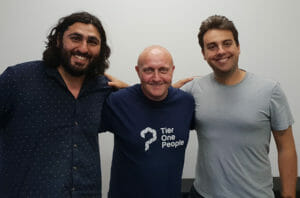
Matt Baxby Appointed Revolut CEO for Australia: How Executive Search Delivered the Perfect Fintech Leader
Leading executive search firm Tier One People partnered exclusively with global fintech giant Revolut to appoint Matt Baxby as Australia Country CEO.
Executive Search Excellence for Australia's Growing Fintech Sector
Global fintech leader Revolut has appointed Matt Baxby as Revolut's new Australia Country CEO, following an exclusive executive search conducted by Tier One People, a top executive search firm specializing in fintech companies Australia.
Matt Baxby brings an exceptional combination of traditional banking expertise and entrepreneurial mindset to Revolut Australia. His experience includes working directly under Sir Richard Branson at Virgin, where he developed a deep understanding of disruptive financial services—crucial experience for leading one of the world's fastest-growing fintech companies in Australia.
Our relationship with Matt Baxby goes back to 2010, when he spearheaded the relaunch of Virgin Money Australia. We had the privilege of helping him build that founding team through our executive search process, which gave us unique insight into his leadership capabilities and cultural fit for Revolut's ambitious Australian fintech expansion.
The timing of Matt Baxby's Revolut appointment is particularly significant. The announcement coincided with Revolut's latest funding round—a massive US$500 million investment at a US$5.5 billion valuation, cementing its position among elite fintech companies Australia is watching closely.
When our executive search firm first started discussions with Revolut in May 2019, the company had 4 million customer accounts and 700 employees worldwide. Today, those numbers have exploded to 10 million accounts and 2,000 employees. The business nearly tripled in size during the executive search and onboarding process alone—a testament to Revolut's momentum in the global fintech market.
How Top Executive Search Firms Navigate Complex Fintech Recruitment
This executive search process stood out for all the right reasons. The Revolut team proved to be an absolute dream to partner with from start to finish.
Throughout the entire process, our Tier One People team—recognised as a top executive search firm for Australian fintech and technology companies—worked as a remote extension of Revolut's Singapore-based recruitment team. The level of transparency, collaboration, and open communication transformed what could have easily become a complex, multi-country executive search into a remarkably smooth operation.
The Future of Fintech Companies in Australia
We're excited to see Matt Baxby lead Revolut's charge into the Australian market. The combination of his proven track record in challenger banking and Revolut's global fintech expertise creates a powerful foundation for success in the competitive Australian fintech landscape.
As fintech companies Australia-wide continue to disrupt traditional banking, Revolut is positioned to become a major player under Matt Baxby's leadership. His experience launching and scaling innovative financial services brands makes him ideally suited for this role.
Partner with a Top Executive Search Firm for Your Fintech Leadership Needs
The entire Tier One People team wishes Matt Baxby and the Revolut team every success as they bring their innovative financial products to Australian consumers. As a top executive search firm specializing in fintech companies Australia, we look forward to continuing this partnership as the business grows.
Looking for executive search expertise for your fintech company? Tier One People specialises in placing C-suite leaders across Australian fintech and technology sectors.
David M Brear, 11:FS - Leadership interview
"Good leaders really understand that it's not about them. It's about what they can do to get the best out of everybody else around them. "
David M Brear 11:FS
Exclusive Interview. Dexter Cousins chats to David M Brear CEO of 11:FS, the globally renowned Fintech and digital banking consultancy. Find out David's secrets on leadership, attracting the very best talent and how to bootstrap a global business.
11:FS is much more than a Podcast. Can you explain the business model?
David: We've been up to a few things other than just hanging out with microphones and doing podcasts.
Over the last three and a bit years, we've built Mettle, a SME challenger bank with NatWest in the UK. In Hong Kong we’ve worked with WeLab and Standard Chartered and in Singapore we’ve worked with our good friends Grab. We’ve also worked with a number of different companies in South Africa and we are midway through building out a consumer bank in the US.
From an 11:FS perspective, we live by the mantra that digital financial services are only 1% finished. Our mission is to change the fabric of financial services. And we do that in many different ways.
On one side we have a consulting services business working with people around the planet, whether it's regulators or banks or tech players or whoever wants to build out new green field propositions. We help to define strategy and move the ideas forward.
On the other side, it's about building products that actually solve problems we've had ourselves, whether it's things like Pulse, a global benchmarking tool, or the blockers we’ve come up against for delivering truly digital services at speed and scale.
That directly led us to establish 11:FS Foundry, which is a digitally native approach to core banking with a full stack architecture.
What prompted you to start 11:FS
David: Four years back we struck on a thesis that we are so early in the cycle of change. The promise of everything the Internet brings to an industry that fundamentally hasn't changed for 300 years was nowhere near being realised.
Digital is really about using the power of data to create an ultra personalised experience with much better services and products.
Unfortunately the way in which big banking organisations have implemented digital is more about taking people and paper out of the process. That’s digitisation, not digital.
The justification of every bank's digital transformation had been cost driven. It has only been in the last few years where banks have realised they need to revolutionise their approach and provide better services and products.
The change has predominantly been led through major changes globally, in the regulatory space and through competition. New players have come into the space, whether that be Fintech startups or Big Tech companies like Apple, and they are showing the banks that people just want better services.
We are just at the beginning of fundamental shifts in banking and financial services.
How Did You Get the Business off the ground?
David: We’ve taken no money. From month three of founding the organisation we were profitable. This pre revenue nonsense is definitely not for me. I don't think you can call it a business unless it makes profit and makes revenue. Call me old fashioned on that one. But for me, it's all about creating something of value for people. And if you do that then you should be able to monetise it.
There have been key moments where we have been very lucky and times when we have been ballsy. Episode One of Fintech Insider is an example. We had no listeners and no idea how we were editing the show, but managed to get a sponsor because they believed in what we were doing.
The first client of 11:FS Pulse was brought in as a partner before the product even existed. DNB invested in Foundry when it was no more than 11 slides.
We've been lucky to find people who believe in what we are doing, are probably as crazy as us and share the same vision, which is awesome. But ultimately our success comes down to creating things that are of great value to our clients.
You have an incredible line up of talent in the business, how have you attracted them to 11:FS?
David: I'm 39 years old now. Entrepreneurs my age can attract the right talent more effectively than people who are starting out a lot younger. You build up a network of people over your career where you think I don't know when, but we're gonna work together again.
I met Jason Bates (11:FS cofounder) back when he was at Starling, I was still at Gartner. I knew with Jason we'd work together at some point. Similar to Ryan Wareham, our COO. We worked really well together when I was at Lloyds Banking.
You get a feel for people in terms of their unique strengths. If there is a pre existing relationship you already have an understanding of each other. From there you build a founding team.
Beyond that, I honestly think success is fundamentally about momentum. One success leads to another success, which over time creates a magnetic pull where you attract the right people.
Have you found the Fintech Insider podcast is a good tool for talent attraction and bringing in new business?
David: Yeah, 100%. It’s crazy, we get hundreds of emails from people interested in working with us either as employees, partners or clients. At the beginning of the company you're five people sitting around a table trying to figure out how you can compete with Accenture and McKinsey.
We couldn't outspend them from a marketing perspective. So, we decided to out play them with brutal authenticity and a level of distribution that would create a fundamentally different way of engaging with our customer base.
We set out asking; 'How can we be authentic? How can we be provocative? How can we really establish human connections with the brand? '
David M. Brear 11:FS
Even now we could not reach the amount of people that we do with the level of content marketing that we put out using our competitors marketing approach. We have focused so much on brand narrative, it’s not about the products or services we offer. Our brand narrative is fundamentally about what we believe in and our values.
When you align with people on your belief system or your aspiration about what the industry could be, then you find a higher level of connectivity that you can never achieve by sending out a bullshit brochure.
What kind of team and culture are you building?
David: 11:FS is my first CEO role. I have worked for some really good CEOs and one or two really bad ones in the past. But I’ve probably learned more from the really bad CEOs, especially on what not to do when it comes building a winning culture!
The 11:FS culture is based on servant leadership. We are not a hierarchical company and believe bad and good ideas can come from anywhere. Whether it's bad ideas coming from the very top or good ideas coming from anybody across the organisation.
Trust is a huge thing from my perspective as a leader. If you have 360 degree trust of your people in the business then there is a positive intent running through the whole company.
When it comes to leadership I don’t consider myself a businessman. I'm more of a sports guy. So, I always look to bring the same mentality of a very successful sports team into the 11:FS team culture.
I think there's an honesty to sports that is often very much missing within the business world. Transparency and accountability are key to a sports team.
If somebody's playing badly on the team, they know and you know really quickly. There is nowhere to hide, but as a sports team you'll do everything you can to increase the productivity of the team and increase the impact you can make from an individual perspective.
With sports teams it is as much about psychology as it is physiology. And I think that is missing in the business world.
How do you motivate the team?
Good leaders really understand that it's not really about them. It's about what they can do to get the best out of everybody else around them.
Whether it's creating a sense of urgency, whether it's creating a vision and reinforcing it until the goal is reached, whether it's giving people a level of motivation to run through walls they wouldn't have tried to do before.
In big organisations leadership stops being about getting the best out of the people and focuses on managing the board or managing a group of shareholders.
And that's where I think you start to see a significant drop in the productivity of people within an organisation. And unfortunately, it's where you start to see an almost unrecoverable position from a cultural perspective.
Alex Badran Spriggy
Spriggy is a financial education product for families that helps parents teach their kids about money. The app has become so important in the 'Cousins' house hold that the kids now call 'pocket money', 'Spriggy money.'
Dexter Cousins of Tier One People talks with Co-Founder and Co-CEO, Alex Badran, to talk about the Spriggy journey. Alex is one of the smartest, likeable and authentic entrepreneurs you will ever meet.
How does Spriggy work?
Alex:Spriggy provides a prepaid card for kids and an app that parents and kids use together. Through the app, kids can learn about earning, saving, and spending, in a responsible manner, in an environment supervised by their parents.
How did the idea for Spriggy come about?
Alex: In 2015, myself and my co-founder Mario Hasanakos got together, and we were talking about banking. We had both worked in a bank and felt banks could do a better job in teaching their customers about money. We could see technological advances were enabling new solutions to enter the market.
Banking at the time was slow-moving, encumbered by legacy technology and regulation. Mario and I felt the conditions were right to deliver something unique to consumers. So, we began talking to people about how they interacted with money and the challenges that they faced. We very quickly discovered a problem that exists between parents and their kids;
We found invisible money was a real concern for most parents out there. It's a very practical problem as kids are spending online nowadays and money is becoming increasingly digital, yet parents are still teaching kids with antiquated techniques.
So, we set out to help parents teach their kids about money. And started by trying to solve a very practical problem, which is:
Alex: Mario and I have a bias towards doing. During the research phase we built a very clunky prototype. Our first-ever family, Annabelle and her kids, sat in the office with us, as we used off-the-shelf products to put together a product.
Within a few days Annabelle, had a basic tool through which she could manage pocket money with her kids. It wasn't the best product, but we were able to observe the challenges that Annabelle faced and iterate on the solution that we had in place. We then built a solution and tested it with fifty families. Based on the learnings from testing we built the commercial version you are using today.
What feedback did you get during the early stages?
Alex: It was an interesting experience. Mario and I were given a front-row seat to the challenges parents face with their kids. We learnt pretty quickly that it can be tough managing kids. The jobs of mums and dads is chaotic. You've got kids going to sport, you've got kids running out the door going to school.
We learned quickly that if we didn't build something to make their lives easier, they wouldn't have the time to consider it. Anything we could do to simplify the challenges faced by parents, would be considered a win.
Building an app for adults and building an app for kids is a very different process. Adults are used to having control, they're not as digitally native. Parents understand concepts around money, but are less literate in technology. Whereas kids, they know their way around Snapchat, Instagram, YouTube, but are less literate when it comes to finance.
We could get away with clunky prototypes with parents. If it was functionally up to what they required, they were happy with it. But with kids, if it wasn't up to the quality standard they had grown used to, they wouldn’t use it.
Building a solution for kids was daunting, but also informative, because we discovered quickly where you need to set the bar. It was intimidating putting products in front of kids. They'd find bugs very quickly and they'd say, ‘look, it's not good enough.’
Don’t underestimate kids. By giving kids control, responsibility, and ownership, and them seeing the consequences of their decisions, it's remarkable how quickly they learn. There's no conversation we've seen to replace the feeling a child gets when they spend five dollars on something stupid and then regret it.
The act of learning by doing is very powerful. Which is something I've always believed. There's plenty of research to back it up, but seeing it in practice was cool.
The Cousins Klan earning their 'Spriggy' money!
What was the point that you realised that, ‘Hey, we’ve actually got something really special here?’
Alex: I remember this moment vividly. We were moving from our prototype product to a commercial product, I called one of our earlier users, Nicola, and asked her if we could wind down the original prototype. She would only have to wait a couple weeks for the commercial version.
Nicola said no. We couldn't take the prototype away from her, because she needed it. Even though it was clunky, didn't work properly, and wasn’t to a commercial standard, Nicola’s daughter had been naughty that week and she was restricting her pocket money. I got off the phone, went back to Mario and said, “Man, we’ve got to keep this product running for one of our families because they just need it.”
There has been a lot of ‘bank bashing’ recently with the Royal Commission. What do you think is the right approach for a FinTech start-up to get traction, and become successful?
Alex: Interesting question. I think it's about knowing who your audience is. There is a lot of talk around banks right now. Could Spriggy take advantage of the Royal Commission and ‘bash the banks?’ Yes, but I think negative messaging is setting the bar low.
Parents don't care about banks. They care about their kids. They care about their kids being able to buy lunch, they care about their kids being able to buy a house when they grow up, they care about being able to afford a family holiday, and don’t want to have to worry about school fees.
Our view at Spriggy is that we're always better off focusing on who our members are and what's important to them. How do you find the core, emotional driver, that keeps your customers up at night, and deliver real value to them?
How have you scaled the business?
Alex: Mario and I are both optimists at heart. The downside of that is you under resource at times. Spriggy was only four full-time people when we launched to the public. It was remarkably challenging in those early days. You don't really know where the cracks are in your system, particularly with a product of this complexity, until you put in front of people.
When it comes to people’s money, if it feels like their money isn't where it should be, that's a terrible user experience. You can't get away with mistakes and bugs. If you build a social app, and a user has two likes instead of three, people don't seem to mind. But the minute you're starting to deal with real money, the quality threshold needs to be extremely high.
At launch, the product was ready to go, but as we started to scale the business, we had challenges. In the early days, we were growing much faster than we expected. And we were receiving a lot of feedback from our customers. It was all-hands-on-deck, to ensure we applied the feedback and iterated the product quickly.
We are now a team of twenty, which is great to see. For the first time since Spriggy started we are not depending on a few remarkably talented people to do everything. We now have remarkably talented people, in specialist roles. We now have processes and support in place, we now have the tools and resources to take a product and business which is scaling and deliver even more value to our customers.
Alex (left) and co-founder Mario Hasanakos (right) with the shiniest head in FinTech!
How have you attracted highly talented people to the business?
Alex: It's a great question! I reflect on this a lot. The product and the space we're in is interesting, so that gets people's attention. Spriggy is also a unique brand, in a unique space, and there's a lot of interesting things happening in FinTech. However, getting people's attention, that just brings them to the table. There is a whole lot more involved in hiring highly talented people.
We have brilliant people in the team and a very eclectic mix of backgrounds. My co-founder is a physicist and an electrical engineer. Our CTO has been building apps ever since apps were around. Our CMO is a software engineer, one of our software engineers has a medical degree and our customer success lead used to be a geneticist.
We have managed to hire remarkably talented people who are great people, not just intelligent. They work hard, they care about what they do, they care about the people around them and they care about our customers.
This might sound simple, but talented people want to work with talented people who share the same values and ethics. That’s it. Sure, our people have flexibility, equity and all the advantages of working in a startup, but they are not the key motivators for joining.
Our people really buy into the Spriggy mission too. I love coming to work, and I learn so much from our team, every day. They are just amazing to be around. I am sure it will become harder to hire exceptional people as we scale, but right now, hiring talent isn’t a challenge for us.
What do you see as the challenges for Spriggy?
Alex: We have a customer base who like our product, we have a very capable team, we're in in a space that is exciting and there is lots of opportunity. The challenge is just to remain focused and keep on executing.
Execution is a lot less glamorous than people make out. It's rolling your sleeves up and doing all the hard parts. Execution is being focused on the right problems. Not trying to solve one hundred different problems, but solving the one or two that really matter. Keeping disciplined and focused when executing will be one of the challenging parts of our growth.
Access to capital in Australia is challenging. Mario and I, we're not natural capital-raisers, we're product guys. We have learned a lot during the capital raise process. Presenting as the founders, hitting the pavement, talking to a lot of people, learning who's in the network, who you should be talking to, who you shouldn't be talking to.
Learning how capital-raising works was a big challenge in the early days. But we are fortunate to have met a lot of good investors, good people, and great founders too. I underestimated how helpful founders can be. Other founders may be a year or two ahead can tell you who to approach and who not to approach, which saves a lot of time.
I personally find capital-raising challenging in the sense that I much prefer to be building the business, rather than talking about building the business. Pitching and raising capital are disciplines I've had to learn.
And what is the end goal for you and Spriggy?
Alex: This is not an easy answer. I am not thinking about an exit strategy. We're just getting started. We have just earned the right to play. And we've spent years earning the right to play. I feel like we're about to start delivering on the vision we had from the beginning.
It's becoming clearer what our customers want and need. It is obvious that the financial services sector is shifting and there are a lot of dynamics which are playing out globally. Tech is evolving rapidly and the consumer segment continues to evolve.
So, there are a lot of unknowns out there. We need to keep making sure we listen to the signal versus the noise, look after our customers, look after our team. And it's that simple.
But there's a lot of momentum in the market and we're looking forward to delivering more value over the next three, six, twelve months. There will be some cool features coming your way very soon.
Daniel Foggo | Plenti
"If we are to compete with the large incumbents and other financial services businesses, and we want to continue to grow at the rate we're growing, we need to be doing things better than what they've been done previously, all the time. It is a constant challenge to each member of our team. "
Daniel Foggo is CEO of Plenti and a true Fintech pioneer. He introduced Australia to the marketplace lending (or peer to peer) model back in 2014, paving the way for Fintech to go mainstream. RateSetter turns 4 in October so it seemed like the perfect time for Daniel to reflect on his journey. Read on in this enlightening interview with Dexter Cousins.
For people who aren't familiar with the marketplace lending model, can you explain how it works?
Daniel:Plenti provides a marketplace, much like a lot of other disruptive businesses (Uber as an example.) We provide investors with access to strong, stable investment returns via investments into consumer loans. By connecting borrowers and investors together, we can cut out costs, improve efficiency and ultimately deliver better value to both sides of the market. In operating our platform, our primary objective is to ensure our investors get a good return and that there's stability in the returns earned.
Our model is quite different to some other marketplace lenders, in that we provision for losses, to help support the stability of returns. For every loan funded, an amount is paid into our Provision Fund. Which helps protect investors from any borrower defaults. Our Provision Fund currently has about 6% of the value of our loan book in it, held in cash.
Our Provision Fund has meant that to date, our investors have received every cent of principle and interest they expected to receive. This fund is carefully managed to help ensure protection for our investors. Not just in the strong economic times we are experiencing now, but also in a sustained, stressed economic environment.
Providing a better deal all round.
On the other side of our marketplace, we provide borrowers with very attractive loans, whether they come directly to us or via an intermediary. We attract customers because we provide very good value. Our rates are up to around 8% lower than those typically offered by the large incumbents. We also provide a very convenient, easy service.
We are a true Fintech business. An equal mix of finance and technology people. Most Fintech's tend very much to be one or the other. We must get credit and finance right. We must deliver the right financial outcomes for our retail investors, We must deliver for important commercial partners such as the Government’s Clean Energy Finance Corporation. Equally we need the right technology in place to perform our duties efficiently and to ensure our customers have an unrivalled experience when borrowing or investing with us.
How did Plenti begin?
Daniel: I spent well over a decade in investment banking, latterly at Barclays Capital here in Australia. Lending money to businesses post the financial crisis was an arduous process. It didn’t seem to work very well for the bank or for the bank’s customer. Even if a loan was approved by our global credit committee, as a bank we were often lending money at a loss. For the bank to break even on lending deals, we would have to cross sell other products.
Customers were also paying high rates and fees for credit. Whilst it was hard for us to make money, it was equally hard for them to reconcile the spread between what they were earning on their deposits versus what they were paying on their loans.
It had also become clear to me the banking model had major systemic flaws. The original concept of a bank was to keep your money safe. But banks today are involved in high risk activities which put customer deposits at risk. As a society we manage those risks by ensuring a bank can withstand a one in a 50 or one in a 100-year event. So logically, we see many years where the bank model is unable to provide good value to customers. Then events repeatedly occur where taxpayers are required to bail out tough situations.
Redesigning a better financial system.
The Financial Crisis of 2008 really highlighted the issues I am talking about. Shortly after the Financial Crisis, I read in the Economist that if you were to redesign finance, you wouldn't start with a bank. The implication was that you would have banks, but that there are other models that can serve both the borrower and the investor better, whilst supporting a more robust, more resilient financial system.
This thinking led me to look for an alternative to the bank model I was working in. I wanted to see a new model prosper, a model that could leverage technology and pass on better value to customers, and not have to lean, unfairly, on the tax payer for support.
Fintech in Australia is born.
So, in 2012 I resigned from my job at Barclays, flew my family to the UK and spent 3 months visiting lots of different businesses trying to find a model I thought would resonate with Australians. On my trip I met amongst other businesses, Funding Circle, (expected to IPO in the next fortnight with an approximate valuation of £1.5bn) and RateSetter. They were both very early stage and had both funded less than £20 million in loans.
Once I explained the bank spreads in the Australia market, it was clear to them that there was a significant opportunity for a marketplace lending model in Australia. The spreads were just so much wider in Australia than in the UK. I very quickly made the decision that the RateSetter model, in particular, could prosper in Australia. I flew back here to assess the market opportunity – really to see if I could uncover any reasons why the model might not work here. A month later I returned to the UK and signed a partnership agreement with RateSetter.
It's been a very successful partnership, they've been extremely supportive in building our Australian business, especially as we went through the process of gaining our regulatory licences from ASIC.
How did you get the Australian business off the ground?
Daniel: The initial years were not the most enjoyable years of my life! I spent just under two years going through the licensing process. We started in late 2012 and the term “Fintech” in the submissions probably caused confusion, as it wasn’t a term in Australia at that stage.
ASIC took the time to understand our offering. With the RateSetter model working very well in the UK, we were fortunate in that we could point to it as an example of success.
Political support for our model in the UK and in Australia also helped. There was an increasing awareness politically, and maybe with regulators, that something needed to be done to increase the diversity of our financial system. We couldn’t just have a reliance on one model, being a bank model, but rather needed various models that work together. I think we had some success in explaining that marketplace lending could be part of the solution.
Finally, in October 2014 we had the relevant licenses in place and launched the business.
As one of the pioneers of Fintech in Australia, what are your views on the opportunities for the industry.
Daniel: The Royal Commission, Open Banking and Comprehensive Credit Reporting are creating significant structural changes in consumer finance. These changes, in turn, are creating opportunities for Fintech business like we have never seen before.
Maybe the most significant structural change is the shift in trust. We are moving into a world where large financial institutions, who may have prided themselves on having consumer's trust, are quickly finding it's being eroded. Conversely technology-led businesses are typically doing a very good job of building customer trust.
Clearly in finance it is especially important to earn a customer’s trust, although it can take much longer to earn than in some other industries. Fintech business do have a few tools in their tool box to help of course, such as by providing high levels of transparency and control to their customers.
What is the long-term strategy for Plenti?
Daniel: We are building an enduring business. There is a perception a tech start-up will become successful overnight. Seek and Carsales.com (a shareholder of RateSetter) are both examples of businesses which listed to great fanfare and are subsequently very successful businesses. What a lot of people don't know is it took each over 10 years to get to IPO.
From day one at RateSetter we've always had a very long view in mind.
This is a multi-decade opportunity to build a model that becomes a significant part of our financial system. To achieve our potential, we want to achieve it in a relatively low risk way, which means very considered growth, which is broadly consistent every month.
Although our approach to growth is conservative, that doesn’t mean we are not growing rapidly, and that there’s not a huge runway for future growth. Our leading volumes are consistently about 100% ahead of where they were a year ago. And we expect to sustain this level of growth for many years to come. We currently fund around $25 million of loans each month. At our current growth rate, within 2 years we will be close to matching a big four bank in terms of the value of amortizing non-mortgage consumer loans funded each month.
What are the secrets of Plenti's success to date?
Daniel: Long term success comes down to putting the building blocks in place. The first building block – of course – has been to recruit the right people. We have attracted great people, generally because they have quickly understood that by offering better value to our customers and diversifying our financial system, we are in fact providing a ‘social good’. There is certainly also something very democratic about our business model, in that we are providing everyday Australians with access to an asset class which was previously more or less the exclusive domain of sophisticated investors.
Of the first six people in the business, five are still here and the one person who departed is still involved. I am proud of our team, and the fact that our core senior team have a very consistent view about the purpose of our business and where we want to go.
We now have a team of about 90 people, and our team continues to expand rapidly. Everyone in the business is very focused on making sure we deliver on our vision. The challenge of course is ensuring this focus remains as our team grows, not just in number, but geographically.
The next building block is technology.
We work daily to ensure our technology is best in class. We've built a fantastic platform from which we can keep growing. The stability of the platform enables the business to grow at scale without problems. We also perform exceptionally well in terms of credit performance because of the quality of our credit data.
The final building block is investors.
Getting the right equity investors on board has been critical to our success. It has been a very conscious decision to look for investors who can contribute not just money but who can contribute more broadly to the success of the business. Pleasingly all investors on our register have contributed to the success of the business in one way or another.
Our management team and related entities, which have delivered our plans, own nearly half of the company. RateSetter UK obviously gave us a foot up and remain very supportive. Carsales and its subsidiary Stratton Finance have helped us break into the loan broker and automotive lending markets. Five V Capital, our financial investor, has a lot of experience with high growth businesses and has shared their expertise in scaling businesses. Then there are private investors who have helped us in various ways
What people challenges have you faced as the business moves from start-up to enterprise?
Daniel:As we continue to add more people the challenges keep evolving. We've been quite lucky, in that our culture has remained consistent. This mostly comes down to the way we recruit people. One of the most important questions for us in recruiting is how a new hire will fit from a cultural perspective, especially whether a candidate understands and buys into our purpose.
In keeping with this philosophy, we have sought to avoid having layers of middle management and to give people flexibility. However, we are a regulated business with significant responsibilities, so you do need to have the right controls and compliance measures in place.
If we are to compete with the large incumbents and other financial services businesses, and we want to continue to grow at the rate we're growing, we need to be doing things better than what they've been done previously, all the time. It is a constant challenge to each member of our team.
How would you describe the culture at RateSetter?
Daniel: The person at the helm is perhaps the worst person to articulate company culture and values, as you can often take your own values and behaviours for granted.
I’ve always sought to foster a culture where people are given a lot of autonomy, can take responsibility for their part of the business and are accountable for their – and where relevant – their team’s performance. Everyone in the business has a responsibility to constantly keep evolving and improving.
I believe we have created a respectful culture across the business. We all do the best we can for the customer and for each other. The customer is always front of mind.
Out of everything you've achieved so far, what has been the most rewarding part of the journey?
Daniel: Every milestone is rewarding. When we were granted our licenses, it was extremely satisfying after so much time and effort. When we funded our first million dollars, it was exciting as we felt we’d proven the model and the platform works. When we funded $100m, we were delighted to be proving to ourselves that we were successfully building a sustainable business, in the way we promised our customers we would.
Maybe that’s it. Delivering on the promise. That is the most rewarding part of the journey.
But really I still feel like the journey is just beginning. I guess that’s the privilege of starting a business that challenges the status quo in such a large part of the economy.
Manage Cookie Consent
We use cookies to optimize our website and our service.
Functional
Always active
The technical storage or access is strictly necessary for the legitimate purpose of enabling the use of a specific service explicitly requested by the subscriber or user, or for the sole purpose of carrying out the transmission of a communication over an electronic communications network.
Preferences
The technical storage or access is necessary for the legitimate purpose of storing preferences that are not requested by the subscriber or user.
Statistics
The technical storage or access that is used exclusively for statistical purposes.The technical storage or access that is used exclusively for anonymous statistical purposes. Without a subpoena, voluntary compliance on the part of your Internet Service Provider, or additional records from a third party, information stored or retrieved for this purpose alone cannot usually be used to identify you.
Marketing
The technical storage or access is required to create user profiles to send advertising, or to track the user on a website or across several websites for similar marketing purposes.