Podcast
Ada Guan – Rich Data Co.
In episode 178 of Fintech Chatter Podcast, Dexter Cousins is joined by Ada Guan, CEO and Co-Founder of Rich Data Co (RDC.)
Rich Data Co Series B Announced.
Is there a viable use case for AI in banking? Will AI replace Bankers?
Making her Fintech Chatter debut Ada Guan CEO of Rich Data Co shares how they are reinventing the way banks assess and provide credit to businesses, using AI.
It’s an awesome episode where we talk about:
Real AI use cases for banking
Modernising a 70 year old credit model
Leaving a corporate job to start a business
Hiring and retaining the best AI and Data engineers
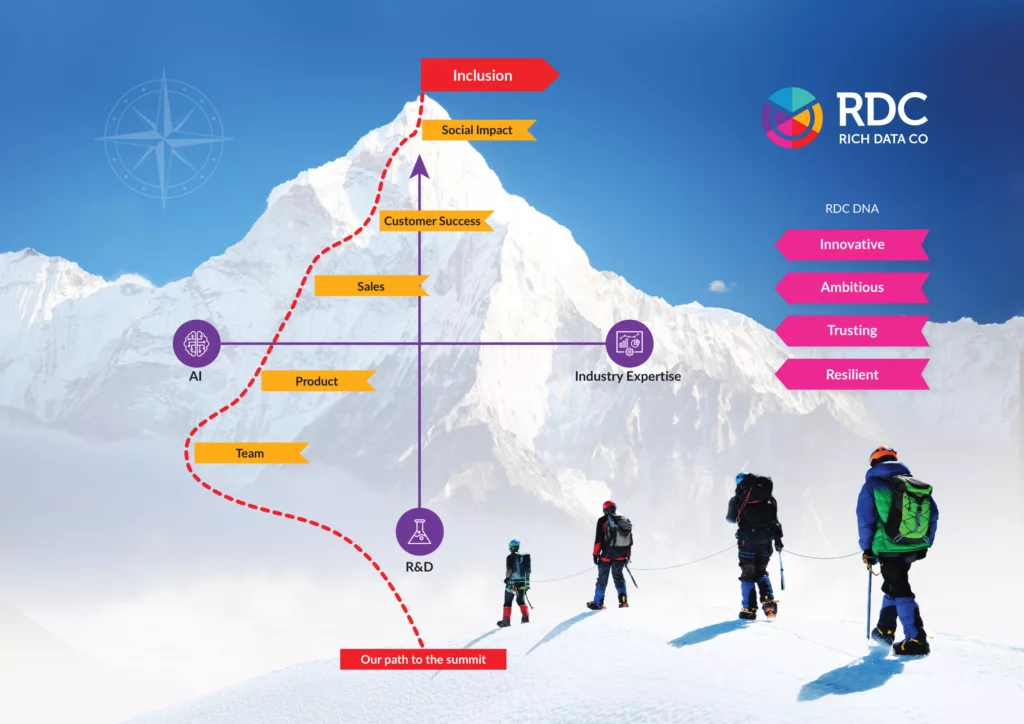
How rock climbing has helped create a high performance culture
How to consistently win business with major banks (with only 2 people in sales and marketing)
About Rich Data Co
RDC is delivering the future of credit, today! Rich Data Co is on a mission to make credit accessible, fair, inclusive, and sustainable. By using AI, the team at RDC has developed new techniques leveraging traditional and non-traditional data to get the right decision in a clear and explainable way.
Customers expectations on credit have changed drastically in the past decade. Global leading financial institutions are leveraging the RDC AI decisioning platform to offer credit in a way that aligns to the customers’ needs and expectations.
RDC’s AI Decisioning platform harnesses the incredible potential of AI and combines it with industry expertise to create the ‘AI brain for a bank’. RDC is accelerating innovation in business lending to deliver transformational and sustainable long-term business success for customers.
Find out more https://www.richdataco.com/
About Ada Guan
Ada brings over 20 years’ global experience in financial services, software, and retail industries.
Leading a Global Client Advisor team at Oracle Corporation, she advised board and C-level executives in large global banks on digital disruption and Fintech strategy, and drove Oracle thought leadership in banking digital transformation for Global Key Accounts.
During her time at Westpac Bank in Australia, Ada implemented a multi-million dollar program to deliver a mission critical services layer for the Bank and formulated the IT strategy that formed the basis of the $800m investment program to transform Westpac’s Product and Operation division, and complete the merger with St. George Bank.
Ada holds an EMBA from the Australia Graduate School of Management, and a Master of Computer Engineering from the University of New South Wales, Australia.
Links from this episode.
- Rich Data Co (RDC)
- Ada Guan on LinkedIn
- RDC on LinkedIn
- Careers at RDC
- nCino’s reseller agreement with Rich Data Co (February 2023)
- Rich Data Co’s $28 million Series B announcement (November 2023)
- Tier One People
More on AI and lending on Fintech Chatter.
- Jamie Twiss on how Beforepay uses AI credit risk (2026)
- Patrick Coghlan on CreditorWatch (2023)
- Peter Jones on Nimo Industries and mutual banks (2026)
- Sean O’Malley on AMP Bank and small business banking (2025)
- All Fintech Chatter episodes
Full transcript.
Lightly edited for readability — filler words removed, wording otherwise unchanged.
Dexter Cousins
Welcome to Fintech Chatter, presented by Tier One People, leaders in fintech executive search. Follow us on your favourite podcast player or Fintech Chatter TV on YouTube.
Hello and welcome to Fintech Chatter, the show for everything fintech down under. I’m your host Dexter Cousins, and today I’m joined by a guest who is making her Fintech Chatter debut. It’s Ada Guan from Rich Data Co. Ada, welcome to your Fintech Chatter debut.
Ada Guan
Thank you Dexter, so glad to be here.
Dexter Cousins
It’s fantastic to have you here. It’s an incredible story. We were just chatting before off air how I think I tried to headhunt you in 2012 when you were at Westpac, and here we are 11 years later and you’re a co-founder of a successful fintech business. But before we kind of get into today’s show, would you mind telling our listeners a bit about Rich Data Co and what you do?
Ada Guan
Yeah, of course. So Rich Data Co, we call RDC, is about eight years old, so we’ve been existence for about eight years. And we provide AI decisioning platform to lenders, and largely in the business lending and the commercial lending space. So our goal is really providing the AI decisioning capability and helps the lenders to make higher quality decisions safely and more efficiently.
Dexter Cousins
So an AI business that’s eight years old, that would kind of make you a dinosaur in today’s terms. Is that right?
Ada Guan
I know. And now you see, if you talk to any business, is a AI business, right? So the thing we’re super proud of is we started really applying AI for lending eight years ago. Yeah, so our first customer is out of North America, and we start to really making lending decisions using their data eight years ago. So we have some experience, which is great.
Dexter Cousins
Now, I’m quite excited about this show and this interview, and the reason why is that today we’re actually celebrating, I think, the fourth anniversary of the first episode of Fintech Chatter. And I was listening to it because I’m going to be recording a special show kind of looking back over the last four years. But in that show, the part of the discussion is around how kind of fintech has really been so far, well, to that point, about improving processes and not really changing the products in any way.
And one of the references that I made was that as a business owner, and just to see the way that work has evolved and changed rapidly over the last 15, 20 years, we’re still using credit decision models that are based on people who had a job for life, and kind of all of these kind of factors from the 1970s, not the 2020s. So I’m really fascinated to kind of understand how Rich Data Co is actually solving this problem and addressing it.
Ada Guan
So let’s get into a little bit details around this. So the method, I think many lenders use or many banks use in terms of credit assessment, are still based on methodology defined 1950s, right? It’s heav being kind by say in 1970, so being around a long time and has been very successful for a long time. And it’s rely heavily on credit history and past behaviour.
So one of the reason we really thinking about how to change the game and how to solve the issue is now there’s so much data become available about individuals and also about business. AI technology advanced a lot in the last 70, 80 years. And can we actually solve the problem differently? Can we actually using AI and using data have a deeper understanding of the behaviour and be able to predict, understand what the future looks like? Can we bring decisioning and AI together, help lenders to make a better decision? And is the, perhaps, the idea behind RDC, and to really thinking about how can we think of the problem differently, and can we solve it using AI, and what type of control we need to be in place and to give that safety and compliance aspect to the lenders, so they can safely use AI in the lending space.
Dexter Cousins
So I’m kind of sitting on the sidelines as a consumer complaining about this, but you, I know only too well, that it’s one thing for us to kind of say, “Hey, technology can make this better,” but then when you get into a bank, the complexity of their technology stacks and legacy systems, etc. Oftentimes you come in with a great idea and people get excited, and then the realisation that, how we ever going to implement this and make it work? And the other challenge being, if this goes wrong, am I potentially going to jail? How have you overcome those two challenges when you’ve been approaching banking clients?
Ada Guan
So if you look at RDC, many of us coming from banking background and coming from large enterprise software background, so we have a solid understanding the challenge of the legacy systems and how difficult it is, and what’s the possible pathway to help banks to solve that issue, perhaps is one. And so we actually understand the pain, and we don’t try to pretend the pain is not there. Often what we help banks to do is AI accelerator type of approach, so setting up environment to help the banks to experiment, testing new ideas around AI, and testing out in a control environment before we rolling that out into production. I think for many large banks that’s the right way to go, to really test out the idea, proven it can work, and before moving that into production, perhaps this one.
Secondly, purely from banks’ perspective, the compliance requirement is very high. It’s a slightly different from many fintech lenders, and the compliance requirement is not as high as banks need to do. So from designing the AI decisioning platform perspective, we focus a lot around transparency and compliance. So we have a term we use called glassbox AI. So what that really means is every decision made in our platform is traceable all the way back to the data. So how the data get ingested, what type of prediction we have done, how many models was used, all the model results are explainable, and the decision itself, which is combination of multiple models and the multiple rules, is traceable all the way through.
So I think we have a term called self-describing decisions. That means if the banks ever wanted to inspect one of the lending decision they ever made, they have a chance to do that on our platform. So I think this type of design and building an investment into the platform and enable us to be able to have the ability to service the banks or fintech lenders.
Dexter Cousins
And what kind of feedback have you been given from your clients as to how impactful the platform is?
Ada Guan
You would seen the press release our customer have done and in the market, and I think we firmly believe it’s best for our customer talking about us versus we promoting ourselves. And so you can see the feedback is overwhelming. And in terms of the impact we have achieve, really helping large banks and innovate in the business lending space, and in a way getting ahead of their competitors, is what we been focusing on doing.
Dexter Cousins
And do you focus purely on business lending, or do you do other forms of lending as well?
Ada Guan
So the platform itself, and the core of the platform itself, is helping organisation to make complex business decisions using AI. So the platform itself has a lot of expendability in terms of extending into other industries. In the past we have worked across multiple industries as well, such as retail, such as telecommunication. Currently we’re very focused around business lending and commercial lending, and the core reason is a space is actually very difficult to solve and very difficult to get the right solution for. So we see this space we wanted to be super good at. Yeah, we also done consumer lending in the past. Is area we could potentially go back to, but currently we really focus on business and commercial lending.
Dexter Cousins
So if we look at the Australian fintech space, I think kind of a lot of the success stories have come in that lending space. You got Judo, Prosper, a whole host of other businesses that are doing a great job. But when I look at the structure of their businesses, and you look at the people within the business, they’re probably about 20%, 25% tech people, the rest are salespeople. So it’s still a kind of heavily dominated, kind of human kind of centred kind of industry. Where do you see the opportunity to be able to, I guess, bring technology more into that? And does a platform like RDC, does that kind of take people out of the process, or does it just help them get a better decision?
Ada Guan
So our business is to enable the bankers, right? So in terms of, if you look at SME lending, it’s perhaps the fully automated decision is possible and under a certain amount. And if you go to the commercial end, and especially about 5 billion dollars lending, and at this point in time no one is going to rely on AI to make a decision and say do a take and a finish. And the things we really focusing on is to harmonise the AI and the human.
So in a way, I haven’t found the best analogy for it, is almost providing a calculator for the bankers, if you would say. And in the days have no calculators, and all the bankers need to do the calculation by hand, is can we provide the next generation of tooling to the bankers, and to help them to not just look at the past, and also looking at the future, into the future, and to see where the future land is actually painting out for their customers.
So if I give you an example to bring this to life. So one of the core thing we do, especially for businesses, is we do cash flow forecast. So we’re predicting the cash flow strength over the next 12 months. So when the bankers examine how their business is doing, they could look at the cash flow strength of that business over 12 months, because business often have seasonality.
So if I give you an example, if the cash balance continue to dropping, very likely that businesses start to run into issues. The banker actually needs to have a conversation with the business owner, say, “What’s going on, Dexter? Are you okay?” And on the other side, if, let’s say, a retail business in December, you see the cash flow continue to drop, but picking up, prediction-wise picking up, in January, February, that’s a fantastic lending opportunity. The bankers should be have a conversation with that business, say, “Dexter, can I help you out? Looks like you need some cash to buy stock for Christmas. Can I help you out? Do you need to buy more stock in order to grow your business, so you can come back stronger in January and February?”
So what AI really is doing is start to provide that insight for the bankers to look into the future in terms of their business customers, and they can have much more meaningful and insightful conversation with the customers. And that’s how the banker is, to enable the bankers, and is not replacing the bankers. Is making the banker’s life better.
Dexter Cousins
Yeah. One of the things that really frustrates me about the recruitment industry, or just recruitment in general, is this kind of the way in which hires are done, particularly through jobs and job advertising. And to me it doesn’t make any sense that I would pay to advertise my brand, get hundreds if not thousands of people to spend the time applying, and then reject them and say, “I’m not interested in you.” Really bad for brand. And I’ve seen a lot of lending businesses follow that approach as well, where they’ve kind of almost given a bad experience to people who could be customers in the future.
Is there, do you see a kind of time, or is it possible through the RDC platform, that if, let’s say for example, my business, I go for a loan and I want $2 million, and it comes back no, is there then alternatives of, “Hey, here’s what we can offer, here’s how we can structure it, here’s kind of how we could make actually the deal work around different scenarios”?
Ada Guan
Yeah, 100%. I think if you’re really thinking about what ideal lending situation is for the customer, is you have the credit available to you when you need it, where you need it and how you need it, right? So if I design the whole lending product around the customer, that would be how I design it. And then from AI perspective, can I use AI to understand your needs better, and to make sure the credit which tailor to your needs is actually available before even thinking about it, is where we driving towards.
And no, it is here now, and we’re helping major banks doing that now, and really looking at the existing customer portfolio and to see how to optimise the offer to existing customers. Because the frustration is, if you are existing customers, I have all your data, I understand you, I have a relationship with you. From a bank perspective, I should know when to offer credit to you, at what time and in what format, and enable banker to have a very meaningful conversation with you. And that’s the things we’re focusing on.
Dexter Cousins
So I’m really interested to kind of dig a bit deeper into the actual business itself. So you mentioned you’re eight years old. As I kind of rocked up to reception, I think the first thing I mentioned was, “Hey, it’s noisy in here.” It is Melbourne Cup Day, so you kind of… But it was quite particular, over the last few years, you’ve kind of forgotten that offices can be noisy places. How many people do you have in the business now?
Ada Guan
Yeah, we have about 60 people in the business. And office-wise, one thing I’m super excited around RDC office is always have a fantastic energy. And so whenever I have a tough day, actually I come into the office, always buzzing, and people laughing, joking and playing, and it’s just a fantastic place to be.
Dexter Cousins
And in terms of the people, are you all technologists? Do you have kind of a, what’s the mix of kind of skills and backgrounds?
Ada Guan
We have, so one of our culture principle is around diversity. We have a very diverse workforce, and largely categorised by two type of people. One is we call them young guns, so the very young kids fresh out of school, full of ambition, full of energy. I think is source of the there. And there’s another generation is more like what we call the corporate warriors. So being around the corporate for while, and done quite well, and F this more in their career, and then working in large corporate, they wanted to try something different. So we also have a group of people like that. So we normally have the young guns and the corporate warriors in RDC.
Dexter Cousins
And whether you, being an AI business, are you kind of, what, predominantly data scientists, or…
Ada Guan
We mainly engineer and data scientists. We have a very, very thin sales and marketing team, so we have two sales guys, zero marketing. And so everyone else is almost all, or either expertise in credit or in banking, or engineers, or data scientists, or data engineers.
Dexter Cousins
So kind of marketing and sales are pivotal to growth, and yet with only, what, three people, in those two people, you’ve managed to bring on some really big, big clients and big names, not just here in Australia but globally. So how have you done that?
Ada Guan
I think one is the product is good. And so the platform itself, sometimes it’s quite amusing, right? And if you’re thinking about you’re talking about AI decision business out of Sydney, and a relatively unknown, RDC is not very well known, I think, overall, and not out of Silicon Valley and not out of east coast of US. And so we relatively unknown and internationally. And we, the platform itself is good, people are good. So we have people has very deep domain expertise and who can really make it work. I think every bit of business we earn, so by delivering results to the business, and then the customer become the advocacy of what we do. And I think that’s how we have done so far. But we will grow ourselves team. It’s a process we going through.
Dexter Cousins
And how on earth have you managed to hire then what I’m assuming is at least 57 data scientists and engineers?
Ada Guan
Talent attracts talents, right? So it’s, we are the RDC team, I mean, are working large banks, large technology companies. I would say RDC have one of the strongest team in the industry. And the core reason for that is there’s a bunch of people come together, and they have huge ambitions, huge talents, they want to do something different. So I think one of things we keep talking about at the very early days is saying it’s a bunch of interesting people to do interesting things which are impactful, is what we’re driving. And so you have people truly passionate about the business, and then good people bring good people. Talent attracts talents. People don’t come into organisation, work for organisation. They come and work for people.
Dexter Cousins
Yeah. Look, there’s a saying, I think, which is, A team people attract A team people, B team people attract C and D and D. And I think it is true, and it might sound a little bit kind of being a bit of a talent snob, but I think the reality is you have to get it right. In a business of this size, there’s just nowhere to hide.
Ada Guan
Oh, 100%. I think people, I feel, especially in startups, people will decide how successful you can be. So one thing we often say is the limitation of any startup such as RDC is how good the people are, and how good we are as, not just individuals, as a team, and how much we can push the boundaries as a team, how we hold each other accountable, how to pushing each other up as a team, is we’ll decide how far we go. It’s actually nothing else. And the product comes because people is good. Customer comes because people is good. So people is core of our business.
Dexter Cousins
And unfortunately what I see, ad as, is kind of the, it’s actually flipped in reality for most of the industry, in that most of the emphasis, well, to say people are a number one asset, most of the emphasis from founders, and you’ve only got to go, and you go to an event or look online, it’s all about raising capital. And the reality is that kind of, if you focus on getting the right people, all of those things kind of will come naturally, where I think founders put all their energy and focus in trying to make that work, rather than trying to bring in the right people and build the right product.
And then, as you pointed out with one of the examples of how the platform works, if you got sales booming, that’s the time everybody wants to lend you money, right? When you need it, nobody wants to lend it you, right?
Ada Guan
Exactly.
Dexter Cousins
So I think that kind of approach that you’ve got around the people in the product, it’s great to see that it’s actually now, with a team of two salespeople, that you’re able to go and win all these great customers.
Ada Guan
Yeah, absolutely. I think from investor perspective, we’ve been talking to many investors, like many startups. Fundamentally, I felt investor wanted to invest in good business. And so if we look at, boil down to, it’s really, really solid business, and especially in the current environment, that’s where investor focusing on. Then what they do, they assess, they assess how good people are, is the number one criteria. And so our investors are always amazed on how good our team are. And so number one, before anything else, then they look at product to market fit, they looking at your revenue, your growth trajectory and all that. But the first gate is actually people. So if you want capital, get a team right is so important.
Dexter Cousins
Yeah. I want to talk about your journey. It’s kind of, I think one of the privileges that I’ve got in my kind of space that I work in is there are people who I’ve got on the podcast who, like yourself, I used to headhunt 15 years ago, and they were coming out with a big four firm, and that was where I would go to go and get first time CA passes. And what was really interesting was, having recruited initially kind of finance and risk, was to see kind of post GFC how finance and risk morphed into strategy and morphed into data and all of these other areas, where people in my network now have gone off and just wanted to solve these problems.
And it kind of was a natural progression for me. People say, “Oh, how did you kind of figure out that fintech was going to be a thing?” Well, I just followed my network. I just followed the people that I really believed in, that I’d kind of worked with previously and were clients or candidates, and seen where they were going, and thought, well, this must be something.
What’s your journey been like? Because I think when we spoke you were in data at Westpac. You then moved to Oracle, and here you are, you’re talking to you businesswoman about raising capital, about people, about kind of cost to serve and all these cash flow models. How have you made that transition, to go from being a employee at a huge organisation like Oracle to being a founder, and all of the challenges that come with that?
Ada Guan
Yeah, I mean, being a founder doing startup perhaps is the most difficult thing I ever done, and also the most fulfilling thing I ever done. So it was not an easy transition. I think my career history has always been in large corporate, right? So I have a w history and a banking history and Oracle history. And so very safe. And different industry is quite fun to be in as well. They all fantastic organisations, I learn a lot.
And making that change from a very large organisation such as Oracle, I think at the time is 120,000 people, right, and into a startup. I think we have a story around seven people, three chairs, when we first started. So it has three chairs for three months. And it’s a massive transition.
The core reason for doing that is that corporate warrior story, right? So what keep wondering, are they more? And if I don’t make the change then, I probably never would. And I think a lot of my mentors at the time actually really guided me as well, say, “What’s there to lose? Go have a try. You can always come back to large corporate and if it’s not successful. Go give a try, and don’t let something you look back and you regret it, say I wish I have done that.”
So I think people doing startup a little bit crazy and a little bit adventure driven. So I think I have that, I believe, in my blood, and I wanted to take a chance, I wanted to take a risk, wanted to see how that goes. And that perhaps is what driven me taking the chance.
Dexter Cousins
One of the startling kind of stats from the research and data that I’ve collected over, what, the seven, eight years that I’ve been in business with Tier One People, is when we’ve looked at people who’ve made the move from a large corporate to a fintech startup, and by a startup I’m talking about a business that’s under 100 people, 90% who’ve made the move leave within the first six months. And it sounds a bit shocking, but I think once you’ve been in the environment and you’ve experienced both environment, it’s really kind of, it’s a lot clearer as to why it doesn’t work for a lot of people. What were the things that you had to change about yourself pretty quickly when you kind of made that leap?
Ada Guan
I think one is, can I just say, for the startup, it’s not shocking. And a startup is not suitable for everyone, and it is tough. And so it’s not something everyone has to do. I think one, it’s suitable for certain people. Especially from recruitment perspective, we actually very conscious, and it might not be suitable for some part of the very talented population, but very suitable for the other population. And some of those attributes is actually that adventure taking attributes, personality traits, and there are people more willing to take a risk and see how it goes.
Dexter Cousins
We’re kind of going a little bit of tangent here, but I remember speaking to a friend of mine who was an old client. We were having a walk, I think a year and a half or so ago, and he’s from the UK as well, and we were just talking about this thing around the kind of risk-taking and entrepreneurial spirit. And he referenced some research that he’d read, where there’s apparently genetically 10% of the population, it’s coded in to the 10% of the population genetically, and that’s how we actually spread from, you have the origins of humanity, or Ethiopia, just that you kind of had to go off adventure and see. And if we didn’t have that 10% of the population, we would all be kind of still in North Africa.
So the whole thing around innovation and entrepreneurship, it seems like there’s kind of 10% of the population predisposed to it. And then when I, because you mentioned that when I was talking about this 90% number that we’d come up with from our data. So it’s kind of fascinating that, I don’t know if it’s just we’re all kind of making this bias towards it, but it’s quite fascinating when you speak to so many people.
Ada Guan
Yeah, because we’ve been in business for eight years. I come back to the changes. But being in business for eight years, we interview a lot of people, we hire a lot of people, and then you’re looking at the attributes, is really one. One thing we joke about in RDC is quite a few of us go rock climbing on weekly basis. We actually say perhaps one of the recruitment thing we need to do is get the, and do a rock climbing lesson. I think a is telling me the insurance might be an issue.
Dexter Cousins
But my son, who’s 11, I take him bouldering every Friday. And he’s done rugby league, soccer, cricket, and it’s the one thing that he has stuck at. He’s committed to everything, but after a season or two seasons he’s said, “Hey, it’s not for me.” This is the one thing. And I asked him, and I said, “Hey, what is it about bouldering and rock climbing that you love?” And he said, “It’s about problem solving.” This is an 11-year-old kid, right?
Ada Guan
Oh wow. Because in terms of climbing, you need a few things, right? You need to be physically fit, and that space second, because there are so many different tracks, you have to use your brain. It’s a mental game. You’re also dealing with your fear of failure, because you fall, you could easy fall. You need to rely on your partner and make sure that person actually holding you up. And then you’re taking a calculated risk constantly, because otherwise you can’t go up the hard course. And then at that point you figure out, am I taking that risk or not taking that risk? If I take that risk, I get to that point, can I go to the next point? Or that’s a de part that role. And so in many ways it’s very, very similar to entrepreneur journey, in terms of how you go up.
Dexter Cousins
I’ve actually used that same kind of metaphor up climate Everest, but using that as how people should look at their careers now. It’s not a linear path. There’s not a ladder going straight the top. There’s no ladder to success. You’re zigzagging, you’re going up, sometimes you’re going to have to go down, move across, but then there’s a faster route to get to where you want to go, or a safer route. So I think your idea about doing rock climbing is part of an assessment, I don’t think is necessarily a crazy idea, especially for startup, because it’s such a—
Ada Guan
So go back to your question before around what I need to change. So if you’re thinking about large organisations, you have a lot of safety in it. You don’t need to worry about payroll, you don’t need to worry about tax, you don’t need to worry about a hiring process. There a ton of safety net around you. So you do what you do, you do it well, but you don’t need to worry about a whole bunch of other stuff which surrounding a business. The biggest adjustment I was have to make is suddenly that’s become a responsibility. And suddenly need to figure out how to even set out an accounting system when we first started, and who is going to minding that, and what type of control we need to put in place. So a lot of business related capability. Smiling, right?
Dexter Cousins
Because I remember when I sat launch Tier One People, I went through exactly that same thing. And I was really fortunate in that I think the first three or four weeks I actually got my first bit of business, right? And I was planning it might take six months, and I was celebrate, and like, “Yes!” And then the first thing that hit my head was, how do I send an invoice? I don’t have a system. And I had to reverse engineer, and I called an accountant, and we set up zero. But I think every process that I had in that business was reverse engineered.
And it kind of, I think the only time that I actually felt like that, well, twice, was when I first moved to Australia and when I first became a parent. And it was just everything was so alien, and it was like, I really do not know what I’m doing here, I’m just making this up as I go.
Ada Guan
I think that’s the time you really grow as a person, because when you’re most uncomfortable you grow as a person, right? So that when you throw into that situation, you kind of like, okay, I somehow just need to make it work. And then I think that’s when a team are super important, so have a team supporting you, and building that out become super important.
Dexter Cousins
If you looked at the two environments, one of the things is that I’m really kind of fascinated by at the moment is, and I don’t know if it’s necessarily a true or whether it’s just kind of media talk, is this talk of the kind of burnout pandemic that we’re going through. And I really struggle to understand, because I look at the way in which our lives are now structured, working from home, we’ve never had it better. Like if we were here 2019 and I said, “Hey, in the next few years people are going to be in the office once or twice a week, and they’re going to be burnt out,” you would have said, “What are you talking about?” Right? Like, what are you talking about?
What you’ve experienced, a corporate career, you’ve experienced a startup career. Which of the two do you think would more likely lead to burnout for you?
Ada Guan
I think it’s very individual, business-based, and instead of category. So because if I talk about RDC, RDC is a startup, right? So the pressure is high at any point in time, and for us it’s a survival pressure versus large corporate. And so one thing we actually very consciously put in place is a culture principle we call a culture key, and is actually to exactly avoiding that issue, is to say we want you to look out of yourself first, your loved one next, and then RDC. So the business will be here, but if you’re not healthy, you’re not strong, you’re not well, you’re not going to be helpful for anyone. If your family or your loved ones are in stress, you’re not going to be helpful for everyone. And so go sort out the base staff first, and then that’s make RDC work.
So I think this type of supportive structure are important in the current world. Working from home, yes, you have a better chance of perhaps doing the school duties and balancing it off, but also means the work actually seeps into your life. It’s hard to turn off, people are online all the time. It’s hard to draw that boundary between work and a personal life. And it’s one thing. And the second, people are social animals. We wanted the energy and the interaction with people, and we’re enjoying making that human connections, and human and social connections are the other factor I think are super important to avoid burnout. We need support, we need connections, we need to feel be part of a group. So I think working from home, there are some benefits, there’s a lot of drawbacks as well. So how to balance that, I think it’s all the business trying to figure out.
Dexter Cousins
Yeah. So, and this is just a beautiful transition into the next thing that I wanted to talk you about. This isn’t the first AI type cycle. There was another one in 2016. They kind of seem to come every seven years, right? Like El Nino, like AI hype cycle. But the conversation in 2016 was heavily focused around ethics and AI. It hasn’t been as much so this time. I think it’s more been around the kind of Terminator, kind of blowing up the world, kind of Armageddon talk. Where do you see the opportunities for AI, and where do you see the dangers, and what do you think kind of needs to happen around regulation?
Ada Guan
Yeah, couple of things, right? So the AI, especially generative AI change we saw in the last, it’s not that long ago, it’s less than year. And what really means is not everybody, and no matter taxi drivers or delivery drivers, everyone can talk about AI. And any conversation sitting in taxi or Uber, everyone was talking about AI, right? So in that sense it’s similar to internet, similar to iPhone, because available, everyone suddenly have a different experience, and everyone has their opinion about it. And that perhaps is the key difference. In 2016 and it’s still a very remote idea, and people can’t relate to it, can’t touch it, can’t feel it. And now we can.
And the key thing I felt are important is, there is a lot of, if you look at AI industry, there are two main layers. The infrastructure layer, which are largely played by large players, and the Google, the Amazon, the Microsoft, OpenAI. So they play well in that space. They provide a foundation and infrastructure layer. And then I think we start to see in different industry the application of AI started to boom, in self-driving cars, in health, in banking. So multiple industry application started to appear.
The biggest test, I think, over the next few years is really how much benefit AI can really deliver to each of the industries. And can we save money, can we deliver more revenue, can we benefit people and deliver impact, and what’s the benefit AI can really deliver, I think, would be the true test case. Are we doing things smarter, faster, more efficiently? And is the test I think we’re facing, each of the AI business is facing: can you deliver true benefit to their end customers?
And in terms of safety and all that, are super important, and the compliance, especially for specific industries. I think Australian government risk-based approach, I actually am super supportive of. And there’s not no-brainer AI applications, we should just do it. And it’s similar to have a faster computer, and you wouldn’t hesitate, and you just go do it. The higher risk one need more thought through, and in terms of how to do it.
In the financial services or in the banking industry we are operating in, there is actually a whole bunch of model governance framework being existence for long, long, long time. And banks just continue to use it and apply that into AI, and to control the usage of AI into different areas, especially core areas. I think we need to treat different industry slightly differently. And there’s no reason to be fearful of AI as well. AI just a technology, it’s an enabler. And it’s around how we can best use the enabler to do more good. It’s the key thing. And the right regulation will support the growth of AI and deliver benefit. The regulation too tight could kill AI, and we won’t benefit from the power of the capability. I think it’s a fine balance thing.
Dexter Cousins
Yeah. I often say to people that one of the reasons why I love recruiting in fintech is the level of complexity, unlike other kind of startup and tech areas. You can’t kind of apply the mantra of move fast and break things. You got to move fast with precision. If you break things, you usually end up in jail, right? Like FTX.
So, I guess, the question I’ve got for you is that, given that you’re in fintech and you’re in AI, how complex is it for you, and kind of how narrow are the guidelines that you’ve got to operate in, and how do you actually innovate in such narrow guidelines?
Ada Guan
So our customer, many banks, right? And we’re in the lending decisioning space, which is a space quite heavily regulated and controlled. So in that sense we tend to work very closely with banks in order to do that. And our model is really, how do we become an extension of banks’ technology team, and also credit team and the risk team, and how to enable them within the current control, because some of the control are absolutely needed. And how do we design a platform actually has that capability to make the compliance easier, to give people the confidence on using AI safely. So we’re thinking through that quite deeply, and working quite closely with banks to do that. Because otherwise they can’t, no matter how good the AI is, they can’t use it. If you can’t use it, there’s no use. And so that control and compliance is there for a reason. So for us, we actually working with it than working against it.
Dexter Cousins
So Ada, it’s been fantastic to hear about the last eight years. What does the next eight years have in store for RDC?
Ada Guan
For us, it’s now, we have a solid product, we have a solid team, and the next eight is all around growth. And so you might have seen we have entered the North America market, and through a very strong partner, Ino. So who is a super successful fintech in the global market. They’re providing lending operating system currently to 1,700 banks globally. So we have signed an agreement with know for them to distribute our product globally. So super excited to enter the market with them, and we will focusing around building more partnership like that, and continue to grow into different markets.
Dexter Cousins
Brilliant. And we get some amazing talent listening to the show. If they’re interested in potentially a career at RDC, where’s the best place for them to find out about any open vacancies you’ve got, or to reach out?
Ada Guan
Yeah, I believe we have a career link on our website, and we’re quite active on LinkedIn as well. So feel free to follow us on LinkedIn and reach out from the website. And we are recruiting quite heavily, and we aiming to adding about 30 people to RDC over the next 12 months. So we are growing quite significantly, especially in the US market and also in the Australia market. So yeah, do reach out, and we are continue to look for interesting people to work on interesting things.
Dexter Cousins
Brilliant. Well, thanks for joining me, Ada, and thanks for listening, folks. If you’re new to the show, make sure to follow us on your favourite podcast player and leave us a review. And if you’re coming back, thanks so much for your support, it really does mean a lot to me. You can follow me on LinkedIn, and until the next episode, keep well.
Fintech Chatter is produced by Tier One People, leaders in fintech executive search. We’ll find world-class leadership talent to build world-class fintech ventures, and you can find us at tieronepeople.com.