The Spriggy Story: The Process To Get One Million Customers.
Alex Badran, Spriggy
The Spriggy story returns to Fintech Chatter Podcast. Five years after his debut, our most-requested guest ever is back sharing his path to one million customers.
Dexter Cousins chats to Alex Badran, the founder of Spriggy, a fintech app designed to help parents teach their children about money management.
Reaching One Million Customers
Spriggy reached the very high bar of one million customers in back in 2022. A massive accomplishment for any Australian consumer focused Fintech App.
This isn't just another success story - it's a masterclass in scaling consumer fintech in a challenging market.
Alex shares his decade-long journey with Spriggy, how they've grown to 1.2 million users, and the importance of real-world financial education for kids.
Join us as Alex walks us through the process of building a category and product that has captured the hearts and minds of millions of Australian families.
Favourite quotes
"We created a category that didn't exist before."
"You can't outsource growth to a partner."
"Your ability to learn is what matters."
Chapters
00:00 Introduction and Background of Spriggy
03:58 The Problem Spriggy Solves
07:13 Understanding User Needs and Early Development
10:10 Adapting to Growing Users and Changing Needs
13:07 The Impact of Technology on Kids' Financial Education
15:57 Growth Strategies and Market Positioning
19:12 Partnerships and Their Role in Growth
22:12 Lessons Learned and Personal Growth as a Founder
29:10 The Importance of Learning and Enjoying Work
30:59 Authenticity in Leadership
33:33 Navigating Team Dynamics and Cohesion
37:00 Adapting to Economic Changes in Hiring
41:49 Future Vision for Spriggy
47:28 Behavioral Education and Parenting
51:56 Podcast intro vid no audio.mp4
About Spriggy
Spriggy is Australia’s #1 Pocket Money app that helps kids learn about money. Spriggy was founded in 2016 with a clear mission to help parents teach their kids about money.
We believe that financial literacy is a crucial life skill, one that lays the groundwork for a secure and confident future.
By learning how to manage money from a young age, kids are empowered to make informed financial decisions as they grow, mastering everything from saving and spending to setting goals and budgeting.
Dexter Cousins talks to Alex Badran of Spriggy, a pocket money app that helps parents teach their kids all about money. 🐷
As personal users of the Spriggy app for 3 years, we've seen the positive impact the product has on our own kids. And with over 500,000 users we are not alone in our appreciation and ❤ for Spriggy.
Our kids love Spriggy so much, they call pocket money, Spriggy money!
And which self-respecting Dad wouldn't love Spriggy when you can get your son their own Darth Vader card!
Founded in 2015 by Alex and co-founder Mario Hasanakos, Spriggy is consistently voted Australia's top-rated pocket money app.
Alex talks through the Spriggy journey and evolution of the product. 🎧 tune in as Alex shares fascinating insights into how we can expect the next generation to engage with Fintech products as they become young adults.
If you are a Fintech leader, you will probably agree that hiring great people can sometimes feel like an impossible task.
Since launching in 2016, Tier One People has interviewed hundreds of Fintech leaders. These frank discussions on the challenges of growing and scaling a startup sometimes can contradict the popular advice from Silicon Valley. We have researched and analysed the hiring strategies of Google, Facebook, Netflix and other tech firms and see some major flaws in following the strategies for a startup in Australia.
Let's bust some hiring myths.
Hire for culture fit.
Katherine McConnell is Founder and CEO of Brighte. She is recognised as the Outstanding FinTech leader in Australia and was named in the Top 10 most influential women in Fintech globally.Katherine had this to say about hiring on culture fit.
Today we’re able to attract great people because of the brand, our investors and the fact we are a solid business. But a year ago, no one had heard of Brighte.
Attracting great people to a start-up is very difficult. You don’t have much leverage. Hiring based on values is nice but not always possible. Now Brighte is established we absolutely recruit on values and cultural alignment.
Initially I hired people based on technical expertise. I had to take a gamble on whether the person would work out or not. We just had to build the platform and get it done. The advice I was given was ‘hire slow, fire fast’ but in a startup sometimes you have to hire fast and fire slow. As a leader you have to make tough decisions.
Hire based on proven experience.
Martin McCann is CEO and Cofounder of Trade Ledger, winner of FinTech Startup of the year 2019. Trade Ledger is rapidly scaling with offices in Sydney and London.
We don’t focus on people’s experience or their background, we focus on whether or not they would fit well with the team or will they be disruptive in the team. We prefer to hire people with high potential or high propensity for success.
What we’ve found is interesting. People who are under-experienced, properly motivated and show high potential are a much better fit for this organisation than people who’ve got proven experience.
People with high potential fit the way we work. They want to get ahead quickly, they appreciate the opportunity to be able to contribute and to learn. And they understand the value it creates for them as an asset that differentiates them in the market.
Create a culture where there is no fear of failure.
Vincent Turner is Founder of Uno Home Loans. He is a Fintech veteran now on his third startup. Vincent spent five years in Silicon Valley, setting up the Valleys first ever Fintech Meetup.Vincent had this to say about failure.
We are a consumer focused fintech, so our culture is driven by discovery and big ideas. You can conduct focus groups, give customers a prototype, let them observe it, but that customer will act differently when you ship the product. To get to something that works is an act of discovery
The team is encouraged to come up with extraordinary ideas and to test them out. Then we make a frank evaluation of what worked and what didn’t. We don’t talk about failure at uno. Failure is when you are reckless in the way you try things. But an experimentation-led culture, where you can call out what works and what doesn’t, is the absolute mainstay for any customer centric business.
Millennials are hard to motivate.
George Lucas is CEO of Raiz Invest and ASX listed investment platform that helps people save and invest automatically. The app has been a big hit with millenials and George applies the same approach to customers as he does managing his team.
Raiz has gained a lot of traction with Millennials, more than 900,000 people have downloaded the app and we are managing more than $250 million in funds.
We have developed a lot of loyalty within our customer base. Engagement is key and we are always listening to our customers. If you look at our product development releases to date, some examples being Raiz Kids, Raiz Rewards, My Finance and most recently Raiz Super, it has all been driven by our customers.
Maybe the difficulties other finance companies experience tapping into the Millennial market are self-inflicted? Let’s face it, Financial Services in Australia is heavily dominated by middle-aged men. We have seen several instances in the last twelve months where young people feel the people in power are out of touch with the modern world.
Rather than lecturing our customers on whether they should spend their money on Avo and Toast, we are providing them with the tools to save for a home deposit, or a holiday, or their kids school fees. Millennials are no different to any other customer. Just listen, give them what they need and treat them with respect.
We have adopted the same approach with our people who seem to enjoy the challenges of a FinTech startup. I listen and provide my team with the tools to do their job. Then I let them get on with it. Its a very laid back environment, we don’t manage people, no one comes in to work in a suit and tie, we’re not that type of financial services organisation. We have a mutual respect for each other. And I am learning so much from our people. It’s a very young business, most of our people are under the age of 30. And they seem to be laughing a lot, so they can’t be that unhappy!
Startups can’t compete for exceptional talent.
Alex Badran is Co-Founder of Spriggy, Fintech Startup of the year. By adopting a Lean Startup approach to hiring, Spriggy has managed to assemble a diverse group of highly talented people, while bootstrapping the business.
We have brilliant people in the team and a very eclectic mix of backgrounds. My co-founder is a physicist and an electrical engineer. Our CTO has been building apps ever since apps were around. Our CMO is a software engineer, one of our software engineers has a medical degree and our customer success lead used to be a geneticist.
We have managed to hire remarkably talented people who are great people, not just intelligent. They work hard, they care about what they do, they care about the people around them and they care about our customers.
This might sound simple, but talented people want to work with talented people who share the same values and ethics. That’s it. Sure, our people have flexibility, equity and all the advantages of working in a startup, but they are not the key motivators for joining.
Our people really buy into the Spriggy mission too. I love coming to work, and I learn so much from our team, every day. They are just amazing to be around. I am sure it will become harder to hire exceptional people as we scale, but right now, hiring talent isn’t a challenge for us.
So, what is the best approach to hiring for a startup?
We wish there were a rule-book for hiring, but every business is different. The one thing all of our interviews have in common? Each leader took their own course and made their own decisions. None followed ‘the Google way’ or ‘the Amazon way’.
Our advice is to go with your gut feel. Instead of focusing on finding the perfect match, focus on the business problem you are trying to solve. You may find there are alternative solutions to hiring. Or as we find in most instances with clients, the person you think you want is not the person you need to hire.
If you are in the process of hiring and want to get some advice contact Dexter or Joanne, info@tieronepeople.com
Alex Badran Spriggy
Spriggy is a financial education product for families that helps parents teach their kids about money. The app has become so important in the 'Cousins' house hold that the kids now call 'pocket money', 'Spriggy money.'
Dexter Cousins of Tier One People talks with Co-Founder and Co-CEO, Alex Badran, to talk about the Spriggy journey. Alex is one of the smartest, likeable and authentic entrepreneurs you will ever meet.
How does Spriggy work?
Alex:Spriggy provides a prepaid card for kids and an app that parents and kids use together. Through the app, kids can learn about earning, saving, and spending, in a responsible manner, in an environment supervised by their parents.
How did the idea for Spriggy come about?
Alex: In 2015, myself and my co-founder Mario Hasanakos got together, and we were talking about banking. We had both worked in a bank and felt banks could do a better job in teaching their customers about money. We could see technological advances were enabling new solutions to enter the market.
Banking at the time was slow-moving, encumbered by legacy technology and regulation. Mario and I felt the conditions were right to deliver something unique to consumers. So, we began talking to people about how they interacted with money and the challenges that they faced. We very quickly discovered a problem that exists between parents and their kids;
We found invisible money was a real concern for most parents out there. It's a very practical problem as kids are spending online nowadays and money is becoming increasingly digital, yet parents are still teaching kids with antiquated techniques.
So, we set out to help parents teach their kids about money. And started by trying to solve a very practical problem, which is:
Alex: Mario and I have a bias towards doing. During the research phase we built a very clunky prototype. Our first-ever family, Annabelle and her kids, sat in the office with us, as we used off-the-shelf products to put together a product.
Within a few days Annabelle, had a basic tool through which she could manage pocket money with her kids. It wasn't the best product, but we were able to observe the challenges that Annabelle faced and iterate on the solution that we had in place. We then built a solution and tested it with fifty families. Based on the learnings from testing we built the commercial version you are using today.
What feedback did you get during the early stages?
Alex: It was an interesting experience. Mario and I were given a front-row seat to the challenges parents face with their kids. We learnt pretty quickly that it can be tough managing kids. The jobs of mums and dads is chaotic. You've got kids going to sport, you've got kids running out the door going to school.
We learned quickly that if we didn't build something to make their lives easier, they wouldn't have the time to consider it. Anything we could do to simplify the challenges faced by parents, would be considered a win.
Building an app for adults and building an app for kids is a very different process. Adults are used to having control, they're not as digitally native. Parents understand concepts around money, but are less literate in technology. Whereas kids, they know their way around Snapchat, Instagram, YouTube, but are less literate when it comes to finance.
We could get away with clunky prototypes with parents. If it was functionally up to what they required, they were happy with it. But with kids, if it wasn't up to the quality standard they had grown used to, they wouldn’t use it.
Building a solution for kids was daunting, but also informative, because we discovered quickly where you need to set the bar. It was intimidating putting products in front of kids. They'd find bugs very quickly and they'd say, ‘look, it's not good enough.’
Don’t underestimate kids. By giving kids control, responsibility, and ownership, and them seeing the consequences of their decisions, it's remarkable how quickly they learn. There's no conversation we've seen to replace the feeling a child gets when they spend five dollars on something stupid and then regret it.
The act of learning by doing is very powerful. Which is something I've always believed. There's plenty of research to back it up, but seeing it in practice was cool.
The Cousins Klan earning their 'Spriggy' money!
What was the point that you realised that, ‘Hey, we’ve actually got something really special here?’
Alex: I remember this moment vividly. We were moving from our prototype product to a commercial product, I called one of our earlier users, Nicola, and asked her if we could wind down the original prototype. She would only have to wait a couple weeks for the commercial version.
Nicola said no. We couldn't take the prototype away from her, because she needed it. Even though it was clunky, didn't work properly, and wasn’t to a commercial standard, Nicola’s daughter had been naughty that week and she was restricting her pocket money. I got off the phone, went back to Mario and said, “Man, we’ve got to keep this product running for one of our families because they just need it.”
There has been a lot of ‘bank bashing’ recently with the Royal Commission. What do you think is the right approach for a FinTech start-up to get traction, and become successful?
Alex: Interesting question. I think it's about knowing who your audience is. There is a lot of talk around banks right now. Could Spriggy take advantage of the Royal Commission and ‘bash the banks?’ Yes, but I think negative messaging is setting the bar low.
Parents don't care about banks. They care about their kids. They care about their kids being able to buy lunch, they care about their kids being able to buy a house when they grow up, they care about being able to afford a family holiday, and don’t want to have to worry about school fees.
Our view at Spriggy is that we're always better off focusing on who our members are and what's important to them. How do you find the core, emotional driver, that keeps your customers up at night, and deliver real value to them?
How have you scaled the business?
Alex: Mario and I are both optimists at heart. The downside of that is you under resource at times. Spriggy was only four full-time people when we launched to the public. It was remarkably challenging in those early days. You don't really know where the cracks are in your system, particularly with a product of this complexity, until you put in front of people.
When it comes to people’s money, if it feels like their money isn't where it should be, that's a terrible user experience. You can't get away with mistakes and bugs. If you build a social app, and a user has two likes instead of three, people don't seem to mind. But the minute you're starting to deal with real money, the quality threshold needs to be extremely high.
At launch, the product was ready to go, but as we started to scale the business, we had challenges. In the early days, we were growing much faster than we expected. And we were receiving a lot of feedback from our customers. It was all-hands-on-deck, to ensure we applied the feedback and iterated the product quickly.
We are now a team of twenty, which is great to see. For the first time since Spriggy started we are not depending on a few remarkably talented people to do everything. We now have remarkably talented people, in specialist roles. We now have processes and support in place, we now have the tools and resources to take a product and business which is scaling and deliver even more value to our customers.
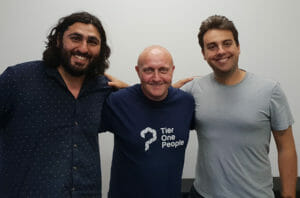
Alex (left) and co-founder Mario Hasanakos (right) with the shiniest head in FinTech!
How have you attracted highly talented people to the business?
Alex: It's a great question! I reflect on this a lot. The product and the space we're in is interesting, so that gets people's attention. Spriggy is also a unique brand, in a unique space, and there's a lot of interesting things happening in FinTech. However, getting people's attention, that just brings them to the table. There is a whole lot more involved in hiring highly talented people.
We have brilliant people in the team and a very eclectic mix of backgrounds. My co-founder is a physicist and an electrical engineer. Our CTO has been building apps ever since apps were around. Our CMO is a software engineer, one of our software engineers has a medical degree and our customer success lead used to be a geneticist.
We have managed to hire remarkably talented people who are great people, not just intelligent. They work hard, they care about what they do, they care about the people around them and they care about our customers.
This might sound simple, but talented people want to work with talented people who share the same values and ethics. That’s it. Sure, our people have flexibility, equity and all the advantages of working in a startup, but they are not the key motivators for joining.
Our people really buy into the Spriggy mission too. I love coming to work, and I learn so much from our team, every day. They are just amazing to be around. I am sure it will become harder to hire exceptional people as we scale, but right now, hiring talent isn’t a challenge for us.
What do you see as the challenges for Spriggy?
Alex: We have a customer base who like our product, we have a very capable team, we're in in a space that is exciting and there is lots of opportunity. The challenge is just to remain focused and keep on executing.
Execution is a lot less glamorous than people make out. It's rolling your sleeves up and doing all the hard parts. Execution is being focused on the right problems. Not trying to solve one hundred different problems, but solving the one or two that really matter. Keeping disciplined and focused when executing will be one of the challenging parts of our growth.
Access to capital in Australia is challenging. Mario and I, we're not natural capital-raisers, we're product guys. We have learned a lot during the capital raise process. Presenting as the founders, hitting the pavement, talking to a lot of people, learning who's in the network, who you should be talking to, who you shouldn't be talking to.
Learning how capital-raising works was a big challenge in the early days. But we are fortunate to have met a lot of good investors, good people, and great founders too. I underestimated how helpful founders can be. Other founders may be a year or two ahead can tell you who to approach and who not to approach, which saves a lot of time.
I personally find capital-raising challenging in the sense that I much prefer to be building the business, rather than talking about building the business. Pitching and raising capital are disciplines I've had to learn.
And what is the end goal for you and Spriggy?
Alex: This is not an easy answer. I am not thinking about an exit strategy. We're just getting started. We have just earned the right to play. And we've spent years earning the right to play. I feel like we're about to start delivering on the vision we had from the beginning.
It's becoming clearer what our customers want and need. It is obvious that the financial services sector is shifting and there are a lot of dynamics which are playing out globally. Tech is evolving rapidly and the consumer segment continues to evolve.
So, there are a lot of unknowns out there. We need to keep making sure we listen to the signal versus the noise, look after our customers, look after our team. And it's that simple.
But there's a lot of momentum in the market and we're looking forward to delivering more value over the next three, six, twelve months. There will be some cool features coming your way very soon.
Manage Cookie Consent
We use cookies to optimize our website and our service.
Functional
Always active
The technical storage or access is strictly necessary for the legitimate purpose of enabling the use of a specific service explicitly requested by the subscriber or user, or for the sole purpose of carrying out the transmission of a communication over an electronic communications network.
Preferences
The technical storage or access is necessary for the legitimate purpose of storing preferences that are not requested by the subscriber or user.
Statistics
The technical storage or access that is used exclusively for statistical purposes.The technical storage or access that is used exclusively for anonymous statistical purposes. Without a subpoena, voluntary compliance on the part of your Internet Service Provider, or additional records from a third party, information stored or retrieved for this purpose alone cannot usually be used to identify you.
Marketing
The technical storage or access is required to create user profiles to send advertising, or to track the user on a website or across several websites for similar marketing purposes.