Nuj Super - Matt McKenzie. From Beancounter to Fintech Founder.

In this episode of Fintech Chatter, host Dexter Cousins speaks with Matt McKenzie, CEO and co-founder of Nuj, a Regtech company making serious strides in the Aus$ 4trn Superannuation sector. Nuj’s plug-and-play solution streamlines workflows while ensuring compliance with all current and upcoming regulations.

The platform enables quick integration, with automated workflows, audit trails, and real-time updates.

Nuj raised a $4m seed round in early 2025 and counts Bluechip names like MUFG and AMP as clients.

Find out more - https://www.nujsuper.com/

Key topics covered in the chat:


Connect with Matt: https://www.linkedin.com/in/matthew-mckenzie/

Anthony Quinn - Arctic Intelligence

Anthony Quinn is founder and CEO of Arctic Intelligence, one of Australia's first Regtech startups. Anthony and the team have developed a platform that tackles the global problem of financial crime and money laundering. Dexter Cousins, CEO of Tier One People caught up with Anthony to talk about the journey so far.


Can you tell me more about Arctic Intelligence?

We specialise in audit risk and compliance software, predominantly in the final crime prevention space. One of our platform solutions is AML Accelerate, which is a cloud-based money laundering and terrorism financing risk assessment platform, that caters to 30 different financial and non-financial industry sectors and contains an AML Program tailored to the laws of over 10 countries

We've got a very diverse client base on AML Accelerate including some larger financial institutions like Suncorp, CUA, TAL, smaller financial institutions like the challenger banks, Xinja, Volt and 86:400, digital currencies, money remitters, non-bank lenders, as well as non-financial sectors including lawyers, accountants, real-estate agents and various pubs and clubs.

We also have developed two other platforms, another Risk Assessment Platform that we are about to launch. It is aimed at sophisticated financial institutions, major corporations and professional services firms and is a risk agnostic, flexible and highly configurable platform. The risk framework, risk and controls assessment and methodology can be adjusted to suit any company.  

The other platform is Health Check which caters for regulated businesses and their professional advisers. The platform assesses the design and operational effectiveness of compliance programs through rigorous controls testing, which is used by clients like Deloitte on their engagements.

How did Arctic Intelligence get started?

I spent 20 years consulting to investment, and retail banks first in the UK. I moved to Australia in 2003 running a number of risk and compliance programs for different banks. Over the last 10 years I specialised in financial crime and was the program director running the AML and FATCA programme for Macquaries Banking and Financial Services Group. I developed a deep interest in solving the financial crime problem. Many of the challenges regulated businesses have in managing their risk and compliance obligations stem from the fact that many of these processes are manual.

So, I set about building a platform to make it easy for regulated businesses of all sizes, sectors and geographies to conduct financial crime risk assessments and build effective control frameworks to mitigate and manage their risks.

There was a huge gap in the market that no one was addressing. Money laundering risk assessments and AML programs have to be signed off by the board, with significant consequences for board directors and companies in the form of millions of dollars in civil penalties.

CBA’s $700m fine (which highlighted among many other things, deficiencies in product risk assessment), the royal commission into banking misconduct and the rise of the board executive accountability regime make it clear organisations can no longer rely on outdated spreadsheets to manage a very important risk category.

Arctic Intelligence started as a side hustle, like most startups do. For two years, I was developing the business while working four days a week with Macquarie. I personally funded the initial development of the platform, working with a development team to build an MVP. At the end of 2015, I finished up with Macquarie and went full time with Arctic Intelligence.

We were one of the first residents at Stone and Chalk. Then in August 2016, we won our first client, Deloitte, and then from there the business has just kept growing.  We're 17 full-time staff at the moment, mostly based in Stone and Chalk but we do have a couple of people as Business Development Managers in Singapore and the UK.

How is the team structured?

First of all, as a startup we need people who are multi-talented. But we are broadly split across three main areas. Our Chief Operating Officer, Darren Cade looks after our operations, client services, HR, finance and content management activities.

We've got a sales and marketing team led by Imelda Newton. Her team is responsible for winning new clients and building relationships with consulting firms of all sizes plus establishing and maintaining active reseller relationships.  

Then we have the product and technology team, headed by Nathan Zaetta our Chief Technology Officer and supported by a Head of Product, Tammy Goodman and Development Lead, David Stephen. They lead the requirements gathering and software development across our three platforms and manage the testing team which we've got in-house.

Under each of these teams we are supported by a very enthusiastic and high-performing team, as well as a very experienced Board, Advisory Group and Investor base.

What are the biggest challenges you have found in hiring people.

The challenges you face in being a startup, is that most people with experience would be mad to join in some ways. Myself and some of the people we've hired could earn a salary of over $400,000 at one of the banks. It’s a tough sell to entice people to leave that comfort and join a startup for 75% less than they are currently earning on a promise of changing the world!

So, you've got to have the right people with the right attitude. Most importantly, anyone you hire needs to clearly understand what they are letting themselves in for.  We hire people who are passionate about the vision and can see where the business will be in a few years time. But even that isn’t enough. The people we hire need to demonstrate how instrumental they can be in making the vision come to life. Startup businesses are pretty tough at the beginning.

Can-do attitude is important, You can’t be political or too precious in a startup. We are building a team of high performers. We have been very selective with the people we have hired . We are very lucky to have high calibre people on the team.

How do you hire high calibre people?

We’ve done a couple of investor rounds which were targeted to private investors. That process not only brought in funding but gave access to investor networks. That is how we have assembled an impressive board. We have the ex Chair of PWC Australia as Chairman, Neil Helm, the ex-CEO of OFX is a director. Our board and investor network are all very deeply experienced and well connected, so we leverage that whenever we can.

Arctic Intelligence were one of the first RegTechs in Australia. How far has the industry come since you launched?  

It’s funny. When we launched RegTech wasn’t even a term. The Regtech Association came together about 18 months ago. A small group of startups were out promoting the benefits of RegTech and highlighting the need for change. We really struggled initially to get momentum, primarily because the care factor of AML compliance was so low.

Fines and penalties for non compliance were very low, the biggest fine was $300,000. And the likelihood of a regulator taking a business to court was virtually non-existent. The big shift started when CBA were fined $700 million, and the Royal Commission into banking  misconduct. There is now a lot of demand for RegTech solutions.

Arctic Intelligence were one of the first nine founding members of the RegTech Association. It has been overwhelming how positive the association has been received and much of the credit should go to Deborah Young, the CEO for driving this forward. At the last conference in March 2019 we had 105 startup and corporate members and sponsors. So it's definitely taken on a life of its own and the conversations are really starting to happen in major firms that may not have considered the value of regulatory technology.

There's certainly a lot of good use cases and testimonials and some really good early adopters of the latest  technology. We have noticed a significant uptake in our business and see this continuing to gain momentum.

What is the opportunity for RegTech in Australia to compete globally?

I think what we've got going for us is that it is a small market, but it's a very open environment. We have Tech hubs like Stone and Chalk, Tank Stream Labs, Fishburners etc fostering innovation in RegTech and FinTech. But we also have very open and engaged regulatory authorities such as AUSTRAC and ASIC. They are running regular update meetings and have developed an outreach programme to RegTech startups.

The regulators are now very open to RegTech and frankly I think they need it as much as the banks do. If you look at a regulator like AUSTRAC, they've got 300 staff to monitor 14,000 regulated businesses. This number will increase to approximately 85,000 businesses in 2020. Without technology it is not feasible that regulators can effectively regulate - they are resource constrained and losing the battle, they have to be smart about supporting technology innovation but also become adopters themselves. I offered our technology to one of the regulators for free, over 4 years ago but nobody has taken up this offer.

It's a great eco-system where you've got regulators, regulatory bodies, professional services firms and tech providers collaborating together, challenging each other on the art of the possible. It is leading to rapid innovation and proving what can be achieved. Everyone is going on their own journey with RegTech, which gives us all a much deeper understanding of multiple perspectives.

I think this is the key reason why Australian RegTech seems to be standing out globally.

What are the future plans for Arctic Intelligence?

We are about to launch, another risk assessment platform, which is domain agnostic. So it can do much more than Anti Money Laundering. The new platform has multiple use cases including bribery, fraud, cyber, operational risk or any risk domain. It allows a lot more flexibility in terms of being able to introduce risk models or control frameworks, add relative weighting of risks and controls, changing methodologies.

We’ve developed a very flexible risk platform primarily aimed at sophisticated reporting entities like major banks. Believe it or not, most of the major banks we work with in Australia and overseas are still managing financial crime and AML risk assessments on spreadsheets. The platform takes the data in those spreadsheets and puts it into a robust risk assessment framework.

The platform is geared towards regulated businesses and the professional services community. Deloitte are white labelling our technology. We are in a beta test program, which is a global program with about 25 different stakeholders in the UK, Canada, the US, Southeast Asia and Australia.

What's the end-game for Arctic Intelligence?

We feel like we're at the bottom of the mountain, even though we've been going for quite some time. There's a lot of growth potential for us in terms of growing into new markets, growing into new industry sectors and growing across our product ranges.

We think we're just at the start and the sky’s the limit, so we are really pumped to get out there and make a difference. And ultimately it is about trying to do our bit to help solve the money laundering problem and the social impact that causes - violence on our streets, rampant ice addiction in Australian cities and country towns, increase in crime rates, domestic violence and broken families.

That is our higher purpose and the thing that really drives us.
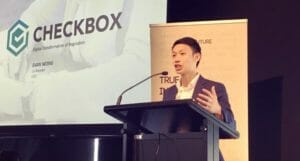
Evan Wong - Checkbox.ai

Checkbox was under the radar for over a year. There was no product to show potential customers. No one knew about us until we won Regtech of the Year at the 2017 Fintech Awards. Fast forward 12 months and we have grown from four to twenty people.

Evan Wong - CheckBox

Evan Wong is CEO and Co-founder of Checkbox. At only 25 he already has two successful  startups under his belt. Checkbox is a Regtech solution that enables business people to build software without any sort of coding.

Checkbox is to business applications what WordPress is to Web Design. Used by lawyers, accountants and bankers Checkbox is considered the ideal tool to fix the Regulatory and Compliance issues facing many financial institutions.

How did you become an Entrepreneur?

Evan: I founded my first business when I was 17, an education business called Hero Education. Until that point I’d never shown any signs that I was going to be an entrepreneur. Looking back, I did possess certain entrepreneurial qualities; constantly learning, the drive and desire to solve problems.

What you bring into the world as an entrepreneur is so unique and it really cannot be matched with any other experience in your life. Because of your hard work, your decisions, your creativity you've now put something new into the world. It is an unparalleled feeling when you know that this has impacted so many people for the better. I really got hooked on the drug of being an entrepreneur with Hero Education. So, when I left university at the age of 22 it felt natural to get started with Checkbox.

How did the idea for Checkbox come about?

Evan: Like every other startup, we didn't begin our journey with this idea. People think you need to find the right idea before you launch a startup. Most startups aren’t successful because of the initial idea. It is usually through a diligent process of speaking with customers, understanding the market, and understanding a customer’s problems that an idea then refines and pivots. Eventually it becomes a viable business not just an idea.

In my experience it is best to start with a big, broad idea that's anchored to a very strong and passionate why. Checkbox happened because I was passionate about two things: Simplifying the complexity around regulation and compliance. I felt that first hand running Hero education. And my second passion was empowering non-technical people to build software.

A lot of people ask me how did you start a software company when you don’t have a software background? Checkbox solves two of the biggest problems I faced when launching my first startup. I hated compliance and process and I hated that I couldn't code.


How did you get the product out to market?

Evan: So here is my tip for people launching a startup and that is you should never approach new contacts with the intention of making a sale. If you want to sell your product you first need to build the right relationships. When you start out, you can't make the sale anyway because the product isn't there. The way to frame your approach is to always ask for advice and feedback. People are more than happy to help you out, especially if your product is in their space.

But what you're doing is a presales process. The advice you get can be used to improve your product from a customer's perspective. And the customer is now invested in the product from an emotional viewpoint. In a few months when you have built your MVP they can’t wait to see the demo.

Then it is a much easier presentation and sales process because you are not coming in cold. The client has contributed to the product, they are invested in its success and if the product delivers value they will buy.

Starting Checkbox straight out of University, I had no professional network to tap into. All our clients are Tier One corporate's, banks, accounting firms, law firms etc. Two years ago, when I started Checkbox, I didn’t know a single person in these types of organisations.

How did you get Tier One corporate's as your first clients?

Evan: As a founder you must be quite good at hustling. I had to grow our network of clients from nothing. Coming straight out of University, there were no existing contacts or network in Corporate land.  So, I started out by creating a general profile of people I thought that would be interested in the product. Through a combination of research, Google searches, reading articles, blog posts and LinkedIn profiles I built a target list of ideal customers.

Next, I’d reach out by email asking to set up a short call for feedback, not to sell anything! Just feedback on the Checkbox value proposition. The discussion would usually be followed up a few months later with an in-person demonstration of the product. At the end asking for recommendations or referrals to other contacts in their network. Today most of our business comes from word of mouth and thought leadership marketing. Being active at industry events and conferences helps our profile a lot.

What is the secret to working with Corporates?

Evan: There is a lot of buzz and hype around innovation and technology. Bluntly speaking corporates are still learning how to integrate technology into their day to day processes. There is a lot of excitement surrounding startups and corporates are always willing to have discussions. But you must cut through that first layer and understand quickly who the real customers are. The real customers are people who take you seriously, treat working with startups like a project implementation and have the intention of purchasing a license. It's tricky but you learn from experience how to prequalify the right opportunities.


How has the business changed since your early days?

Evan: Checkbox was under the radar for over a year. There was no product to show potential customers. No one knew about us until we won Regtech of the Year at the 2017 Fintech Awards. Fast forward 12 months and we have grown from four to twenty people. Today we have a product that is purchased by tier one enterprises. We went from bootstrapping to closing a $1.7m funding round. We have gone from no revenue to now generating revenue. And we won Regtech of the Year again at the 2018 Fintech Awards. It has been a totally crazy year.

Out of all the challenges we have faced, finding the right people has been the toughest. As soon as the business gets to a certain level you can't do it alone anymore, no matter how brilliant you are or how hard you work. At the end of the day it's going to be a team of great people who will realise your vision and build on the initial success of the founders.

I have learned people are the most important factor to business success. You need to be very, very precious about who you bring into your team. When you are a startup every new addition changes the dynamic and culture, way more dramatically than it does at a larger company.

How do you attract the right talent to Checkbox?

Evan: I hate to say this, as it's a love hate relationship, the best way we have found talent is through recruiters. But they're expensive. We started off hiring through our personal networks, but we didn't know the right people. Then we tried out some of the newer recruitment platforms. They were okay, again the quality wasn't quite there.

Then the pressure hit, and we had no other option but to use recruiters. The amount we've paid in recruitment fees over the last year is enough to justify two full time in-house recruitment resources. So, we are exploring tools like LinkedIn recruiter. But we are still finding it very difficult to find the right quality if I'm being honest.

The secret is to create partnerships with the best recruiters in their field. Using multiple recruiters was probably our greatest recruiting flaw. Maybe that is the right thing to do at the very beginning because you don't know anyone in the market? But eventually you realize that by working with so many different recruiters you don't get the best talent. Recruiters will save the best talent for the clients they have the strongest relationships with. People are the most important asset in a company. It is the one area where you can’t afford to cut costs, even in a startup.

We have gained the best results by working in partnership with select recruiters and paying their fees. I have found if we give exclusivity we can negotiate cheaper fees and still get access to the best talent. It is all about creating a win/win relationship. We get great talent at a reduced fee; the recruiter gets repeat business and knows they will get paid for the work they do.

Attracting the right people is massively important.

Evan: Getting the right talent to stay is even more important. Especially when you consider the pain and the cost for finding someone. Founders can sometimes be a little complacent and don't fight for employees when they resign. How expensive was it to get them into the business? How much time did you have to spend convincing them to join? How much time and money have you invested in them as a person? Then why aren't you figuring out ways to make the person want to stay? Especially when replacing them is an extremely expensive exercise. Will the replacement be a fit to your company and can they perform? Retention of good people is more important than acquisition of good people.


How do you retain your people?

Evan: Retaining the best people is about leadership. It's about being a good leader. Good leadership includes understanding and listening to your employees. You need to understand what your peoples career goals. When issues arise, you need to act quickly and resolve in a professional, mature and empathetic way.

Culture has the biggest impact on retaining talent, especially if you're a startup. If you're a startup with a crap culture, then you are a crap business and a crap place to work. As founders you need to work out exactly what your culture is going to be. Get your vision, your purpose and your values set early days. The values of your company must flow from the values of the founders. I feel very strongly about this. When you are starting a business, the founders are the brand of the company. The founders are going to set the energy, the expectations and the culture of the company as well.

Similarly, the values of the company must reflect the values of the founders. We have three founders at Checkbox. Now all three of us may not have the exact same personal values. So, we have spent days working out what we truly cared about. Collectively we decided on the top five shared values. Values we could demonstrate and action every day, values our customers and employees would also care about.

The Checkbox values are:

Practice positivity, master empathy. It's about creating a very positive outlook no matter what happens. It is about choosing positivity over negativity and keeping up morale in the team.

No ego, no blame, no mercy. No mercy means having an open company culture where if there's a problem we talk it through. There's a mutual understanding within the company that there are no personal attacks. We are just calling issues as they are but bringing no ego and no blame to the discussion.

Simply first class. We strive to over deliver in everything we do. We want to exceed expectations.

Empowered as a team. This is a concept whereby we provide autonomy to all team members, so they can direct the company in a way they see best, as a team. If it's not done as a team everyone is just running around like headless chickens. But if we are all aligned to the same target then people can make autonomous decisions.

Be Bold. Suck less. Be Bold means taking calculated risks and experimenting. Learn so that you can Suck Less. If you understand what you suck at then you can fix it. It's about continuous improvement.

I feel aligned to all five values but the hardest one to practice daily is Simply First Class. As a startup we've got limited resources. You often compromise. The quality of the code, the type of talent you can hire or the product you present to the customer. There's always going to be a compromise. It is tough because you don't want the company values to be something you aspire to. They should be the expectation today.

What does the future hold for Checkbox?

Evan: We are considered a Regtech startup. For now, we are focusing on regulation and compliance. But there's no reason why we can't extend the software for other purposes. Our mission is to empower business people to build software. The vision for our company is to become the industry standard for anyone who wants to build software. In the same way Microsoft Office is used to create documents, presentations and spreadsheets. We see Checkbox as the tool to create software. But today we are focused on business applications to manage processes, policies and decisioning.

Over the next 12 months we have a major project in Asia. International expansion is very much in our sights. In my role as CEO, right now is about laying the right foundations for scalable growth. We are past the phase of product validation, but we are not quite ready for high growth.

We are in a period where we need to hire the right people so that when we hit the 'Go' button the business won't fall apart in the process. We have just hired a Head of Finance and Operations, Head of Professional Services and a Customer Success Manager. These are examples of the more operational roles we need to hire right now. But we are hiring across the whole spectrum; engineers, developers, sales people, operations. In two years, we could have two hundred employees, so we are always open to conversations with talented people who have what it takes to grow a business and share our values and culture.

Get more info on Checkbox  

Check out our latest Fintech jobs