David Washbrook - Look Who's Charging

Look Who's Charging had a stellar 2018 with numerous awards, accolades such as featuring in KPMG's FinTech 100 and commercial success with two of the Big 4 Aussie banks becoming customers. Sibos and Money 20/20 helped put Look Who's Charging on the global FinTech map.

Tier One People's Dexter Cousins talks with Co-Founder David Washbrook to talk about a fine year and a Vegas road trip!

Tell us about Look Who’s Charging.

Look Who's Charging is all about improving the customer experience through enriching bank statement transactions. Everyone has experienced the issue. You look at your bank statement and half the time it may as well be written in foreign language. You see C&A WALKER PTY LIMITED, for example. A Google search brings up hundreds of businesses none of which you recognise.

So, you phone your bank. Twenty minutes on hold, verify yourself, bounce between two or three different departments, and at the end of all of that, more often than not the bank can't do anything other than a Google search themselves. In fact, two of the Big Four bank's contact centres don't even have access to Google.

It is a very frustrating problem for the consumer, leaving them feeling genuinely worried that they might be subject to fraud. It's also a very expensive problem for banks. Ten percent of all the calls to a banks contact centre relate to queries on unrecognised transactions. Sixty percent result in manual chargebacks, costing a bank around $80-$90 dollars for each one.

We improve the customer experience and save banks millions of dollars in costs through reduced calls and chargebacks.

How did you come up with the idea for the solution?

It was two-fold.  My fellow Co-Founder, Stuart, was running a separate business at the time.  He became increasingly frustrated with trying to reconcile his accounts due to the large number of confusing descriptions (most small accounting packages use bank statement data).

At the same time, I inadvertently committed a friendly fraud. I disputed a transaction with my bank as didn't recognise the merchant. I genuinely thought it was a fraud. I got my money back for the transaction which later turned out to be legitimate.

We did some further research and we quickly realised that unrecognised transactions were a big issue for consumers and also a very expensive problem for banks.  Australian banks alone are spending somewhere in the region of $200m a year dealing with the problem.

Your solution sounds so simple. Why is it that nobody's done this before?

A lot of Fintech businesses can often be complex to explain. You are correct in that ours is very simple. However, solving the problem is far from simple. Lots of people have tried before. We know big banks who have tried; large software companies who have tried; other Fintechs who have tried.

They throw a team of people at it, work on the problem as a project, get something that is fifty, sixty percent of the way there, but unless you're maintaining the data, staying on top of it, it quickly becomes redundant.  Our senior team has over 80 years’ experience working in IT and on big data problems, and this is by far the most complex problem any of us have ever come across.

The idea is not new but being able to execute on the idea, that's where we have achieved something that no one else has managed to.  We return over 180 different fields on a merchant and our accuracy is >95%.  Most other offerings simply return one field (being category) and the accuracy is far lower than us.  Banks are pushing our data to one of the most important consumer touch points being the transaction feed of digital applications; they have to have trust and confidence in our product.

Our solution has three core components, all using proprietary market first technology:

Merchant database. We have compiled a database of the 1.3m card accepting merchants in Australia.  Over 1m lines of code and we draw on over 150 different data sources to ensure we always have the most up to date information.

To solve the problem you need to understand both the legal entity information and trading entity information for a merchant.  Some businesses out there know the legal entity information of a company, and some know the trading entity information, but from what we can tell we are the first business to build a complete legal and trading view of a merchant.

Search engine. We have developed a proprietary search engine to match the 20m+ transactions descriptions (per debit and credit card statements) back to this database of 1.3m card accepting merchants.

Robust architecture. Our robust architecture enables our data to be pushed to bank’s digital applications in real time.  Our API can return data on up to 50 transactions in less than 30ms.

Most importantly you need a solution that solves a genuine customer pain point, saves the bank money or improves regulatory compliance.  Tick two or three of these boxes and your chances of working with a bank significantly improve.
But you also have to have the correct governance, compliance and risk management protocols in place to pass their security and procurement checks.

You've partnered with NAB. How difficult is it to partner with a Big 4 bank?

First conversation to go-live with NAB took seven months for us, which was fantastic, especially as they were our first customer.  NAB had identified the problem of unrecognised transactions as a top consumer pain point and one that was costly for the bank.  We offered a unique, market-first solution and NAB was able to move quickly to bring this to their customers.

In general the sales cycle with a big bank, or any bank for that matter, is relatively long.  Most importantly you need a solution that solves a genuine customer pain point, saves the bank money or improves regulatory compliance.  Tick two or three of these boxes and your chances of working with a bank significantly improve.

But you also have to have the correct governance, compliance and risk management protocols in place to pass their security and procurement checks. You can have the best product in the world but if you don’t have the right risk management procedures in place then you won’t go-live with a bank. The Hayne Commission and recent high-profile data breaches from companies such as Equifax, British Airways and Marriot-Starwood Hotels make it increasingly harder.

Finally, you must make your solution as easy as possible for a bank to integrate with. Our solution is at the easier end of the spectrum, but it's still a lot of work for a bank to integrate with a third-party. If your solution is going deep into banking systems, even if it's the greatest product in the world, it makes it a much harder task to partner with a bank.


Gaining recognition in the KPMG Fintech 100, has it had a noticeable impact on being able to attract talent and clients?

Absolutely. It has been a really good win for us, especially as we were selected without even applying. We've been fielding a lot of inbound inquiries from all around the world after the report was published.  I think we were one of only seven Australian companies to make the list.

We're almost at thirty people now, twelve people onshore and another fifteen people offshore. We will continue to hire people in 2019. The decision has been made to draw on the best expertise from people around the world as there is a lot of complexity to our solution. Finding the skills onshore can sometimes be challenging; machine learning, AI, the search components of our architecture. We've developed a hybrid model with three very senior developers onshore managing the specialist skill sets from around the world and bringing everything together to make the solution work.

Culture becomes a critically important element in growing a business, and the culture is really determined by the quality of people that you hire.  If you have a start-up with some traction, you're building something exciting and people can get involved with growing the business, it’s generally very appealing to great talent, especially with the buzz around tech at the moment.

You recently presented on stage at Money 20/20 in Las Vegas.  How was that experience?

Money 20/20 brought together over 15,000 people from leading Banks and FinTech companies from around the World in Las Vegas during the final week of October. We were lucky enough to get a spot on stage and a stand at Money 20/20. Look Who’s Charging was selected, as one of only 24 companies, out of over 800 from around the globe, to pitch on centre stage.  If you're a tech business you really have to think globally from day one. Money 20/20 provided the perfect springboard to explore off-shore expansion.

Immediately after our presentation there was a long line of companies queuing at our stand up saying 'we need this in the market. No one is focused on the problem.' The greatest interest came from Canada and the UK, they're a bit more advanced with digital banking than the U.S.

What’s your perception of the Australian FinTech market compared to the US?

We expected to go to Money 20/20 and find 10 other companies doing what we do. However, despite a high demand for transaction enrichment, we were unable to find any company who has or is trying to provide a solution quite like ours.

More generally in the banking and the payment space it seems that the U.S. is definitely lagging Australia.  For example, we have contactless payments rolled out across the country.  I personally haven't taken cash out in Australia since 2017 and I haven’t had any problems. I solely rely on my phone and my watch now.

The U.S. still primarily has legacy infrastructure where you have swipe your card, sign, and show ID to verify your signature.  A number of merchants also still don’t accept card payments.  This makes it much harder to enact behavioural change and get people to switch to a digital wallet.

The environment in Australia is the perfect testing ground for financial services companies to get their product to market. If you can perfect your product here, there's a massive opportunity to then launch in the U.S. and other markets like Europe.

However, I think that we have got to go to them because they're generally not coming to Australia to find out about us.  The support is there for Australian FinTechs to expand, for example, Austrade’s Global Landing Pads and the recent UK FinTech Bridge.  In addition, if you have a product in market, and that product is scalable, you shouldn’t have any issues raising money in the markets like the U.S.

What growth plans are there for 2019?

We are super excited about the coming 12 months.  We’re making good progress in the Australian market having on-boarded two of the big four banks and a number of small banks. This will remain our number one priority in the short term.

There’s also a growing number of use cases for the technology – enriching transactions within digital banking applications is just the tip of the iceberg.  For example, one of the top findings from The Hayne Commission was that banks are generally good at verifying income on loan applications but that they were generally poor with expense verification.  Our technology can quickly and easily automate the verification of both income and expenses to a high-degree of accuracy.

Overseas expansion definitely remains our longer-term goal.  We’ll likely look to expand into the Canadian and U.K. markets next as they are similar in nature and size to Australia. We're very excited by that prospect and opportunity.

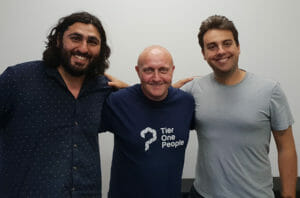
Alex Badran Spriggy

Spriggy is a financial education product for families that helps parents teach their kids about money. The app has become so important in the 'Cousins' house hold that the kids now call 'pocket money', 'Spriggy money.'

Dexter Cousins of Tier One People talks with Co-Founder and Co-CEO, Alex Badran, to talk about the Spriggy journey. Alex is one of the smartest, likeable and authentic entrepreneurs you will ever meet.

How does Spriggy work?

Alex: Spriggy provides a prepaid card for kids and an app that parents and kids use together. Through the app, kids can learn about earning, saving, and spending, in a responsible manner, in an environment supervised by their parents.


How did the idea for Spriggy come about?

Alex: In 2015, myself and my co-founder Mario Hasanakos got together, and we were talking about banking. We had both worked in a bank and felt banks could do a better job in teaching their customers about money. We could see technological advances were enabling new solutions to enter the market.

Banking at the time was slow-moving, encumbered by legacy technology and regulation. Mario and I felt the conditions were right to deliver something unique to consumers. So, we began talking to people about how they interacted with money and the challenges that they faced. We very quickly discovered a problem that exists between parents and their kids;

We found invisible money was a real concern for most parents out there. It's a very practical problem as kids are spending online nowadays and money is becoming increasingly digital, yet parents are still teaching kids with antiquated techniques.

So, we set out to help parents teach their kids about money. And started by trying to solve a very practical problem, which is:

"how do I manage digital money with my kids?"

Listen to Alex on the FinTech Australia Podcast

How did you bring the idea of Spriggy to life?

Alex: Mario and I have a bias towards doing. During the research phase we built a very clunky prototype. Our first-ever family, Annabelle and her kids, sat in the office with us, as we used off-the-shelf products to put together a product.

Within a few days Annabelle, had a basic tool through which she could manage pocket money with her kids. It wasn't the best product, but we were able to observe the challenges that Annabelle faced and iterate on the solution that we had in place. We then built a solution and tested it with fifty families. Based on the learnings from testing we built the commercial version you are using today.

What feedback did you get during the early stages?

Alex: It was an interesting experience. Mario and I were given a front-row seat to the challenges parents face with their kids. We learnt pretty quickly that it can be tough managing kids. The jobs of mums and dads is chaotic. You've got kids going to sport, you've got kids running out the door going to school.

We learned quickly that if we didn't build something to make their lives easier, they wouldn't have the time to consider it. Anything we could do to simplify the challenges faced by parents, would be considered a win.

Building an app for adults and building an app for kids is a very different process. Adults are used to having control, they're not as digitally native. Parents understand concepts around money, but are less literate in technology. Whereas kids, they know their way around Snapchat, Instagram, YouTube, but are less literate when it comes to finance.

We could get away with clunky prototypes with parents. If it was functionally up to what they required, they were happy with it. But with kids, if it wasn't up to the quality standard they had grown used to, they wouldn’t use it.

Building a solution for kids was daunting, but also informative, because we discovered quickly where you need to set the bar. It was intimidating putting products in front of kids. They'd find bugs very quickly and they'd say, ‘look, it's not good enough.’

Don’t underestimate kids. By giving kids control, responsibility, and ownership, and them seeing the consequences of their decisions, it's remarkable how quickly they learn. There's no conversation we've seen to replace the feeling a child gets when they spend five dollars on something stupid and then regret it.

The act of learning by doing is very powerful. Which is something I've always believed. There's plenty of research to back it up, but seeing it in practice was cool.

Spriggy Money
The Cousins Klan earning their 'Spriggy' money!


What was the point that you realised that, ‘Hey, we’ve actually got something really special here?’

Alex: I remember this moment vividly. We were moving from our prototype product to a commercial product, I called one of our earlier users, Nicola, and asked her if we could wind down the original prototype. She would only have to wait a couple weeks for the commercial version.

Nicola said no. We couldn't take the prototype away from her, because she needed it. Even though it was clunky, didn't work properly, and wasn’t to a commercial standard, Nicola’s daughter had been naughty that week and she was restricting her pocket money. I got off the phone, went back to Mario and said, “Man, we’ve got to keep this product running for one of our families because they just need it.”


There has been a lot of ‘bank bashing’ recently with the Royal Commission. What do you think is the right approach for a FinTech start-up to get traction, and become successful?

Alex: Interesting question. I think it's about knowing who your audience is. There is a lot of talk around banks right now. Could Spriggy take advantage of the Royal Commission and ‘bash the banks?’ Yes, but I think negative messaging is setting the bar low.

Parents don't care about banks. They care about their kids. They care about their kids being able to buy lunch, they care about their kids being able to buy a house when they grow up, they care about being able to afford a family holiday, and don’t want to have to worry about school fees.

Our view at Spriggy is that we're always better off focusing on who our members are and what's important to them. How do you find the core, emotional driver, that keeps your customers up at night, and deliver real value to them?

How have you scaled the business?

Alex: Mario and I are both optimists at heart. The downside of that is you under resource at times. Spriggy was only four full-time people when we launched to the public. It was remarkably challenging in those early days. You don't really know where the cracks are in your system, particularly with a product of this complexity, until you put in front of people.

When it comes to people’s money, if it feels like their money isn't where it should be, that's a terrible user experience. You can't get away with mistakes and bugs. If you build a social app, and a user has two likes instead of three, people don't seem to mind. But the minute you're starting to deal with real money, the quality threshold needs to be extremely high.

At launch, the product was ready to go, but as we started to scale the business, we had challenges. In the early days, we were growing much faster than we expected. And we were receiving a lot of feedback from our customers. It was all-hands-on-deck, to ensure we applied the feedback and iterated the product quickly.

We are now a team of twenty, which is great to see. For the first time since Spriggy started we are not depending on a few remarkably talented people to do everything. We now have remarkably talented people, in specialist roles. We now have processes and support in place, we now have the tools and resources to take a product and business which is scaling and deliver even more value to our customers.

Spriggy Co-Founders
Alex (left) and co-founder Mario Hasanakos (right) with the shiniest head in FinTech!


How have you attracted highly talented people to the business?

Alex: It's a great question! I reflect on this a lot. The product and the space we're in is interesting, so that gets people's attention. Spriggy is also a unique brand, in a unique space, and there's a lot of interesting things happening in FinTech. However, getting people's attention, that just brings them to the table. There is a whole lot more involved in hiring highly talented people.

We have brilliant people in the team and a very eclectic mix of backgrounds. My co-founder is a physicist and an electrical engineer. Our CTO has been building apps ever since apps were around. Our CMO is a software engineer, one of our software engineers has a medical degree and our customer success lead used to be a geneticist.

We have managed to hire remarkably talented people who are great people, not just intelligent. They work hard, they care about what they do, they care about the people around them and they care about our customers.

This might sound simple, but talented people want to work with talented people who share the same values and ethics. That’s it. Sure, our people have flexibility, equity and all the advantages of working in a startup, but they are not the key motivators for joining.

Our people really buy into the Spriggy mission too. I love coming to work, and I learn so much from our team, every day. They are just amazing to be around. I am sure it will become harder to hire exceptional people as we scale, but right now, hiring talent isn’t a challenge for us.


What do you see as the challenges for Spriggy?

Alex: We have a customer base who like our product, we have a very capable team, we're in in a space that is exciting and there is lots of opportunity. The challenge is just to remain focused and keep on executing.

Execution is a lot less glamorous than people make out. It's rolling your sleeves up and doing all the hard parts. Execution is being focused on the right problems. Not trying to solve one hundred different problems, but solving the one or two that really matter. Keeping disciplined and focused when executing will be one of the challenging parts of our growth.

Access to capital in Australia is challenging. Mario and I, we're not natural capital-raisers, we're product guys. We have learned a lot during the capital raise process. Presenting as the founders, hitting the pavement, talking to a lot of people, learning who's in the network, who you should be talking to, who you shouldn't be talking to.

Learning how capital-raising works was a big challenge in the early days. But we are fortunate to have met a lot of good investors, good people, and great founders too. I underestimated how helpful founders can be. Other founders may be a year or two ahead can tell you who to approach and who not to approach, which saves a lot of time.

I personally find capital-raising challenging in the sense that I much prefer to be building the business, rather than talking about building the business. Pitching and raising capital are disciplines I've had to learn.


And what is the end goal for you and Spriggy?

Alex: This is not an easy answer. I am not thinking about an exit strategy. We're just getting started. We have just earned the right to play. And we've spent years earning the right to play. I feel like we're about to start delivering on the vision we had from the beginning.

It's becoming clearer what our customers want and need. It is obvious that the financial services sector is shifting and there are a lot of dynamics which are playing out globally. Tech is evolving rapidly and the consumer segment continues to evolve.

So, there are a lot of unknowns out there. We need to keep making sure we listen to the signal versus the noise, look after our customers, look after our team. And it's that simple.

But there's a lot of momentum in the market and we're looking forward to delivering more value over the next three, six, twelve months. There will be some cool features coming your way very soon.