Peter Jones - Nimo Industries: Breaking Into Mutual Banks.
Peter Jones used to be the CEO he now sells to. It's helped him bootstrap a core banking platform that now holds 20% market share in Australia's mutual banking sector, without a dollar of outside capital.
We are celebrating the World Credit Union Conference coming to Sydney. Dexter Cousins will be bringing you interviews from the show and special announcements.
Peter Jones co-founded Nimo Industries with Leann Jones after living the core banking problem himself as a mutual bank CEO. Ten years ago, Peter and Leann were sticking Post-it notes to a glass wall in a Melbourne office. Today, Nimo is a platform serving over 20 Australian banks and lenders, entirely bootstrapped.
The category Nimo competes in has seen huge raises. Mambu has raised $446 million. Thought Machine has raised $706 million. nCino raised $222 million in venture funding before listing on Nasdaq in 2020 at a $2.8 billion valuation. Nimo built a comparable platform on savings, sleepless nights, and two former bank executives' understanding of exactly what their customers would tolerate.
I've known Peter a while, and when we sat down for Fintech Chatter this month, two things stood out more than the product itself.
Most fintechs think you need to break into banks by overselling.
He didn't start in Fintech. Peter spent close to two decades in banking before Nimo, including as CEO of Plenty Credit Union nearly 20 years ago, and in roles at ANZ, NAB and ME Bank. That's the exact profile of customer Nimo is targeting: more than 20 Australian banks and lenders, and counting are customers of the platform.
Core banking change has such a reputation for going wrong that Peter and his team used to have a name for it in their old jobs: "touching core is a CEO killer." Careers end over botched migrations, so most mutual bank CEOs simply don't touch the system, and the fragmented, twenty-year-old stack stays exactly where it is.
Peter told me the advantage isn't the technology he's selling. "I have walked in the shoes, I know how hard it is," he said, and it shows in how Nimo sells: no pre-sale promises it can't keep, because he's watched vendors make exactly that mistake from the buyer's chair.
That experience shows up in the compliance work most new entrants can't stomach. Nimo has built to ISO27001, SOC2 and APRA's CPS 230 and CPS 234 frameworks as a condition of entry, not a differentiator, and Peter is blunt that it's "really, really hard, especially for a new entrant." The pay-off is speed once trust is established: one Nimo client went live within five to six weeks of signing, where Peter says the old model runs to "twelve months or eighteen months."
Another client, South West Slopes, used Nimo to push further into open banking and CDR than most lenders twice its size. "We try to talk about promises made and promises kept," Peter said, and that line summarises the whole sales model.
Bootstrapping against some of the world's biggest Fintechs.
Nimo started out self-funded. Peter and Leann first built on Pega, then spent eighteen months on Salesforce, before realising neither platform let them control enough of the stack to price the product at what a mutual bank could actually afford.
That's when they went 100% serverless on AWS and stopped renting someone else's architecture. It's an Australian specific version of what Mambu, Thought Machine and nCino solved with hundreds of millions in venture funding.
Every fintech conference Peter goes to runs the same cycle: digital ID, open banking, neobanks, BNPL, and now AI, each one arriving with investors keen to see it in the pitch deck whether or not it belongs in the product.
Nimo never had that pressure, because it never had investor money. "We're pretty pragmatic at the core of it," Peter told me of Nimo's approach to AI, at a moment when most of his funded competitors are running the opposite play.
None of that made it easy. "There's been many sleepless nights, there's been many all-nighters," Peter said, and he's clear that staying "totally self-funded" for a decade was a choice made under real strain, not a badge of a honour.
What it bought Nimo is now, for the first time, a seat where it can choose who backs its next phase of growth, rather than needing anyone's money to keep the business alive. Peter told me those conversations are underway. Investor meetings are happening from a position most bootstrapped fintechs never reach.
Nimo on the World Stage.
Ten years after the Post-it notes went up on that WeWork wall, Nimo is a Platinum sponsor at the World Credit Union Conference, the globalised version of COBA. They've attended every year but have evolved significantly from what one client jokes was "a little orange stand in the back corner."
Leann is speaking at the plenary. What's notable is that their presence doesn't come from a term sheet and fresh round of funding. They've earned their standing from spending a decade being the kind of operator, and the kind of business, that couldn't afford to be anything other than exactly what it promised.
Find out more: https://nimoindustries.com/
Dexter Cousins is the founder of Tier One People, Australia's leading executive search firm for fintech. He has completed 200+ executive placements and hosts Fintech Chatter, Australia's longest running fintech podcast with 370+ episodes and 30,000 monthly listeners across 40 countries.
Andy Taylor - Stakk: The ten year overnight success.
Andy Taylor is Co-Founder of Stakk an embedded finance infrastructure solution. On 6 July 2026, ASX-listed Stakk Limited signed a definitive agreement to acquire US document intelligence firm ParaScript for US$63 million. I've interviewed Andy more than once over the past decade, way back when he was just starting to build Douugh out of Tank Stream Labs. Talking to him last week about the deal and the pivot to Stakk, three things stuck with me, perhaps even more than the acquisition itself.
Being early can almost be as challenging as being wrong.
When I interviewed Andy in 2018 he described an AI concierge for Douugh called Sophie, a digital assistant that would manage someone's entire financial life. His vision blew my mind so much so that I called him a visionary at the time. He was also about eight years too early. Large language models didn't exist. Open banking data was still screen-scraped. Customers weren't ready to hand a chatbot their financial life, let alone trust its advice. The idea was right. The infrastructure to build it wasn't there yet, and neither was the customer.
Douugh didn't get the chance to wait for the world to catch up. Capital dried up overnight in 2022 as Russia invaded Ukraine. Investors moods changed from grow at all costs to cut costs at all costs. Douugh relied on infrastructure and rails provided by other Fintechs. Unfortunately they didn't survive 2022. Overnight Douugh's business model came crashing down. "I probably still have nightmares about it," Andy told me.
Douugh had to pivot fast and become something else to survive: They repurposed what they had built with Douugh into an embedded fraud and identity platform, licensed to companies like Chime, Robinhood and T-Mobile rather than sold to consumers.
"It's a data game," Andy said of the pivot, and the ParaScript deal is the next evolution of Stakk. Three decades of document intelligence, clients including USPS and Deloitte, bolted onto a business now claiming 99.99 per cent decisioning accuracy for the fraud programs it runs.
If Douugh hadn't survived 2022 it would have just been another failed neobank to the armchair critics. Being early and being wrong look identical to people from the outside. But for those who've been around Fintech a long time, what often determines success is whether the business is still standing when the market catches up to the idea.
"The days of raising money on a vision are gone," Andy said. What's left is whether you built something that can pay its own way until the vision becomes obvious to everyone else too.
Visionary is a small part of the job.
Being a visionary used to be the main role of a founder. But it's not what got Andy through 2022 and turning the business around. What he talked about instead was grit: keeping a team believing in a plan when the plan has just been completely rewritten.
Shutting out the external noise and pressures and always showing strength for the team is probably the hardest trait for any founder. "You can never be seen to be showing that weakness," he told me.
It's at odds with most of the leadership advice doing the rounds in fintech, which tells founders to be open about their struggles and to lead with vulnerability. I don't disagree with Andy being vulnerable may be useful advice for founders when we are in "Peace Time" but the reality is Fintech is in "War Time" mode.
In times of challenge people need a leader to be strong. Andy's instincts have led to Stakk growing rapidly, expansion into the US and a $63m acquisition.
Maybe the pivot isn't product, but location?
Andy's advice to any young Australian founder listening is blunt: move. Go to a market that backs risk-taking and has real access to capital. It's confronting advice because Andy is a founding father of Australian fintech. He co-founded SocietyOne in 2011, the first peer to peer lender in Australia. He's forged a path for others to follow.
Fifteen years on, his advice to the next generation is to build somewhere else more supportive of innovation and startups. If the person who helped build the local industry is telling founders to leave, then maybe the pivot founders should consider in this market isn't embedded finance or AI - but Australia versus Singapore or Dubai or the USA.
Too often for founders what seems like the light at the end of the tunnel has been a train coming at them full speed. The acquisition is a rare moment to reflect and congratulate Andy and the team on a fantastic turnaround.
Dexter Cousins is the founder of Tier One People, Australia's leading executive search firm for fintech. He has completed 200+ executive placements in Fintech and hosts Fintech Chatter, Australia's leading industry podcast with 370+ episodes and 30,000 monthly listens across 40 countries.
Hiring for AI native fintech: what Lorikeet's $50M raise tells us
When QED Investors, Blackbird, Square Peg and Airtree all back the same early-stage Australian AI startup, the funding round is news. What matters more for anyone hiring or being hired in fintech right now is why they all said yes, and what the founder behind it says about building and hiring in an AI native company from the ground up.
Steve Hind, co-founder and CEO of Lorikeet, joined me on Fintech Chatter after closing more than $50 million USD in funding, the first time since Canva that all three of Australia's top venture firms have backed a company at this stage. What he shared about the decade of experience he brought into founding Lorikeet, across BCG, Bridgewater Associates, Stripe and climate tech company Watershed, is some of the most useful thinking on fintech hiring and AI native leadership I've heard on the show.
Lorikeet - Why it Matters for Fintech
Lorikeet builds AI concierges for high-complexity, high-regulation businesses in financial services, healthcare and energy. The platform handles customer interactions across phone, chat, SMS and email, 24 hours a day, and is designed to resolve problems rather than deflect them to a FAQ page or a human queue.
The distinction matters for fintech recruitment and AI adoption alike. Most AI customer support tools were built for simple SaaS or e-commerce businesses. Lorikeet was built from the start for businesses where the wrong answer carries real risk: regulated financial products, sensitive health data, compliance obligations across multiple jurisdictions. Customers include Airwallex, Linktree and Eucalyptus, the Australian telehealth business recently acquired by Hims & Hers in a deal valued at up to $1.15 billion.
Co-founder Jamie Hall, who ran LLM research at Google Brain before leaving to build with Steve, is the architecture behind why Lorikeet works where off-the-shelf AI tools don't. Rather than taking an existing model and wrapping it, Hall and Hind built their own architecture for the specific requirements of regulated industries, one that can take actions, follow standard operating procedures and apply judgement in a way that a knowledge-base chatbot cannot.
What Stripe taught Steve about fintech hiring
Steve spent several years at Stripe in product roles during a period of rapid headcount growth. He ran hundreds of interviews, focused heavily on hiring product managers, and saw what it looks like when every qualified candidate in the market wants to work for you. It is, by his account, the opposite problem to the one he faces at Lorikeet.
At Stripe, the work was filtering: everyone with an impeccable CV was applying, so the challenge was finding the genuinely good ones inside a very large pool. At an AI native startup like Lorikeet, the candidates with the best CVs have no shortage of offers, including from frontier AI labs like Anthropic and OpenAI. The only way to win them is to offer something the market at large won't: a role with a scope they wouldn't get elsewhere, a technology bet they want to be part of, or a career step the obvious employers won't give them yet.
His framework for fintech hiring at startup stage: find people who need this role to work out, not people who can afford for it to go either way. Mutual alignment is the foundation, not the nice-to-have. If a candidate doesn't need your company to succeed for their career to go where they want it to go, you will never get the commitment and ownership the role requires. This is a lesson that applies directly to fintech recruitment across the board, not just AI native companies.
What BCG and Bridgewater taught Steve about operating with rigour
Hind's path into fintech and AI is not linear. He started at BCG, moved to Bridgewater Associates, completed an MBA at Harvard Business School, joined Stripe, then went to Watershed before founding Lorikeet. He is explicit that if he had known what he wanted to do earlier, the detours would have been costly. Because he didn't, they compounded.
BCG gave him what he calls an excellent apprenticeship in structured thinking and problem solving. It also taught him what he didn't want: the frustration of generating recommendations he never got to implement. That push toward execution rather than advice is visible in how Lorikeet operates, and in how Hind describes the leaders he wants to hire.
Bridgewater is where the operating principles came from. The culture demands obsessive focus on what is true rather than being right, and a low ego approach to feedback that is easier to describe than to practise. For fintech executives and board members evaluating AI native leadership candidates, these are the qualities that separate people who can function in a high-uncertainty environment from those who can only operate off a defined playbook. Fintech and AI are both fields where the playbook is being rewritten faster than most people can read it.
AI native leadership: what it actually requires
One of the most direct statements Hind made on Fintech Chatter is worth quoting in full for anyone in fintech recruitment or building a leadership team in 2026: if your leaders are not personally and actively using frontier AI tools in their day-to-day work, they cannot coach their teams effectively. They don't know what's possible, they can't challenge timelines or estimates with any accuracy, and they're running a 2021 playbook in a 2026 environment.
For fintech and financial services businesses hiring senior leaders right now, that is a filtering question, not a preference. A chief operating officer, chief product officer or chief compliance officer who has not built personal fluency with AI tools is carrying a material capability gap. The AI native era has changed what every leadership role requires, not just the technology roles.
Hind is also specific about what AI native does not mean at leadership level. It is not about removing experience. It is about being able to tell which parts of accumulated experience still apply and which parts are now obsolete, and being honest about the difference. The leaders who can't make that distinction will, in his view, get left behind regardless of how strong their prior track record is.
Regulation and compliance as a competitive advantage in AI and Fintech
One of Lorikeet's differentiators is that it built for regulated industries first rather than treating compliance as a constraint to work around later. Operating across financial services, healthcare and energy meant building a single architecture capable of meeting the requirements of multiple regulatory environments, an approach that has proved more scalable than building bespoke solutions for each client.
The compliance observation that resonates most from Hind's conversation is also the most counterintuitive: AI, when built correctly, is already more rule-consistent and auditable than human agents. Policy changes propagate instantly rather than going through a retraining cycle. Every decision can be logged and its reasoning made explicit. Consistency doesn't degrade with volume, time of day or workload.
For fintech recruitment, this reshapes what a head of compliance or chief risk officer actually needs to be in 2026. The tick-and-bash compliance professional is being displaced by AI doing the rules-based work consistently and at scale. The compliance leaders who are thriving are the ones who have become more commercial and more creative, able to set intelligent guardrails rather than just enforce existing ones. They are also, as Hind notes, rarer. The supply of that profile has not kept pace with fintech demand, and it shows up every time a client calls Tier One People with a compliance brief.
The raise, the VCs, and what it signals for fintech hiring
Lorikeet's $50 million USD raise, led by QED Investors with Blackbird, Square Peg and Airtree all participating, is notable for two reasons beyond the dollar figure. First, it is the largest early-stage consensus among Australian venture funds since Canva. Second, QED Investors is the leading global fintech VC fund, and their investment signals that Lorikeet is being evaluated against a global peer set, not just the Australian AI startup market.
For fintech recruitment and talent attraction, that backing matters in practical terms. It signals to senior candidates that the business has the institutional credibility and capital runway to support a serious career move. It also signals to the market that AI native fintech infrastructure is a category worth building careers in, not a hype cycle to wait out.
Airwallex, one of Australia's most recognised fintech success stories and a Lorikeet customer, is a useful data point here. Fintech talent in Australia has watched Airwallex scale from a payments startup to a global platform. The same arc is available in AI native infrastructure, and Lorikeet is one of the earliest credible entrants in that space in this market.
What this means for fintech executive search in 2026
The Fintech Chatter conversation with Steve Hind covers a lot of ground, but the talent and hiring signal running through all of it is consistent: the gap between founders and executives who understand AI native operating models and those who don't is widening, and it's widening fast.
At Tier One People, the briefs we're seeing in fintech recruitment are reflecting this. Clients are asking for leaders who have built or operated inside AI native environments, not just leaders who are open to AI. The two are not the same profile. Fintech companies that are still hiring for the former profile when they need the latter are going to lose time and ground to the ones who are calibrating their search correctly.
If you're building a fintech leadership team in 2026, or if you're a senior fintech executive thinking about your next move, the Lorikeet story is worth studying closely. The $50 million is the headline. The operating philosophy sitting behind it is the more useful thing to understand.
Listen to this episode of Fintech Chatter
Steve Hind, co-founder and CEO of Lorikeet, on raising $50 million USD, hiring for an AI native startup, and what BCG, Bridgewater and Stripe taught him about building.
00:00 Introduction 01:32 Understanding Lorikeet and Its AI Concierge Solutions 05:54 The Origin of Lorikeet and Its Founding Story 09:50 Navigating the AI Landscape and Company Growth 12:49 Regulatory Challenges in FinTech and AI Compliance 15:12 The Role of AI in Compliance and Customer Relationships 20:03 Steve's Career Journey and Lessons Learned 23:51 The Art of Startup Hiring 28:34 Navigating AI's Impact on Work 33:36 The Future of Work and Leadership 39:05 Optimism in the Age of AI 41:57 Advice for Aspiring Founders
What we discuss
How Lorikeet became the first Australian AI startup since Canva to secure backing from Blackbird, Square Peg, Airtree and QED Investors in a single raise.
Why Lorikeet was built AI native from day one, and why that changes every hiring decision from the first engineer to the leadership team.
What Steve learned about structured thinking and execution at BCG, and why the frustration of never implementing drove him toward operational roles.
The rigour and low-ego feedback culture he absorbed at Bridgewater Associates, and how it shapes the leadership standard he applies at Lorikeet.
Why Stripe's hiring challenge (filtering too many great candidates) is the opposite of the startup hiring challenge (winning great candidates away from better-known alternatives).
Why leaders who don't personally use frontier AI tools can no longer manage AI native teams effectively.
How building for financial services, healthcare and energy simultaneously shaped a single, scalable compliance architecture rather than bespoke builds.
Why the compliance role in fintech is bifurcating: AI handles the rules-based work, humans handle the judgement-heavy and commercial interpretation.
His advice on raising capital: track record and reputation do more work than the pitch deck.
His one hiring tip for job seekers: three lines of independent thinking about the business puts you in the top 0.1 per cent of cold applicants.
This show is brought to you by Tier One People, where we work with founders like Steve to find the 1% who redefine what's possible. If you're scaling your fintech leadership team, start at tieronepeople.com.
About Tier One People
Tier One People is Australia's specialist executive search firm for fintech, banking and the digital economy. We find the 1% who redefine what's possible. If you're upscaling your leadership team connect with Dexter Cousins at tieronepeople.com.
Fintech Chatter is Australia's longest-running fintech podcast, hosted by Dexter Cousins. 350+ episodes, 30,000 monthly listeners across 40 countries.
Clayton Howes - MONEYME: The leadership shift every founder must make to scale
Clayton Howes is the co-founder and CEO of MONEYME (ASX: MME), a Sydney-based non-bank lender that has originated over $5 billion in consumer credit since 2013 and manages a $1.9 billion loan book today. In this conversation, Clayton covers the full arc: bootstrapping without external capital, listing on the ASX two months before the pandemic, acquiring SocietyOne on the day Russia invaded Ukraine, and how MONEYME's proprietary Horizon platform has become a competitive moat in Australian consumer finance.
About Clayton Howes
Clayton Howes is the co-founder and CEO of MONEYME (ASX: MME), which he has led since founding the business in 2013 after nearly 10 years at Vodafone Hutchinson Australia in commercial finance, sales strategy, and retail transformation. He holds an undergraduate degree from Oxford Brookes University and previously worked at GlaxoSmithKline in the UK in M&A analysis.
The MONEYME journey
How MONEYME grew from a self-funded startup in a desk-sized office to a $1.9 billion loan book serving hundreds of thousands of Australians across personal loans, credit cards, and car finance
Why Clayton believes consumer fintech is the hardest vertical in startup land and how regulatory complexity becomes a barrier to entry once you reach scale
The IPO timing that saw MONEYME list in December 2019 and face a pandemic two months later, and how a challenger mindset beat every forecast during Covid
How the SocietyOne acquisition closed on the day Russia invaded Ukraine, the capital markets fallout that followed, and why the asset ultimately thrived under MONEYME management
Why the Horizon technology platform, built with over 450,000 developer hours, is MONEYME's core competitive moat and why Clayton refuses to white-label it
The leadership shift every founder must make from player on the field to coach, and the cultural signals Clayton watches to know when it is time to change roles
What it actually takes to keep 250 staff coming into the office voluntarily, and why MONEYME placed its Newcastle office next to the university it hires from
Why being a Certified B Corp (B Impact Assessment score of 91.2) and a listed company are congruent with what's right for shareholders, communities, and the business
The product innovations in car finance and credit cards that Clayton believes will drive MONEYME to $5 billion, and the future role of cryptocurrency in the product mix
Fintech Chatter is brought to you by Tier One People, executive search for Fintech - where we work with founders like Clayton to find the 1% who redefine what's possible. If you're upscaling your leadership team, start at tieronepeople.com.
Jamie Twiss: How Beforepay uses AI credit risk to destroy payday lending
Jamie Twiss took Beforepay Group from a pre-IPO startup into a profitable ASX-listed fintech writing 40,000 loans a week with a 99% repayment rate. He explains why the company exists to destroy payday lending, how Carrington Labs is selling AI credit risk models to US lenders, and why he believes AI will fundamentally rewire the entire finance sector.
About Jamie Twiss
Jamie Twiss is CEO of Beforepay Group (ASX: B4P) and Carrington Labs, with over 20 years in financial services spanning McKinsey, Commonwealth Bank, and Westpac where he served as Chief Strategy Officer and Chief Data Officer. He holds a degree in Slavic Languages and Literature from Harvard and an MBA from Stanford.
Beforepay Group and Carrington Labs
• Why Beforepay exists to destroy the payday lending sector and how it charges one tenth the cost
• How the company’s AI credit risk models analyse hundreds of variables to achieve a 1.1% default rate
• Beforepay’s H1 FY26 results including $4.2 million net profit, up 50% year on year
• Why 2026 is the year of personal loans with originations up 73% quarter on quarter
• How Carrington Labs packages Beforepay’s risk IP into a SaaS product for US lenders
• Jamie’s comparison of AI to electricity and why he believes it will rewire entire sectors
• Why he backs capability over experience every time when hiring
• The culture formula of accountability, kindness and obsessive data analysis
• How studying Russian literature at Harvard prepared him for running a fintech
LINKS & RESOURCES
Jamie Twiss on LinkedIn: linkedin.com/in/james-twiss
Fintech Chatter is brought to you by Tier One People - Executive Search for Fintech, where we work with founders like Jamie to find the 1% who redefine what’s possible. If you’re upscaling your leadership team, start at tieronepeople.com.
Raiz CEO: 10 Years - $2.1 Billion FUM and What Comes Next
When Brendan Malone brought the Acorns micro-investing concept from the US to Australia in February 2016, the idea was straightforward: break down the barriers to investing so that every Australian could get into the stock market for as little as $5. A decade on, that idea has compounded into $2.1 billion in funds under management, 340,000 active monthly users and over $5.5 billion invested in total.
Brendan joined Dexter Cousins on Fintech Chatter to mark the 10-year milestone and talk through what it actually takes to build a durable fintech in Australia.
From Acorns to Raiz: the first 10 months
The business started as a joint venture with US-based Acorns Grow. The deal was straightforward: Acorns provided the technology and Raiz built the operational and regulatory infrastructure for Australia. That meant spending the first 11 months navigating ASIC, learning the payments system and selecting infrastructure partners who would still be operating a decade later.
"You want to set up a business for sustainability," Brendan said. "We're sitting here in 2016 going, who's going to be around in 10 years to take us on that journey?"
The business launched publicly in February 2016, listed on the ASX as Raiz Invest in April 2018 and has operated under its own brand since.
The roundup innovation and $2.1 billion in small amounts
The core product is still the roundup. Link a debit or credit card, spend $6.50 on coffee, the app rounds it to $7.00 and holds the 50 cents. Once the accumulated roundups hit $5, the amount is direct debited from the linked bank account and invested in the chosen portfolio.
It is not complicated, but the compounding effect is. Raiz has paid over $230 million in dividends to customers, many of whom received a dividend for the first time through the platform. The business operates on a subscription model: $2.50 per month for the Light tier, $5.50 for Regular and $6.50 for Plus.
Southeast Asia: the right market, the wrong timing
Indonesia's 280 million population made the expansion case easy to argue. The revenue model is user-based, so scale matters. Local governments had financial inclusion mandates that aligned with Raiz's mission. The smartphone had already skipped the laptop generation.
The challenge was the market's preference for crypto over equities, the absence of an ETF market equivalent to Australia's and fragmented payment infrastructure. Brendan is candid about the lesson: "We were probably a bit too early for all that coming together."
It is the same lesson Netflix learned arriving in Australia before broadband was ready.
CDR: a decade of roundtables with no consumer outcome
Consumer Data Right has been one of the recurring frustrations of Australian fintech's first decade. Brendan's position is direct: the problem is who is being consulted. The conversations have been dominated by legal and technical stakeholders, not consumers.
"They're not talking to middle Australia, the masses," he said. Raiz put a survey in-app last year and received 66,000 responses in 48 hours. That is the type of consumer signal the CDR process has consistently lacked.
Raiz has deliberately chosen not to be a first mover on CDR implementation. The strategy is to wait for the second or third wave, once the kinks are resolved and adoption is real.
42 people, $2.1 billion: what a lean fintech looks like in 2026
Raiz runs on a team of 42, with 7.3 FTEs handling customer support. When investors ask Brendan why he cannot cut staff the way a major bank has by deploying AI, his response is that he does not have 3,000 support staff to cut. He never hired them in the first place.
The product team runs three meaningful development projects at any time: two customer-facing and one back-of-house. The internal principle is not to become an owner builder whose house is never finished. AI is embedded in the workflow, not bolted on.
"RAIZ, R-A-I-Z. AI is in our name," Brendan noted. "We've been using machine learning for years. That's how we do what we do with 42 staff."
The next 10 years: ecosystem, consolidation and endurance
Brendan's product roadmap centres on building an ecosystem that spans a customer's full financial life. Raiz Kids already serves the under-18 cohort. The vision is that a child who opens a Raiz Kids account and turns 18 migrates into the adult product and stays in that ecosystem indefinitely.
He also expects consolidation among micro-investing platforms within the next few years. His argument is that several players do different things well but none does everything well, and that consolidation would deliver a better, cheaper experience for customers.
The endurance principles he identifies in the fintechs that have survived a decade: stay close to customers, resist the bright shiny things, stick to your strategy three, five and 10 years out. Raiz has navigated the buy-now-pay-later hype, the crypto boom, the CDR promises and now AI without pivoting away from its core.
"A lot has changed," Brendan said, "but there's still a massive ramp for the next ten."
Listen to the full episode
Available on Spotify, Apple Podcasts and all major podcast platforms. Watch on YouTube at Fintech Chatter TV.
What AI job losses tell us about the next decade
In March 2021, I sat on national television and said we were at the precipice of a quantum shift. AI was removing task-based roles. The organisations that would survive were the ones with leaders who had already learned to deliver results in chaos and constraint.
Five years later, the numbers arrived. All at once.
I wrote the full analysis for Startup Daily. Here are two of the key arguments.
Why the market rewards AI job cuts
Block cut more than 4,000 roles last week. Stock up 24%. WiseTech Global cut 2,000 roles the same week. Stock up 11%. Commonwealth Bank eliminated 300 technology positions. Investors barely flinched.
The pattern is clear. When a company cuts staff because it is in financial distress, the market punishes it. When it cuts because AI enables the same or better output with fewer people, the market rewards it.
Block was not in distress. Its gross profit grew 24% in the quarter it announced the layoffs. WiseTech reported a first-half profit 6% ahead of consensus on the same day it announced the cuts.
These are not companies retreating. They are companies restructuring around AI as infrastructure, not as a feature.
Who leads what's left after the cuts
The restructuring decision is easy. A board can make that call in an afternoon. The hard question is what comes next.
When you take headcount from a thousand to five hundred, when you collapse three functions into one, when you rebuild around AI as infrastructure, the people who remain need to operate at a level most of them have never been asked to reach. They need to make decisions that committees used to make. Lead teams at a pace that large organisations were never designed to move at.
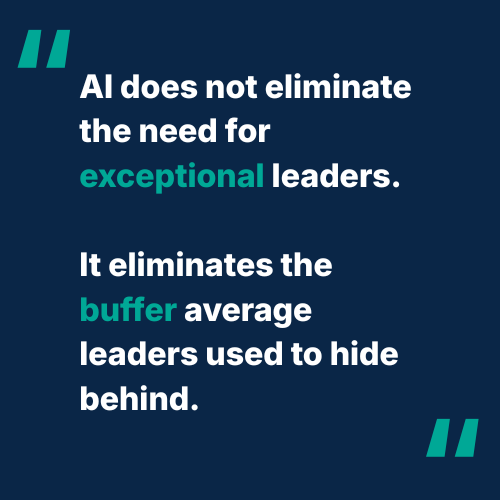
AI does not eliminate the need for exceptional leaders. It eliminates the buffer that average leaders used to hide behind.
The leaders who already operate this way
The executives who can lead a restructured, AI-native organisation already exist. They were forged by a decade of startup conditions: no budget, no playbook, constant change, relentless pressure.
I wrote about this operator profile back in 2022 for Startup Daily, when I predicted the talent market would shift from a supply crisis to a capability crisis. The talent shortage was never really about headcount. It was about finding people who had built under constraint and could do it again at scale.
That profile, someone who runs lean by instinct, context-switches across product and operations, makes irreversible decisions with incomplete information, is now exactly what every restructuring organisation needs.
What this means for founders and CEOs hiring right now
The organisations that thrive in the next decade will not be the ones with the most sophisticated AI stack. Those tools are a commodity. Every competitor has access to the same models, the same infrastructure.
The differentiator is the human who knows how to use it. Who has already built in the conditions that AI restructuring creates. Who does not need a playbook because they wrote the last one themselves.
Finding that person requires a network built inside the ecosystem where they were produced. Not a LinkedIn search filtered by job title.
Last week, 4,000 people at Block were told they no longer had a job. The stock rose 24%. WiseTech Global cut 2,000 roles - nearly a third of its global workforce - as part of a two-year AI restructuring plan. Commonwealth Bank eliminated 300 technology positions the same day. Three AI restructuring announcements. Five days. Three share prices up across the board.
That is today's headline. But the story begins a decade ago, and it starts with a bet I made in 2016 - not on a product or a market, but on a type of person. The founders I was working with in fintech were operating in conditions the rest of the corporate world had not experienced yet. I believed those conditions were coming for everyone. Last week, they arrived.
Why AI layoffs sent three share prices higher
The market is not mourning these cuts. It is rewarding them. That is the fact worth sitting with, and it is the one that most of the coverage has moved past too quickly. In a traditional framing, a company cutting half its workforce is in crisis. Investors flee. The narrative is failure. That is not what happened.
What happened is that investors looked at Block's AI restructuring and concluded the company will be more valuable with fewer, more capable people and a properly deployed AI stack than it was with a larger, more expensive, less leveraged workforce. The cuts were not a symptom of decline. They were the mechanism of transformation. Block CEO Jack Dorsey was unambiguous in his letter to shareholders: 'Intelligence tools have changed what it means to build and run a company. A significantly smaller team, using the tools we're building, can do more and do it better.' WiseTech CEO Zubin Appoo was equally direct: 'The era of manually writing code as the core act of engineering is over.'
These are not euphemisms or careful corporate language. They are executives stating on the record that their previous headcount was a legacy of how organisations used to have to operate, and that AI has made that model obsolete. The market agreed, loudly, both times. Block is not alone and it will not be the last. Every week the number of similar announcements grows, and every week somewhere in a boardroom the same conversation is happening: we need to restructure, we need to go leaner, we need AI to do what teams used to do. What almost nobody is saying in that conversation is what comes after the cuts.
What I predicted about AI and jobs in 2021
I find myself thinking about 3rd March 2021, sitting in front of a camera for Ausbiz TV. The interview was about remote work. The world had just spent twelve months working from home and everyone was trying to figure out whether that was permanent or a blip. The conversation turned to productivity, to AI, to what the jobs market was actually telling us beneath the headline numbers.
I had been doing my own research at the time. Tracking job ad data in fintech, running surveys across our network, talking to founders every week about what they actually needed versus what the market was supplying. The challenge with remote work, I argued, was not technology. The technology worked fine. The challenge was leadership. Leaders were struggling to build and maintain high-performing teams they could not see, and we were starting to see dips not in task completion but in the collaborative moments that produce the ideas nobody plans for.
'We are at the precipice of a quantum shift. Not just in how we work. In the economy. In everything. AI is removing task-based roles. The roles that remain will require a different kind of person. This is happening. Just because you don't see it doesn't mean it's not.'
The interviewer moved on. The segment ended. The world kept going. That was five years ago.
What AI restructuring leaves behind after the cuts
When I started Tier One People in 2016, the Australian fintech ecosystem was young and full of promise that not everyone believed in. The founders I worked with were building companies the incumbents did not take seriously, competing for talent against organisations with resources they did not have, solving problems that had never been solved before in markets that were still being defined. They had no budget, no playbook, and no margin for error.
The people who joined those companies were self-selecting into a formation that a traditional career path cannot replicate. I wrote in 2022 that the expectations placed on fintech employees are closer to elite sport than to corporate banking. In elite sport, players are hired not just for their skills but for their ability to perform under intense pressure. Delivering results without process was the only option because there was no process. Decisions had to be made fast because slow ones were fatal. Running lean was not a strategy; it was the only budget available.
These executives built cultures under pressure, scaled teams mid-flight, restructured while shipping, and did all of it under the scrutiny of investors who expected quarterly proof that the thesis was working. Becoming AI-native was not a priority on a roadmap; it was the only way to compete with organisations ten times their size. That is not a job history. That is a decade of conditions that produced a very specific kind of executive - one who has already lived through what every AI restructuring organisation is now trying to build.
Why the leader above the AI stack is the differentiator
When you eliminate the middle layer, collapse three functions into one, and rebuild your organisation around AI as infrastructure rather than AI as a tool, the people who remain need to operate at a completely different level than the people who left. This is not a technology problem. The AI stack is available to anyone. You can buy it, build it, deploy it. The technology is not the differentiator.
The differentiator is the human sitting at the top of that stack. The executive who can run a leaner, faster, higher-stakes organisation. Who can make irreversible decisions without a committee. Who can context-switch across product, data, operations, and culture without losing momentum. The assessment framework I built in 2016 has not changed: skills plus learning ability plus performance under pressure equals outcomes. The number one predictor of a leader in the AI age is the ability to context-switch. Fintech executives have been doing this ten times a day for a decade.
The current conversation is dominated by two camps. One says AI will take everyone's jobs and the future is bleak. The other says AI is just a tool and humans will always be needed. Both are wrong in the ways that matter to the people making hiring decisions right now. AI does not eliminate the need for exceptional leaders. It eliminates the buffer that average leaders used to hide behind: the layers of process, the large teams, the slow decision cycles that kept organisations running despite mediocre leadership at the top. What remains is a direct line between the quality of the leader and the performance of the organisation. In that environment, the difference between a good hire and a great one is not marginal. It is existential.
What a decade in fintech produced that no other sector did
The organisations that get the AI restructuring right will do so because they solve the talent problem correctly. They will understand that the cuts are the easy part, that a board can make that decision in an afternoon. The hard question is what comes after: who leads an organisation with no redundancy, no process layers, and a direct line between leader quality and organisational performance.
The ones that get it wrong will make the cuts and then hire the same profile they always hired. They will promote the most experienced person in the room rather than the most capable one. They will apply traditional executive search methodology to a talent profile that traditional executive search was never built to find. They will discover, six to twelve months later, that the AI restructuring did not work. Not because the AI was wrong or the numbers were wrong, but because the person at the top of the stack was the wrong person. In a restructured organisation operating with no redundancy, that is a mistake that is potentially fatal.
The executives who built Australia's fastest-scaling fintechs are the most valuable leaders in any sector right now. Not because of their fintech credentials, but because of what those credentials represent. They have already done what every organisation undergoing AI restructuring is now trying to do. Functions collapsed, lean was built, ambiguity was led through without a safety net. Finding them requires a network built inside the environment where they were forged, not a LinkedIn search filtered by job title.
How to hire a leader for an AI-native organisation
1 March 2016. A conviction.
3 March 2021. A prediction.
27 February 2026. A reckoning.
WiseTech. CBA. Block. Share prices up across all three. The market rewarding the AI restructuring. The era of large teams as a proxy for value officially over.
I did not build Tier One People to be right about a prediction. I built it because I believed, and still believe, that finding the right person for the right role at the right moment is the highest-leverage decision any organisation makes. The conditions that forged the operators in my network were brutal and clarifying in equal measure: no budget, no playbook, constant change, relentless pressure, results or nothing. Those conditions are now the operating reality for every organisation serious about competing in what comes next.
Those people are ready. They have been ready for a decade. The question is whether the organisations that need them are ready to find them. I have spent ten years building for this moment. It is here.
Dexter Cousins is the founder of Tier One People, Australia's leading executive search firm for fintech. Since. He has completed 200+ executive placements and hosts Fintech Chatter, Australia's leading fintech podcast with 350+ episodes and 30,000 monthly listeners across 40 countries.
If you are restructuring and facing the question of who leads what's left, that is the question Tier One People was built to answer.
Build Your Professional Brand Using First Principles
Last week, you built your Career Balance Sheet. You listed every problem you've solved. You put real numbers on your impact.
Maybe you automated processes and saved $1.5M. Maybe you closed a deal worth $20M in ARR. Maybe you cut sales cycles from 6 months to 8 weeks.
But here's the first principles question: What's the fundamental truth underneath all those achievements?
Strip away the job titles. Strip away the company names. Strip away the activities.
What's left is your pattern. Your superpower. Your professional brand.
Not a vague statement like "I'm a strategic leader." A precise statement built from fundamental truths that makes someone say "I need that person right now."
Breaking Your Career Down to First Principles
Look at your Career Balance Sheet. All your achievements are there. Now look for the pattern.
What's the thread that runs through everything you've done?
Let me show you with real examples.
The CFO who raised Series A ($5M), Series B ($15M), Series C ($40M), and took the company public ($200M valuation).
Pattern: Takes companies from early stage funding to IPO.
Professional brand: "I'm the CFO who takes companies from seed to IPO."
The CRO who joined at $2M ARR, built the sales team from 3 to 15 people, and left at $22M ARR.
Pattern: Scales revenue in the $2M to $20M range.
Professional brand: "I'm the CRO who scales revenue from $2M to $20M ARR."
The Product Leader who inherited a feature with 15% adoption, rebuilt the feedback loop, redesigned onboarding, and hit 82% adoption.
Pattern: Makes products people actually use.
Professional brand: "I'm the Product Leader who took feature adoption from 15% to 82%."
See the pattern in these patterns?
Each one has three elements:
Your role - CFO, CRO, Product Leader
Specific numbers - Seed to IPO, $2M to $20M, 15% to 82%
The outcome - What actually happened
Not activities. Not responsibilities. Outcomes.
How to Test Your Professional Brand Statement
Now you need to know if your brand actually resonates.
Think of it like a doctor testing a diagnosis. You have a hypothesis. You run tests. You see if you're right.
Create three variations of your brand statement. Test them.
Update your LinkedIn headline with Version A. Give it two weeks. Track profile views, connection requests, InMail messages.
Switch to Version B. Another two weeks. Compare the numbers.
Test in real conversations. When someone asks what you do, use your brand statement. Watch their reaction.
Do they lean in and ask questions? That's resonance.
Do they nod politely and change the subject? That's not working.
After 4-6 weeks, you'll have data. One version will clearly outperform. That's your signal. That's what the market wants.
Finding Companies That Need Your Exact Capability
Your professional brand tells you exactly who to target.
"I'm the CFO who takes companies from seed to IPO" → Target companies that just raised Series B or C. They'll need IPO prep in 18-24 months.
"I'm the CRO who scales revenue from $2M to $20M ARR" → Target companies currently at $2M to $5M ARR who just raised Series A.
"I'm the Compliance Head who gets startups their license" → Target pre-license companies that just raised funding.
You're not searching "fintech jobs."
You're searching for companies at the exact stage where they need your exact capability.
Building Your Problem Portfolio: 10-15 Target Companies
Create a hit list of 10-15 companies you've researched deeply. For each one, track:
Evidence they need you - Funding stage, LinkedIn posts, job listings
Specific pain points - What they're struggling with right now
Your solution - Straight from your Career Balance Sheet
Your entry point - Who you know, how to reach them
Not 200 random applications. 10-15 companies where you've done your homework.
This is precision targeting, not spray and pray.
What Quantified Professional Brands Actually Look Like
Before: "Hi, I'm applying for your CFO role. I have 15 years of finance experience. I'm detail-oriented and a strong communicator."
After: "Hi, I noticed you just closed your $40M Series C with Sequoia. Based on their portfolio pattern, you're likely 18-24 months from IPO conversations. I'm the CFO who's taken three companies through that exact journey. The biggest challenge is always audit readiness 12 months before filing. I'd like to discuss what you're seeing."
Which one gets a response?
The second one shows you understand their business. You've done your homework. You're not applying - you're offering to solve a specific problem they have right now.
That's the difference between 1% response rates and 60% response rates.
Your Next Step: From Balance Sheet to Professional Brand
You have your Career Balance Sheet. Now turn it into your professional brand.
Extract the pattern. Write it as one quantified sentence. Test it. Find companies who need exactly what you do.
Then reach out with precision, not desperation.
Listen to the full episode of Finding Your Next Role in Fintech for the complete framework, testing methodology, and research strategies.
Stop Networking Like Everyone Else (The 95-5 Principle)
Most people treat networking like fitness. They lie on the sofa for three years eating chips and drinking beers, watching sport instead of playing it. Then they wake up one day, realize they've gained 20kg professionally, and can't climb the career stairs anymore.
Sound familiar?
You go three years without talking to anyone in your network. Then you panic. Coffee meetings everywhere. LinkedIn messages flying. Desperate energy everywhere.
Here's the problem: You wouldn't train for a marathon by doing nothing for three years, then running 100km the week before the race. Your network works the same way.
The 95-5 Principle
When I launched Tier One People 10 years ago, I had 5,000 contacts in my database. Most people would email all 5,000. Spray and pray.
I did something different.
I filtered that list down to 98 people using a specific method. That was my critical 5%.
Those 98 people generated over 95% of my business results in the first year.
Here's the truth: 95% of your results will come from 5% of your network.
Not 10%. Not 20%. Five percent.
How to Find Your Critical 5%
Break your network into three tiers:
Tier 1: Former bosses and colleagues who are now in hiring positions. People who know what it's like to work with you and can now make hiring decisions.
Tier 2: People with massive networks. Clients, law firm partners, investors, VCs, board members. People whose job is knowing other people.
Tier 3: Everyone else.
Your critical 5% is Tier 1 plus Tier 2. That's your focus.
The Message That Actually Works
Here's what everyone else writes:
"Hi X, how are you? Not sure if you heard but I was made redundant the other day. I'm on the market and I've attached my CV. Would love to catch up for a coffee, my shout."
See the problem? You're leading with your need. You're asking for too much. And you're valuing their time at the price of a flat white.
Here's what works:
"I'm thinking about a few possible career paths and as someone I highly rate and whose opinion I trust, I wondered if you had two minutes to chat. I know you won't sugarcoat things."
Two minutes. Not coffee. Not lunch. Not a job.
Two minutes is incredibly hard to say no to.
The Psychology That Makes It Work
When you ask people for two minutes, they ask you for coffee.
When you ask them for their honest opinion, they give it. I've never met a single person who didn't enjoy telling me what they really thought.
But here's where the magic happens:
As soon as someone says "I think you should do X," they feel responsible for helping you do it. And they follow up with "Let me introduce you to Y."
Now you get another meeting with an influential person who could hire you. And you arrive pre-endorsed.
This is the compound effect. One conversation generates 1-2 warm introductions. Those introductions generate more conversations. Those conversations generate opportunities.
When I sent my two-minute message to 98 people, I had 60 meetings confirmed within 3 days. That's a 61% response rate.
Not because I'm special. Because the message made it easy to say yes. And because I focused on my critical 5%.
The Trust Shortcut
Years ago, I watched a sales rep push past me at a networking event and try to force his business card on a CEO. She calmly put her hands behind her back and said:
"You don't need to give me that. What you need to do is get someone I know and trust to give it to me."
That taught me everything about networking.
Stop trying to build trust from scratch with cold emails and forced connections. That takes months or years.
Instead, leverage the relationships you already have. When your former boss introduces you to their colleague, you don't start at zero. You start at 50%. You borrow their trust, their credibility, their relationship capital.
That's why warm introductions are 10 times more powerful than cold outreach.
Start Today
Your critical 5% might be 10 people. It might be 50. It might be 200. The number doesn't matter.
What matters is this: Stop trying to network with everyone. Start identifying your critical 5%.
Better contacts beat more contacts every single time.
Listen to the full episode for the complete T1/T2/T3 framework, exact email templates, and the two-minute call structure that turns conversations into opportunities.
Nuj Super - Matt McKenzie. From Beancounter to Fintech Founder.
In this episode of Fintech Chatter, host Dexter Cousins speaks with Matt McKenzie, CEO and co-founder of Nuj, a Regtech company making serious strides in the Aus$ 4trn Superannuation sector. Nuj’s plug-and-play solution streamlines workflows while ensuring compliance with all current and upcoming regulations.
The platform enables quick integration, with automated workflows, audit trails, and real-time updates.
Nuj raised a $4m seed round in early 2025 and counts Bluechip names like MUFG and AMP as clients.
Find out more - https://www.nujsuper.com/
Key topics covered in the chat:
Nudge was founded during COVID-19 in 2020.
The superannuation industry has significant legacy challenges.
Client acquisition requires proving value in a slow-moving market.
Funding strategies can include leveraging early client relationships.
Growth in fintech requires patience and resilience.
Remote work has become integral to Nudge's culture.
Establishing authentic company values is crucial for team alignment.
Hiring should focus on cultural fit and embracing collective wisdom.
Networking within the fintech community provides valuable insights.
Future growth at Nuj will leverage AI and technological innovations.
Connect with Matt: https://www.linkedin.com/in/matthew-mckenzie/
Building the Best Culture in Fintech
Ritchie Cotton, CTO and Co-Founder of Valiant Finance talks about their journey on Fintech Chatter Podcast
In this episode of Fintech Chatter, host Dexter Cousins speaks with Ritchie Cotton, co-founder of Valiant Finance, about the company's journey over the past decade.
Key Talking Points
Valiant connects small businesses with the right finance options.
The company has helped nearly 25,000 small businesses with over $2bn in funding.
How Ritchie and Co-founder Alex Molloy met and the genesis for Valiant.
Building one of the best working environments in Fintech.
Valiant's push into embedded finance solutions.
Getting the right combination of technology and human touch.
How COVID-19 was a pivotal moment for Valiant.
Valiant's plans for global expansion.
The companies customer centric values.
Ritchie's leadership style and focus on empowering teams and fostering collaboration.
Find out more https://www.valiantfinance.com/careers
Manage Cookie Consent
We use cookies to optimize our website and our service.
Functional
Always active
The technical storage or access is strictly necessary for the legitimate purpose of enabling the use of a specific service explicitly requested by the subscriber or user, or for the sole purpose of carrying out the transmission of a communication over an electronic communications network.
Preferences
The technical storage or access is necessary for the legitimate purpose of storing preferences that are not requested by the subscriber or user.
Statistics
The technical storage or access that is used exclusively for statistical purposes.The technical storage or access that is used exclusively for anonymous statistical purposes. Without a subpoena, voluntary compliance on the part of your Internet Service Provider, or additional records from a third party, information stored or retrieved for this purpose alone cannot usually be used to identify you.
Marketing
The technical storage or access is required to create user profiles to send advertising, or to track the user on a website or across several websites for similar marketing purposes.