Who leads what's left - AI restructuring.
Last week, 4,000 people at Block were told they no longer had a job. The stock rose 24%. WiseTech Global cut 2,000 roles - nearly a third of its global workforce - as part of a two-year AI restructuring plan. Commonwealth Bank eliminated 300 technology positions the same day. Three AI restructuring announcements. Five days. Three share prices up across the board.
That is today's headline. But the story begins a decade ago, and it starts with a bet I made in 2016 - not on a product or a market, but on a type of person. The founders I was working with in fintech were operating in conditions the rest of the corporate world had not experienced yet. I believed those conditions were coming for everyone. Last week, they arrived.
Why AI layoffs sent three share prices higher
The market is not mourning these cuts. It is rewarding them. That is the fact worth sitting with, and it is the one that most of the coverage has moved past too quickly. In a traditional framing, a company cutting half its workforce is in crisis. Investors flee. The narrative is failure. That is not what happened.

What happened is that investors looked at Block's AI restructuring and concluded the company will be more valuable with fewer, more capable people and a properly deployed AI stack than it was with a larger, more expensive, less leveraged workforce. The cuts were not a symptom of decline. They were the mechanism of transformation. Block CEO Jack Dorsey was unambiguous in his letter to shareholders: 'Intelligence tools have changed what it means to build and run a company. A significantly smaller team, using the tools we're building, can do more and do it better.' WiseTech CEO Zubin Appoo was equally direct: 'The era of manually writing code as the core act of engineering is over.'
These are not euphemisms or careful corporate language. They are executives stating on the record that their previous headcount was a legacy of how organisations used to have to operate, and that AI has made that model obsolete. The market agreed, loudly, both times. Block is not alone and it will not be the last. Every week the number of similar announcements grows, and every week somewhere in a boardroom the same conversation is happening: we need to restructure, we need to go leaner, we need AI to do what teams used to do. What almost nobody is saying in that conversation is what comes after the cuts.
What I predicted about AI and jobs in 2021
I find myself thinking about 3rd March 2021, sitting in front of a camera for Ausbiz TV. The interview was about remote work. The world had just spent twelve months working from home and everyone was trying to figure out whether that was permanent or a blip. The conversation turned to productivity, to AI, to what the jobs market was actually telling us beneath the headline numbers.
I had been doing my own research at the time. Tracking job ad data in fintech, running surveys across our network, talking to founders every week about what they actually needed versus what the market was supplying. The challenge with remote work, I argued, was not technology. The technology worked fine. The challenge was leadership. Leaders were struggling to build and maintain high-performing teams they could not see, and we were starting to see dips not in task completion but in the collaborative moments that produce the ideas nobody plans for.
'We are at the precipice of a quantum shift. Not just in how we work. In the economy. In everything. AI is removing task-based roles. The roles that remain will require a different kind of person. This is happening. Just because you don't see it doesn't mean it's not.'
The interviewer moved on. The segment ended. The world kept going. That was five years ago.
What AI restructuring leaves behind after the cuts
When I started Tier One People in 2016, the Australian fintech ecosystem was young and full of promise that not everyone believed in. The founders I worked with were building companies the incumbents did not take seriously, competing for talent against organisations with resources they did not have, solving problems that had never been solved before in markets that were still being defined. They had no budget, no playbook, and no margin for error.
The people who joined those companies were self-selecting into a formation that a traditional career path cannot replicate. I wrote in 2022 that the expectations placed on fintech employees are closer to elite sport than to corporate banking. In elite sport, players are hired not just for their skills but for their ability to perform under intense pressure. Delivering results without process was the only option because there was no process. Decisions had to be made fast because slow ones were fatal. Running lean was not a strategy; it was the only budget available.
These executives built cultures under pressure, scaled teams mid-flight, restructured while shipping, and did all of it under the scrutiny of investors who expected quarterly proof that the thesis was working. Becoming AI-native was not a priority on a roadmap; it was the only way to compete with organisations ten times their size. That is not a job history. That is a decade of conditions that produced a very specific kind of executive - one who has already lived through what every AI restructuring organisation is now trying to build.
Why the leader above the AI stack is the differentiator
When you eliminate the middle layer, collapse three functions into one, and rebuild your organisation around AI as infrastructure rather than AI as a tool, the people who remain need to operate at a completely different level than the people who left. This is not a technology problem. The AI stack is available to anyone. You can buy it, build it, deploy it. The technology is not the differentiator.
The differentiator is the human sitting at the top of that stack. The executive who can run a leaner, faster, higher-stakes organisation. Who can make irreversible decisions without a committee. Who can context-switch across product, data, operations, and culture without losing momentum. The assessment framework I built in 2016 has not changed: skills plus learning ability plus performance under pressure equals outcomes. The number one predictor of a leader in the AI age is the ability to context-switch. Fintech executives have been doing this ten times a day for a decade.
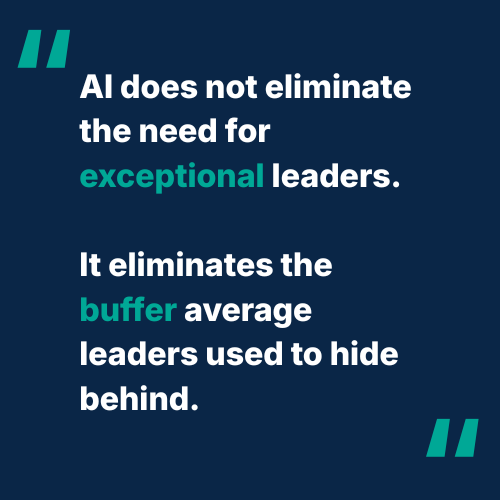
The current conversation is dominated by two camps. One says AI will take everyone's jobs and the future is bleak. The other says AI is just a tool and humans will always be needed. Both are wrong in the ways that matter to the people making hiring decisions right now. AI does not eliminate the need for exceptional leaders. It eliminates the buffer that average leaders used to hide behind: the layers of process, the large teams, the slow decision cycles that kept organisations running despite mediocre leadership at the top. What remains is a direct line between the quality of the leader and the performance of the organisation. In that environment, the difference between a good hire and a great one is not marginal. It is existential.
What a decade in fintech produced that no other sector did
The organisations that get the AI restructuring right will do so because they solve the talent problem correctly. They will understand that the cuts are the easy part, that a board can make that decision in an afternoon. The hard question is what comes after: who leads an organisation with no redundancy, no process layers, and a direct line between leader quality and organisational performance.
The ones that get it wrong will make the cuts and then hire the same profile they always hired. They will promote the most experienced person in the room rather than the most capable one. They will apply traditional executive search methodology to a talent profile that traditional executive search was never built to find. They will discover, six to twelve months later, that the AI restructuring did not work. Not because the AI was wrong or the numbers were wrong, but because the person at the top of the stack was the wrong person. In a restructured organisation operating with no redundancy, that is a mistake that is potentially fatal.
The executives who built Australia's fastest-scaling fintechs are the most valuable leaders in any sector right now. Not because of their fintech credentials, but because of what those credentials represent. They have already done what every organisation undergoing AI restructuring is now trying to do. Functions collapsed, lean was built, ambiguity was led through without a safety net. Finding them requires a network built inside the environment where they were forged, not a LinkedIn search filtered by job title.
How to hire a leader for an AI-native organisation
1 March 2016. A conviction.
3 March 2021. A prediction.
27 February 2026. A reckoning.
WiseTech. CBA. Block. Share prices up across all three. The market rewarding the AI restructuring. The era of large teams as a proxy for value officially over.
I did not build Tier One People to be right about a prediction. I built it because I believed, and still believe, that finding the right person for the right role at the right moment is the highest-leverage decision any organisation makes. The conditions that forged the operators in my network were brutal and clarifying in equal measure: no budget, no playbook, constant change, relentless pressure, results or nothing. Those conditions are now the operating reality for every organisation serious about competing in what comes next.
Those people are ready. They have been ready for a decade. The question is whether the organisations that need them are ready to find them. I have spent ten years building for this moment. It is here.
Dexter Cousins is the founder of Tier One People, Australia's leading executive search firm for fintech. Since. He has completed 200+ executive placements and hosts Fintech Chatter, Australia's leading fintech podcast with 350+ episodes and 30,000 monthly listeners across 40 countries.
If you are restructuring and facing the question of who leads what's left, that is the question Tier One People was built to answer.