In March 2021, I sat on national television and said we were at the precipice of a quantum shift. AI was removing task-based roles. The organisations that would survive were the ones with leaders who had already learned to deliver results in chaos and constraint.
Five years later, the numbers arrived. All at once.
I wrote the full analysis for Startup Daily. Here are two of the key arguments.
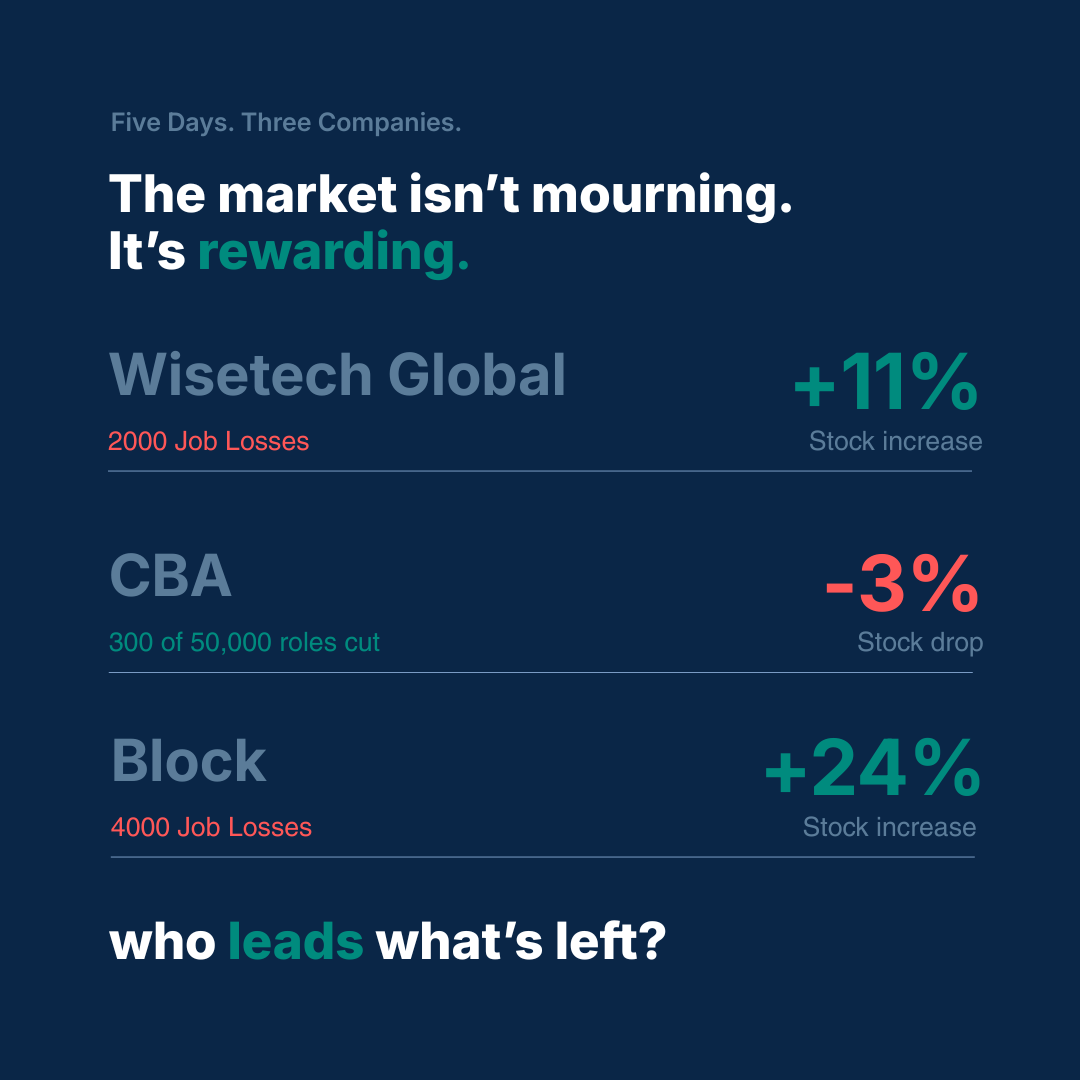
Block cut more than 4,000 roles last week. Stock up 24%. WiseTech Global cut 2,000 roles the same week. Stock up 11%. Commonwealth Bank eliminated 300 technology positions. Investors barely flinched.
The pattern is clear. When a company cuts staff because it is in financial distress, the market punishes it. When it cuts because AI enables the same or better output with fewer people, the market rewards it.
Block was not in distress. Its gross profit grew 24% in the quarter it announced the layoffs. WiseTech reported a first-half profit 6% ahead of consensus on the same day it announced the cuts.
These are not companies retreating. They are companies restructuring around AI as infrastructure, not as a feature.
The restructuring decision is easy. A board can make that call in an afternoon. The hard question is what comes next.
When you take headcount from a thousand to five hundred, when you collapse three functions into one, when you rebuild around AI as infrastructure, the people who remain need to operate at a level most of them have never been asked to reach. They need to make decisions that committees used to make. Lead teams at a pace that large organisations were never designed to move at.
AI does not eliminate the need for exceptional leaders. It eliminates the buffer that average leaders used to hide behind.
The executives who can lead a restructured, AI-native organisation already exist. They were forged by a decade of startup conditions: no budget, no playbook, constant change, relentless pressure.
I wrote about this operator profile back in 2022 for Startup Daily, when I predicted the talent market would shift from a supply crisis to a capability crisis. The talent shortage was never really about headcount. It was about finding people who had built under constraint and could do it again at scale.
That profile, someone who runs lean by instinct, context-switches across product and operations, makes irreversible decisions with incomplete information, is now exactly what every restructuring organisation needs.
The organisations that thrive in the next decade will not be the ones with the most sophisticated AI stack. Those tools are a commodity. Every competitor has access to the same models, the same infrastructure.
The differentiator is the human who knows how to use it. Who has already built in the conditions that AI restructuring creates. Who does not need a playbook because they wrote the last one themselves.
Finding that person requires a network built inside the ecosystem where they were produced. Not a LinkedIn search filtered by job title.
Read the full piece on Startup Daily →
Hiring the leader who takes your organisation through this shift? Talk to us about your search.