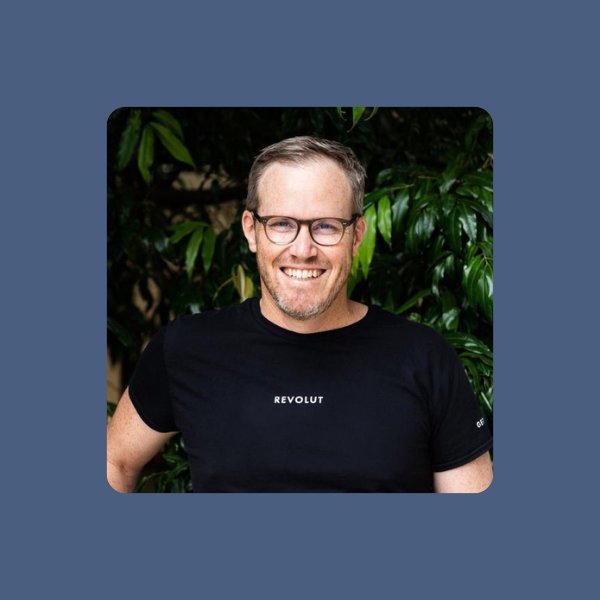
Revolut Australia CEO Matt Baxby has done what most Australian neobanks couldn't: reach 1 million customers and profitability. Six years after soft-launching with three employees during a global pandemic, the Revolut Australia CEO sits down with Dexter Cousins on Fintech Chatter to discuss the journey from travel FX startup to 30-product super app, the $250 million saved for Australians, and the ambition to become the country's number one finance app. More importantly, Matt Baxby reveals the hiring philosophy and culture that made it all possible.
This interview was recorded on 4 February 2026.
Dexter Cousins: Matt, congratulations on a massive milestone. Let's start with the big news: Revolut Australia has just hit 1 million customers. Take us through what that means.
Matt Baxby: Thanks, Dexter. Yeah, we crossed 1 million customers at the end of January, which is a really proud moment for the team. But what's more meaningful to me is that we've saved Australians close to $250 million in FX fees compared to what the major banks charge. That demonstrates there's a real need for what we're offering in this market. When you can put that kind of money back in people's pockets, you know you're solving genuine problems.
DC: The awareness is certainly building. People are starting to understand there are alternatives to those airport FX desks, and Revolut is at the front of that pack. But you've evolved well beyond just travel money, haven't you? You're now offering 30 plus products.
MB: Absolutely. When we launched six years ago, the proposition was simple: bring together disparate financial solutions into one app. Things like overseas money transfer, bill splitting, peer-to-peer transfers. One of the key features from those early days that's still incredibly popular is the ability to transfer any currency directly to another Revolut customer in a different market. No friction, no cost, no waiting around for three days. That was the hook.
But you're right: we've expanded significantly. Today we're a modular platform. There's no set use case for our customers. Some people use us primarily for travel, others for everyday spending, some for investing in crypto or US shares. We build based on what customers tell us they need solved.
DC: That's interesting because as a Gen Xer maybe it's my eyes going, but the app is getting more complex to navigate with all those features. Is product proliferation becoming a challenge?
MB: [Laughs] Fair observation. Look, we're very aware of that, and it's something we're constantly working on. But I'd rather have that problem than the alternative: being too narrow in what we offer. The development continues to be driven by customer feedback. If enough customers are telling us they need something, we'll build it. That customer-first approach has been core to our success.
And here's the thing that keeps me confident we're on the right track: word-of-mouth referrals still represent a large proportion of our new customer acquisition. That's the highest compliment we can receive. When customers are actively recommending us to friends and family despite the complexity, it tells me we're delivering real value.
DC: Let's talk about Revolut Business. Small businesses are the backbone of the Australian economy, but they often feel overlooked by the major banks and even by many fintechs. What's happening there?
MB: Revolut Business has been incredible since we launched it in 2023. We've seen 235% growth in transaction volumes over just the last 12 months. The opportunity is massive because you're right: small businesses have been underserved for years.
The really exciting development is our new merchant acquiring product. We've just launched physical terminals and payment gateways through "Revolut Pay." What makes this powerful is we have a double-sided marketplace: a large consumer base who already have Revolut on their phones, and a rapidly growing small business base. When you can connect both sides, you create real network effects.
DC: That's a significant expansion beyond your core FX and payments business. Speaking of expansion, where are you with the APRA banking licence?
MB: The process is ongoing, and it remains very important to us. A banking licence enables services like interest-bearing savings accounts and broader credit products. It also provides government guarantees on deposits, which builds customer trust and gives us access to more sustainable long-term funding.
But here's what's critical: the lack of a licence hasn't constrained our product delivery or business growth. We've been very deliberate about that. We've continued shipping products, growing customers, and most importantly, we reached profitability in 2024. That's a very different path from other neobanks in Australia.
DC: Indeed. Most of the local neobanks either failed or were acquired before reaching profitability. What did Revolut do differently?
MB: Our strategy was fundamentally different from day one. We established a strong foothold in payments and foreign exchange first: areas where we could demonstrate clear value and actually make money. Then we expanded the product offering from that profitable base.
A lot of other neobanks tried to be full-service banks from the start, which meant massive infrastructure investment before they had meaningful revenue. They were burning capital trying to replicate everything the Big Four do, just with a better app interface. That's incredibly capital intensive and the unit economics don't work until you have massive scale.
We took a different approach. Build what customers need, prove the economics work, then expand. Stay lean, stay focused, stay profitable.
DC: Let's go back to the beginning. You joined Revolut in February 2020 as the first Australia CEO. You started with three people, then literally one month later, COVID hit and the world went into lockdown. What was going through your mind?
MB: [Laughs] Honestly? It was a significant inflection point, to put it mildly. Here we were with a travel-oriented FX proposition, and borders just… closed. Completely. For what ended up being over a year in Australia.
But looking back now, I'd say it was the best thing that could have happened to us. It forced us to think much more broadly and pivot into new opportunities immediately. We accelerated our plans for US share trading, we introduced cryptocurrency exposure, we focused on international e-commerce. All the things that didn't require getting on a plane.
That agility, that bias to action, is core to Revolut's culture. Our founders backed us to make those pivots quickly. We didn't spend six months doing market research and business cases. We identified the opportunity, built the product, shipped it, learned from it. That's how we survived and then thrived despite the pandemic.
DC: You mentioned culture, and I want to dig into that because you've built teams at Virgin under Richard Branson, at Bank of Queensland, and now at Revolut. How do those experiences compare?
MB: They're all very different cultures, but there are principles I've carried through. At Virgin, I learned the power of entrepreneurialism and brand: what it means to genuinely put customers first and challenge incumbents. At BOQ, I learned the discipline of running a bank, dealing with regulators, managing risk at scale.
What I've adapted for Revolut is being very specific about what type of people succeed here. We're rigorous about hiring problem solvers: people who can think critically and exhibit a strong bias to action. We assess that through interview scenarios, not just by asking people to talk about their CV.
DC: Your recruitment process has a reputation for being thorough. And you're doing all of this with a "work from anywhere" policy, which is quite different from the banking norm.
MB: The remote working policy works because of the discipline and mindset of the people we hire. We have high expectations for performance, ambitious quarterly KPIs, and structured measurement. There's a misconception that you need people in an office to have performance oversight. What you actually need is clarity on objectives, rigorous measurement, and people who are self-motivated.
If you've hired properly — true problem solvers with a bias to action — it doesn't matter if they're working from a Sydney office or a beach in Byron Bay. They'll deliver. If you haven't hired properly, having them in an office won't fix that.
DC: You now have 100 people in Australia. When you're hiring, what are the absolute non-negotiables?
MB: Problem-solving ability and cultural fit around action. I'd rather have someone who can think critically, move fast, and figure things out than someone with a perfect CV who needs to be told exactly what to do.
We're also looking for people who are comfortable with ambiguity. Revolut is a founder-led organisation. Nick, our founder, sets ambitious goals without caveats. His goal for us is to be the number one app in the finance category in Australia. Not "number one neobank" or "number one among challengers." Number one, full stop. You need people who find that energising, not terrifying.
DC: That's quite an ambition when you're competing against the Big Four banks who control 80% of the market. After six years and 1 million customers, how's that battle going?
MB: We're bringing genuine competition to a market that's needed it for years. The Big Four have had it pretty comfortable: wide margins, suboptimal user experiences, business models built on customer apathy. We're changing that equation.
What's surprised me is how quickly Australians have embraced an alternative once they try it. The word-of-mouth growth I mentioned earlier: that's people voting with their wallets and their recommendations. That doesn't happen if you're just marginally better. It happens when you're delivering something genuinely different.
Are we number one yet? No. But every customer we win, every dollar we save them, every feature we ship: we're getting closer. And unlike some of our competitors who've fallen by the wayside, we're profitable and sustainable. We're in this for the long term.
DC: Looking forward, what's the vision for the next 3 to 5 years?
MB: All our actions, whether it's our F1 sponsorship, our product development, our marketing, are focused on that number one goal. We want to be the app Australians open every day to manage their money. All their money. Spending, saving, investing, borrowing.
We'll continue expanding our product suite based on customer needs. The banking licence, when it comes through, will unlock more capabilities. We'll keep investing in making the experience better, more intuitive, more valuable.
But fundamentally, it's about meeting Aussie consumer needs better than anyone else. That's been our mission from day one, and it won't change.
DC: For people interested in joining this journey, where should they look?
MB: Head to revolut.com and check out our careers page. We've got live roles across product, engineering, operations, commercial, compliance: pretty much every function you'd expect. If you're someone who loves solving problems, moving fast, and making an impact, we'd love to hear from you.
DC: Matt, congratulations again on the milestone. It's been an incredible journey to watch, and I'm proud that Tier One People could play a part in it six years ago.
MB: Thanks, Dexter. And thanks to you and the Tier One People team. We couldn't have done it without finding the right people, and that partnership has been crucial to our success.
Revolut Australia has 1 million customers and 100 employees nationwide. The company is certified as a Great Place to Work in Australia and is actively hiring. For more information, visit revolut.com.
Tier One People is Australia's leading fintech executive search firm. Six years ago, Tier One People placed Matt Baxby as Revolut Australia's founding CEO - a placement that has delivered 1 million customers, $250 million in savings for Australians, and a profitable, sustainable fintech business.
That's what happens when you find the 1% who define what's possible.If you're building a fintech team or looking for your next role in fintech, visit tieronepeople.com or connect with Dexter Cousins on LinkedIn.