Tier One People up against DLA Piper and King and Wood Mallesons for the Excellence in FinTech Support Services.
The award recognises the support services that have provided the highest level of assistance to fintechs in their operation and growth or a business that helps drive the growth of the fintech community through physical infrastructure (space), connections and capital.
We are up against consulting firms, legal support, accounting, technology companies and incubators/hubs/co-working spaces, accelerators and investment firms.
This is the first year an Executive Search firm has been nominated for the award. And to say we are delighted is an under statement. To be recognised by your peers and the people you serve is a huge honour and we are immensely proud to be up there against such strong competition.
Finnies 2020 promises to be the biggest and best yet!
Given the restrictions the event will be a mix of virtual and in person events. There'll be a live transmission from The Studio (where we host the FinTech Australia Podcast.) Stone and Chalk will be holding small live events in Sydney and Adelaide.
People are also encouraged to host their own events and office parties. Fintech Australia will be shipping Alcohol and goodies if you host your own office event. We are already hearing of some cool waterfront venues being booked out here in Sydney!
And if you prefer to celebrate from home First 100 registrations will receive an exclusive gift box with goodies, alcohol discounts, sponsor gifts and other offers.
And in an effort to get everyone involved, two categories this year will go to the people's choice awards. You can vote for your favourite Fintech and help them get bonus points if you listen to their exclusive show on our special Finnies Podcast.
But be fast, you can only listen to the shows 7th - 14th October!
Thursday 1 August 2019, Ashurst hosted the 4th Annual Australian FinTech Awards in Sydney. It was an opportunity for the community to come together and celebrate success.
Tier One People Sponsors Of Australian Fintech Awards 2019.
Traditionally the awards focused on recognising grass roots, Fintech startups. With Unicorn companies like AfterPay and the rapidly growing Brighte now serious businesses, the awards symbolised the maturity of the Fintech sector in Australia.
Keynote speaker of this years awards was Todd Forest, Managing Director, nabventures. Todd passionately spoke of the opportunities in Fintech and made the bold claim that one day a Fintech will acquire a major bank (Todd illustrating his theory with the story of AOL buying Time Warner).
Big shout out to our friends at Split, Brighte, Xinja, Wisr, Arctic Intelligence and Checkbox who all won awards.
“The FinTech Awards recognize businesses as well as individuals, with Awards such as CIO/CTO Of The Year, Female FinTech Leader of The Year, and FinTech Leader of The Year,” said Frost.
David Washbrook - Look Who's Charging
Look Who's Charging had a stellar 2018 with numerous awards, accolades such as featuring in KPMG's FinTech 100 and commercial success with two of the Big 4 Aussie banks becoming customers. Sibos and Money 20/20 helped put Look Who's Charging on the global FinTech map.
Tier One People's Dexter Cousins talks with Co-Founder David Washbrook to talk about a fine year and a Vegas road trip!
Tell us about Look Who’s Charging.
Look Who's Charging is all about improving the customer experience through enriching bank statement transactions. Everyone has experienced the issue. You look at your bank statement and half the time it may as well be written in foreign language. You see C&A WALKER PTY LIMITED, for example. A Google search brings up hundreds of businesses none of which you recognise.
So, you phone your bank. Twenty minutes on hold, verify yourself, bounce between two or three different departments, and at the end of all of that, more often than not the bank can't do anything other than a Google search themselves. In fact, two of the Big Four bank's contact centres don't even have access to Google.
It is a very frustrating problem for the consumer, leaving them feeling genuinely worried that they might be subject to fraud. It's also a very expensive problem for banks. Ten percent of all the calls to a banks contact centre relate to queries on unrecognised transactions. Sixty percent result in manual chargebacks, costing a bank around $80-$90 dollars for each one.
We improve the customer experience and save banks millions of dollars in costs through reduced calls and chargebacks.
How did you come up with the idea for the solution?
It was two-fold. My fellow Co-Founder, Stuart, was running a separate business at the time. He became increasingly frustrated with trying to reconcile his accounts due to the large number of confusing descriptions (most small accounting packages use bank statement data).
At the same time, I inadvertently committed a friendly fraud. I disputed a transaction with my bank as didn't recognise the merchant. I genuinely thought it was a fraud. I got my money back for the transaction which later turned out to be legitimate.
We did some further research and we quickly realised that unrecognised transactions were a big issue for consumers and also a very expensive problem for banks. Australian banks alone are spending somewhere in the region of $200m a year dealing with the problem.
Your solution sounds so simple. Why is it that nobody's done this before?
A lot of Fintech businesses can often be complex to explain. You are correct in that ours is very simple. However, solving the problem is far from simple. Lots of people have tried before. We know big banks who have tried; large software companies who have tried; other Fintechs who have tried.
They throw a team of people at it, work on the problem as a project, get something that is fifty, sixty percent of the way there, but unless you're maintaining the data, staying on top of it, it quickly becomes redundant. Our senior team has over 80 years’ experience working in IT and on big data problems, and this is by far the most complex problem any of us have ever come across.
The idea is not new but being able to execute on the idea, that's where we have achieved something that no one else has managed to. We return over 180 different fields on a merchant and our accuracy is >95%. Most other offerings simply return one field (being category) and the accuracy is far lower than us. Banks are pushing our data to one of the most important consumer touch points being the transaction feed of digital applications; they have to have trust and confidence in our product.
Our solution has three core components, all using proprietary market first technology:
Merchant database. We have compiled a database of the 1.3m card accepting merchants in Australia. Over 1m lines of code and we draw on over 150 different data sources to ensure we always have the most up to date information.
To solve the problem you need to understand both the legal entity information and trading entity information for a merchant. Some businesses out there know the legal entity information of a company, and some know the trading entity information, but from what we can tell we are the first business to build a complete legal and trading view of a merchant.
Search engine. We have developed a proprietary search engine to match the 20m+ transactions descriptions (per debit and credit card statements) back to this database of 1.3m card accepting merchants.
Robust architecture. Our robust architecture enables our data to be pushed to bank’s digital applications in real time. Our API can return data on up to 50 transactions in less than 30ms.
Most importantly you need a solution that solves a genuine customer pain point, saves the bank money or improves regulatory compliance. Tick two or three of these boxes and your chances of working with a bank significantly improve. But you also have to have the correct governance, compliance and risk management protocols in place to pass their security and procurement checks.
You've partnered with NAB. How difficult is it to partner with a Big 4 bank?
First conversation to go-live with NAB took seven months for us, which was fantastic, especially as they were our first customer. NAB had identified the problem of unrecognised transactions as a top consumer pain point and one that was costly for the bank. We offered a unique, market-first solution and NAB was able to move quickly to bring this to their customers.
In general the sales cycle with a big bank, or any bank for that matter, is relatively long. Most importantly you need a solution that solves a genuine customer pain point, saves the bank money or improves regulatory compliance. Tick two or three of these boxes and your chances of working with a bank significantly improve.
But you also have to have the correct governance, compliance and risk management protocols in place to pass their security and procurement checks. You can have the best product in the world but if you don’t have the right risk management procedures in place then you won’t go-live with a bank. The Hayne Commission and recent high-profile data breaches from companies such as Equifax, British Airways and Marriot-Starwood Hotels make it increasingly harder.
Finally, you must make your solution as easy as possible for a bank to integrate with. Our solution is at the easier end of the spectrum, but it's still a lot of work for a bank to integrate with a third-party. If your solution is going deep into banking systems, even if it's the greatest product in the world, it makes it a much harder task to partner with a bank.
Gaining recognition in the KPMG Fintech 100, has it had a noticeable impact on being able to attract talent and clients?
Absolutely. It has been a really good win for us, especially as we were selected without even applying. We've been fielding a lot of inbound inquiries from all around the world after the report was published. I think we were one of only seven Australian companies to make the list.
We're almost at thirty people now, twelve people onshore and another fifteen people offshore. We will continue to hire people in 2019. The decision has been made to draw on the best expertise from people around the world as there is a lot of complexity to our solution. Finding the skills onshore can sometimes be challenging; machine learning, AI, the search components of our architecture. We've developed a hybrid model with three very senior developers onshore managing the specialist skill sets from around the world and bringing everything together to make the solution work.
Culture becomes a critically important element in growing a business, and the culture is really determined by the quality of people that you hire. If you have a start-up with some traction, you're building something exciting and people can get involved with growing the business, it’s generally very appealing to great talent, especially with the buzz around tech at the moment.
You recently presented on stage at Money 20/20 in Las Vegas. How was that experience?
Money 20/20 brought together over 15,000 people from leading Banks and FinTech companies from around the World in Las Vegas during the final week of October. We were lucky enough to get a spot on stage and a stand at Money 20/20. Look Who’s Charging was selected, as one of only 24 companies, out of over 800 from around the globe, to pitch on centre stage. If you're a tech business you really have to think globally from day one. Money 20/20 provided the perfect springboard to explore off-shore expansion.
Immediately after our presentation there was a long line of companies queuing at our stand up saying 'we need this in the market. No one is focused on the problem.' The greatest interest came from Canada and the UK, they're a bit more advanced with digital banking than the U.S.
What’s your perception of the Australian FinTech market compared to the US?
We expected to go to Money 20/20 and find 10 other companies doing what we do. However, despite a high demand for transaction enrichment, we were unable to find any company who has or is trying to provide a solution quite like ours.
More generally in the banking and the payment space it seems that the U.S. is definitely lagging Australia. For example, we have contactless payments rolled out across the country. I personally haven't taken cash out in Australia since 2017 and I haven’t had any problems. I solely rely on my phone and my watch now.
The U.S. still primarily has legacy infrastructure where you have swipe your card, sign, and show ID to verify your signature. A number of merchants also still don’t accept card payments. This makes it much harder to enact behavioural change and get people to switch to a digital wallet.
The environment in Australia is the perfect testing ground for financial services companies to get their product to market. If you can perfect your product here, there's a massive opportunity to then launch in the U.S. and other markets like Europe.
However, I think that we have got to go to them because they're generally not coming to Australia to find out about us. The support is there for Australian FinTechs to expand, for example, Austrade’s Global Landing Pads and the recent UK FinTech Bridge. In addition, if you have a product in market, and that product is scalable, you shouldn’t have any issues raising money in the markets like the U.S.
What growth plans are there for 2019?
We are super excited about the coming 12 months. We’re making good progress in the Australian market having on-boarded two of the big four banks and a number of small banks. This will remain our number one priority in the short term.
There’s also a growing number of use cases for the technology – enriching transactions within digital banking applications is just the tip of the iceberg. For example, one of the top findings from The Hayne Commission was that banks are generally good at verifying income on loan applications but that they were generally poor with expense verification. Our technology can quickly and easily automate the verification of both income and expenses to a high-degree of accuracy.
Overseas expansion definitely remains our longer-term goal. We’ll likely look to expand into the Canadian and U.K. markets next as they are similar in nature and size to Australia. We're very excited by that prospect and opportunity.
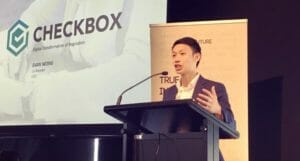
Evan Wong - Checkbox.ai
Checkbox was under the radar for over a year. There was no product to show potential customers. No one knew about us until we won Regtech of the Year at the 2017 Fintech Awards. Fast forward 12 months and we have grown from four to twenty people.
Evan Wong - CheckBox
Evan Wong is CEO and Co-founder of Checkbox. At only 25 he already has two successful startups under his belt. Checkbox is a Regtech solution that enables business people to build software without any sort of coding.
Checkbox is to business applications what WordPress is to Web Design. Used by lawyers, accountants and bankers Checkbox is considered the ideal tool to fix the Regulatory and Compliance issues facing many financial institutions.
How did you become an Entrepreneur?
Evan: I founded my first business when I was 17, an education business called Hero Education. Until that point I’d never shown any signs that I was going to be an entrepreneur. Looking back, I did possess certain entrepreneurial qualities; constantly learning, the drive and desire to solve problems.
What you bring into the world as an entrepreneur is so unique and it really cannot be matched with any other experience in your life. Because of your hard work, your decisions, your creativity you've now put something new into the world. It is an unparalleled feeling when you know that this has impacted so many people for the better. I really got hooked on the drug of being an entrepreneur with Hero Education. So, when I left university at the age of 22 it felt natural to get started with Checkbox.
How did the idea for Checkbox come about?
Evan:Like every other startup, we didn't begin our journey with this idea. People think you need to find the right idea before you launch a startup. Most startups aren’t successful because of the initial idea. It is usually through a diligent process of speaking with customers, understanding the market, and understanding a customer’s problems that an idea then refines and pivots. Eventually it becomes a viable business not just an idea.
In my experience it is best to start with a big, broad idea that's anchored to a very strong and passionate why. Checkbox happened because I was passionate about two things: Simplifying the complexity around regulation and compliance. I felt that first hand running Hero education. And my second passion was empowering non-technical people to build software.
A lot of people ask me how did you start a software company when you don’t have a software background? Checkbox solves two of the biggest problems I faced when launching my first startup. I hated compliance and process and I hated that I couldn't code.
How did you get the product out to market?
Evan:So here is my tip for people launching a startup and that is you should never approach new contacts with the intention of making a sale. If you want to sell your product you first need to build the right relationships. When you start out, you can't make the sale anyway because the product isn't there. The way to frame your approach is to always ask for advice and feedback. People are more than happy to help you out, especially if your product is in their space.
But what you're doing is a presales process. The advice you get can be used to improve your product from a customer's perspective. And the customer is now invested in the product from an emotional viewpoint. In a few months when you have built your MVP they can’t wait to see the demo.
Then it is a much easier presentation and sales process because you are not coming in cold. The client has contributed to the product, they are invested in its success and if the product delivers value they will buy.
Starting Checkbox straight out of University, I had no professional network to tap into. All our clients are Tier One corporate's, banks, accounting firms, law firms etc. Two years ago, when I started Checkbox, I didn’t know a single person in these types of organisations.
How did you get Tier One corporate's as your first clients?
Evan:As a founder you must be quite good at hustling. I had to grow our network of clients from nothing. Coming straight out of University, there were no existing contacts or network in Corporate land. So, I started out by creating a general profile of people I thought that would be interested in the product. Through a combination of research, Google searches, reading articles, blog posts and LinkedIn profiles I built a target list of ideal customers.
Next, I’d reach out by email asking to set up a short call for feedback, not to sell anything! Just feedback on the Checkbox value proposition. The discussion would usually be followed up a few months later with an in-person demonstration of the product. At the end asking for recommendations or referrals to other contacts in their network. Today most of our business comes from word of mouth and thought leadership marketing. Being active at industry events and conferences helps our profile a lot.
What is the secret to working with Corporates?
Evan:There is a lot of buzz and hype around innovation and technology. Bluntly speaking corporates are still learning how to integrate technology into their day to day processes. There is a lot of excitement surrounding startups and corporates are always willing to have discussions. But you must cut through that first layer and understand quickly who the real customers are. The real customers are people who take you seriously, treat working with startups like a project implementation and have the intention of purchasing a license. It's tricky but you learn from experience how to prequalify the right opportunities.
How has the business changed since your early days?
Evan:Checkbox was under the radar for over a year. There was no product to show potential customers. No one knew about us until we won Regtech of the Year at the 2017 Fintech Awards. Fast forward 12 months and we have grown from four to twenty people. Today we have a product that is purchased by tier one enterprises. We went from bootstrapping to closing a $1.7m funding round. We have gone from no revenue to now generating revenue. And we won Regtech of the Year again at the 2018 Fintech Awards. It has been a totally crazy year.
Out of all the challenges we have faced, finding the right people has been the toughest. As soon as the business gets to a certain level you can't do it alone anymore, no matter how brilliant you are or how hard you work. At the end of the day it's going to be a team of great people who will realise your vision and build on the initial success of the founders.
I have learned people are the most important factor to business success. You need to be very, very precious about who you bring into your team. When you are a startup every new addition changes the dynamic and culture, way more dramatically than it does at a larger company.
How do you attract the right talent to Checkbox?
Evan:I hate to say this, as it's a love hate relationship, the best way we have found talent is through recruiters. But they're expensive. We started off hiring through our personal networks, but we didn't know the right people. Then we tried out some of the newer recruitment platforms. They were okay, again the quality wasn't quite there.
Then the pressure hit, and we had no other option but to use recruiters. The amount we've paid in recruitment fees over the last year is enough to justify two full time in-house recruitment resources. So, we are exploring tools like LinkedIn recruiter. But we are still finding it very difficult to find the right quality if I'm being honest.
The secret is to create partnerships with the best recruiters in their field. Using multiple recruiters was probably our greatest recruiting flaw. Maybe that is the right thing to do at the very beginning because you don't know anyone in the market? But eventually you realize that by working with so many different recruiters you don't get the best talent. Recruiters will save the best talent for the clients they have the strongest relationships with. People are the most important asset in a company. It is the one area where you can’t afford to cut costs, even in a startup.
We have gained the best results by working in partnership with select recruiters and paying their fees. I have found if we give exclusivity we can negotiate cheaper fees and still get access to the best talent. It is all about creating a win/win relationship. We get great talent at a reduced fee; the recruiter gets repeat business and knows they will get paid for the work they do.
Attracting the right people is massively important.
Evan: Getting the right talent to stay is even more important. Especially when you consider the pain and the cost for finding someone. Founders can sometimes be a little complacent and don't fight for employees when they resign. How expensive was it to get them into the business? How much time did you have to spend convincing them to join? How much time and money have you invested in them as a person? Then why aren't you figuring out ways to make the person want to stay? Especially when replacing them is an extremely expensive exercise. Will the replacement be a fit to your company and can they perform? Retention of good people is more important than acquisition of good people.
How do you retain your people?
Evan: Retaining the best people is about leadership. It's about being a good leader. Good leadership includes understanding and listening to your employees. You need to understand what your peoples career goals. When issues arise, you need to act quickly and resolve in a professional, mature and empathetic way.
Culture has the biggest impact on retaining talent, especially if you're a startup. If you're a startup with a crap culture, then you are a crap business and a crap place to work. As founders you need to work out exactly what your culture is going to be. Get your vision, your purpose and your values set early days. The values of your company must flow from the values of the founders. I feel very strongly about this. When you are starting a business, the founders are the brand of the company. The founders are going to set the energy, the expectations and the culture of the company as well.
Similarly, the values of the company must reflect the values of the founders. We have three founders at Checkbox. Now all three of us may not have the exact same personal values. So, we have spent days working out what we truly cared about. Collectively we decided on the top five shared values. Values we could demonstrate and action every day, values our customers and employees would also care about.
The Checkbox values are:
Practice positivity, master empathy.It's about creating a very positive outlook no matter what happens. It is about choosing positivity over negativity and keeping up morale in the team.
No ego, no blame, no mercy.No mercy means having an open company culture where if there's a problem we talk it through. There's a mutual understanding within the company that there are no personal attacks. We are just calling issues as they are but bringing no ego and no blame to the discussion.
Simply first class.We strive to over deliver in everything we do. We want to exceed expectations.
Empowered as a team.This is a concept whereby we provide autonomy to all team members, so they can direct the company in a way they see best, as a team. If it's not done as a team everyone is just running around like headless chickens. But if we are all aligned to the same target then people can make autonomous decisions.
Be Bold. Suck less.Be Bold means taking calculated risks and experimenting. Learn so that you can Suck Less. If you understand what you suck at then you can fix it. It's about continuous improvement.
I feel aligned to all five values but the hardest one to practice daily is Simply First Class. As a startup we've got limited resources. You often compromise. The quality of the code, the type of talent you can hire or the product you present to the customer. There's always going to be a compromise. It is tough because you don't want the company values to be something you aspire to. They should be the expectation today.
What does the future hold for Checkbox?
Evan:We are considered a Regtech startup. For now, we are focusing on regulation and compliance. But there's no reason why we can't extend the software for other purposes. Our mission is to empower business people to build software. The vision for our company is to become the industry standard for anyone who wants to build software. In the same way Microsoft Office is used to create documents, presentations and spreadsheets. We see Checkbox as the tool to create software. But today we are focused on business applications to manage processes, policies and decisioning.
Over the next 12 months we have a major project in Asia. International expansion is very much in our sights. In my role as CEO, right now is about laying the right foundations for scalable growth. We are past the phase of product validation, but we are not quite ready for high growth.
We are in a period where we need to hire the right people so that when we hit the 'Go' button the business won't fall apart in the process. We have just hired a Head of Finance and Operations, Head of Professional Services and a Customer Success Manager. These are examples of the more operational roles we need to hire right now. But we are hiring across the whole spectrum; engineers, developers, sales people, operations. In two years, we could have two hundred employees, so we are always open to conversations with talented people who have what it takes to grow a business and share our values and culture.
3rd Annual Fintech Awards, Scott Morrison MP guest of honour.
Tier One People sponsored the awards and presented CTO of the year.
Congratulations to Jins Kaduthodil of Incent Loyalty on winning the CTO of the year award.
Fintech Startup of the Year went to Trade Ledger. Congratulations to Martin McCann and Matt Born who are taking their open banking solution global.
Fintech Leader of the Year went to the outstanding Katherine McConnell of Brighte, also winners of Innovation in Lending.
The attendees were encouraged by a heartfelt rallying call by Prime Minister, Scott Morrison MP, expressing his support for the Fintech community. He made it explicitly clear the Open Banking programme is a Government priority.
The PM is relying on the Fintech industry to make the programme a success. If successful, it could well be the template for all future Australian innovation. Scott Morrison has put a flag in the sand with Australia's Open Banking initiative set to go live 1st July 2019. He seems personally and politically invested in Open Banking and committed to supporting the Fintech community.
The winners 2018
AfterPay - FinTech Innovation in Payments
Raiz - FinTech Innovation in Wealth Management
Brighte - FinTech Innovation in Lending
Xinja - Best FinTech Communications Campaign
Look Who's Charging - Best FinTech-Bank Collaboration of the Year
Katherine McConnell, Brighte - FinTech Leader of the Year
Lucy Yueting Liu, Airwallex - Female FinTech Leader of the Year
Jins Kaduthodil, Incent Loyalty - FinTech CTO/CIO of the Year
Audeamus Risk - InsureTech Startup of the Year
Checkbox - RegTech of the Year
Trade Ledger - Ashurst FinTech Startup of the Year
Manage Cookie Consent
We use cookies to optimize our website and our service.
Functional
Always active
The technical storage or access is strictly necessary for the legitimate purpose of enabling the use of a specific service explicitly requested by the subscriber or user, or for the sole purpose of carrying out the transmission of a communication over an electronic communications network.
Preferences
The technical storage or access is necessary for the legitimate purpose of storing preferences that are not requested by the subscriber or user.
Statistics
The technical storage or access that is used exclusively for statistical purposes.The technical storage or access that is used exclusively for anonymous statistical purposes. Without a subpoena, voluntary compliance on the part of your Internet Service Provider, or additional records from a third party, information stored or retrieved for this purpose alone cannot usually be used to identify you.
Marketing
The technical storage or access is required to create user profiles to send advertising, or to track the user on a website or across several websites for similar marketing purposes.